Edexcel IAL - Pure Maths 2- 2.1 Simple Algebraic Division- Study notes - New syllabus
Edexcel IAL – Pure Maths 2- 2.1 Simple Algebraic Division -Study notes- New syllabus
Edexcel IAL – Pure Maths 2- 2.1 Simple Algebraic Division -Study notes -Edexcel A level Physics – per latest Syllabus.
Key Concepts:
- 2.1 Simple Algebraic Division
Simple Algebraic Division and the Factor Theorem
Algebraic division is used to divide a polynomial by a linear expression of the form \( ax + b \) or \( ax – b \). It is closely linked to the Factor Theorem, which helps determine whether a given linear expression is a factor of a polynomial.
The Factor Theorem
Let \( f(x) \) be a polynomial.
Factor Theorem:
If \( f\!\left(\dfrac{b}{a}\right) = 0 \), then \( (ax – b) \) is a factor of \( f(x) \).
This theorem allows us to test whether a given linear expression is a factor by substitution.
Simple Algebraic Division
When dividing a polynomial \( f(x) \) by \( ax – b \):
- Use long division or inspection.
- The remainder must be zero for \( ax – b \) to be a factor.
- The quotient will be a quadratic if \( f(x) \) is cubic.
Steps to Factorise a Cubic Polynomial
| Step | Action |
| 1 | Use Factor Theorem to test possible values of \( x \). |
| 2 | Identify a linear factor \( (ax – b) \). |
| 3 | Divide the cubic by the linear factor. |
| 4 | Factorise the resulting quadratic if possible. |
Example
Given \( f(x) = x^3 + 3x^2 – 4 \), show that \( (x – 1) \) is a factor and factorise \( f(x) \).
▶️ Answer / Explanation
Test \( x = 1 \):
\( f(1) = 1^3 + 3(1)^2 – 4 = 1 + 3 – 4 = 0 \)
So \( (x – 1) \) is a factor.
Divide \( x^3 + 3x^2 – 4 \) by \( (x – 1) \):
Quotient obtained is:
\( x^2 + 4x + 4 \)
Factorise the quadratic:
\( x^2 + 4x + 4 = (x + 2)^2 \)
Final factorisation:
\( (x – 1)(x + 2)^2 \)
Example
Factorise the cubic polynomial:
\( f(x) = 6x^3 + 11x^2 – x – 6 \)
▶️ Answer / Explanation
Test possible rational roots.
Try \( x = \dfrac{1}{2} \):
\( f\!\left(\dfrac{1}{2}\right) = 6\!\left(\dfrac{1}{8}\right) + 11\!\left(\dfrac{1}{4}\right) – \dfrac{1}{2} – 6 \)
\( = \dfrac{3}{4} + \dfrac{11}{4} – \dfrac{1}{2} – 6 = 0 \)
So \( (2x – 1) \) is a factor.
Divide \( 6x^3 + 11x^2 – x – 6 \) by \( (2x – 1) \):
Quotient obtained:
\( 3x^2 + 7x + 6 \)
Factorise the quadratic:
\( 3x^2 + 7x + 6 = (3x + 2)(x + 3) \)
Final factorisation:
\( (2x – 1)(3x + 2)(x + 3) \)
Example
Given that \( f(x) = 2x^3 – 5x^2 – 4x + 3 \) and that \( f\!\left(\dfrac{3}{2}\right) = 0 \), factorise \( f(x) \).
▶️ Answer / Explanation
Since \( f\!\left(\dfrac{3}{2}\right) = 0 \), by the Factor Theorem:
\( (2x – 3) \) is a factor of \( f(x) \).
Divide \( 2x^3 – 5x^2 – 4x + 3 \) by \( (2x – 3) \):
Quotient obtained:
\( x^2 – x – 1 \)
This quadratic does not factorise further over the integers.
Final factorisation:
\( (2x – 3)(x^2 – x – 1) \)
Simple Algebraic Division and the Remainder Theorem
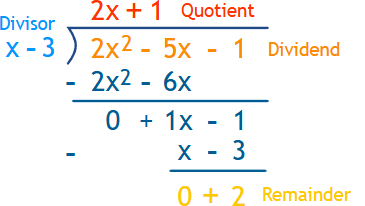
Algebraic division is used to divide a polynomial by a linear expression of the form \( ax + b \) or \( ax – b \). The Remainder Theorem allows us to find the remainder quickly without performing full division.
The Remainder Theorem
Let \( f(x) \) be a polynomial.
Remainder Theorem:
When \( f(x) \) is divided by \( (x – a) \), the remainder is \( f(a) \).
More generally:
When \( f(x) \) is divided by \( (ax – b) \), the remainder is \( f\!\left(\dfrac{b}{a}\right) \).
Important Observations
- If the remainder is zero, then the divisor is a factor of the polynomial.
- The Remainder Theorem does not require division.
- It is commonly used to check answers in factorisation questions.
Using the Remainder Theorem
| Divisor | Remainder |
| \( x – a \) | \( f(a) \) |
| \( ax – b \) | \( f\!\left(\dfrac{b}{a}\right) \) |
Example
Find the remainder when \( f(x) = x^3 – 4x + 7 \) is divided by \( (x – 2) \).
▶️ Answer / Explanation
By the Remainder Theorem, the remainder is \( f(2) \).
\( f(2) = 2^3 – 4(2) + 7 \)
\( = 8 – 8 + 7 = 7 \)
Remainder: 7
Example
Find the remainder when \( f(x) = 2x^3 + 5x^2 – x + 1 \) is divided by \( (2x – 1) \).
▶️ Answer / Explanation
Here \( ax – b = 2x – 1 \), so the remainder is:
\( f\!\left(\dfrac{1}{2}\right) \)
\( f\!\left(\dfrac{1}{2}\right) = 2\!\left(\dfrac{1}{8}\right) + 5\!\left(\dfrac{1}{4}\right) – \dfrac{1}{2} + 1 \)
\( = \dfrac{1}{4} + \dfrac{5}{4} – \dfrac{1}{2} + 1 \)
\( = 2 \)
Remainder: 2
Example
Find the value of \( k \) such that the remainder when \( f(x) = x^3 + kx^2 – 3x + 1 \) is divided by \( (x + 2) \) is 5.
▶️ Answer / Explanation
Since the divisor is \( x + 2 = x – (-2) \), the remainder is:
\( f(-2) = 5 \)
Substitute \( x = -2 \):
\( (-2)^3 + k(-2)^2 – 3(-2) + 1 = 5 \)
\( -8 + 4k + 6 + 1 = 5 \)
\( 4k – 1 = 5 \)
\( 4k = 6 \Rightarrow k = \dfrac{3}{2} \)
Value of \( k \): \( \dfrac{3}{2} \)
