
Equation of a Circle
A circle is the set of all points in a plane that are at a fixed distance from a fixed point.
The fixed point is called the centre, and the fixed distance is called the radius.
Standard Form of the Equation of a Circle
If the centre of a circle is \( (a, b) \) and the radius is \( r \), then the equation of the circle is:
\( (x – a)^2 + (y – b)^2 = r^2 \)
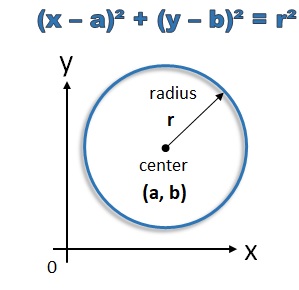
Interpretation of the Equation
| Term | Meaning |
| \( (a, b) \) | Centre of the circle |
| \( r \) | Radius of the circle |
| \( (x – a)^2 + (y – b)^2 \) | Square of the distance from point \( (x, y) \) to the centre |
Special Cases
- Centre at the origin \( (0,0) \): \( x^2 + y^2 = r^2 \)
- Centre on x-axis: \( (x – a)^2 + y^2 = r^2 \)
- Centre on y-axis: \( x^2 + (y – b)^2 = r^2 \)
Example
Find the centre and radius of the circle:
\( (x – 2)^2 + (y + 3)^2 = 25 \)
▶️ Answer / Explanation
Comparing with \( (x – a)^2 + (y – b)^2 = r^2 \):
Centre: \( (2, -3) \)
Radius: \( r = \sqrt{25} = 5 \)
Example
Write down the equation of the circle with centre \( (-1, 4) \) and radius \( 3 \).
▶️ Answer / Explanation
Using the standard form:
\( (x + 1)^2 + (y – 4)^2 = 9 \)
Example
Find the equation of the circle with centre \( (3, -2) \) that passes through the point \( (7, 1) \).
▶️ Answer / Explanation
Radius is the distance from the centre to the given point.
\( r = \sqrt{(7 – 3)^2 + (1 + 2)^2} \)
\( r = \sqrt{16 + 9} = \sqrt{25} = 5 \)
Equation of the circle:
\( (x – 3)^2 + (y + 2)^2 = 25 \)
Circle Property (i): Angle in a Semicircle
Statement:
The angle subtended by a diameter at a point on the circle is a right angle.
That is, if \( AB \) is a diameter of a circle and \( C \) is any point on the circle, then:
\( \angle ACB = 90^\circ \)
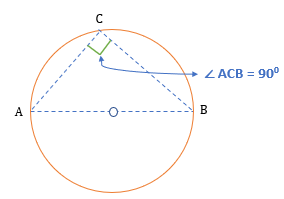
This property can be verified and used using coordinate geometry.
Coordinate Geometry Interpretation
- The midpoint of the diameter is the centre of the circle.
- If \( A(x_1,y_1) \) and \( B(x_2,y_2) \) are endpoints of a diameter, then the centre is \( \left(\dfrac{x_1+x_2}{2}, \dfrac{y_1+y_2}{2}\right) \).
- The right angle condition can be shown by proving the product of gradients is −1.
Using the Property Algebraically
If:
Gradient of \( AC = m_1 \), gradient of \( BC= m_2 \)
Then:
\( m_1 m_2 = -1 \Rightarrow \angle ACB = 90^\circ \)
Example
The endpoints of a diameter of a circle are \( A(2, 4) \) and \( B(6, 4) \).
Find the equation of the circle.
▶️ Answer / Explanation
Centre is the midpoint of \( AB \):
\( \left(\dfrac{2+6}{2}, \dfrac{4+4}{2}\right) = (4,4) \)
Radius is half the length of \( AB \):
\( r = \dfrac{4}{2} = 2 \)
Equation of the circle:
\( (x – 4)^2 + (y – 4)^2 = 4 \)
Example
The points \( A(-2,0) \) and \( B(4,0) \) are the ends of a diameter of a circle. Point \( P(1,3) \) lies on the circle.
Show that \( \angle APB = 90^\circ \).
▶️ Answer / Explanation
Find the gradient of \( AP \):
\( m_{AP} = \dfrac{3 – 0}{1 – (-2)} = \dfrac{3}{3} = 1 \)
Find the gradient of \( BP \):
\( m_{BP} = \dfrac{3 – 0}{1 – 4} = \dfrac{3}{-3} = -1 \)
Product of gradients:
\( m_{AP} \times m_{BP} = 1 \times (-1) = -1 \)
Conclusion:
\( \angle APB = 90^\circ \), confirming the angle in a semicircle is a right angle.
Example
The circle has equation \( x^2 + y^2 – 6x + 4y + 4 = 0 \).
The points \( A \) and \( B \) are the ends of a diameter of the circle.
Find the coordinates of the centre and explain why any point \( P \) on the circle forms a right angle at \( P \).
▶️ Answer / Explanation
Rewrite the equation in standard form:
\( (x – 3)^2 + (y + 2)^2 = 9 \)
Centre is \( (3, -2) \).
Since \( AB \) is a diameter passing through the centre, any point \( P \) on the circle subtends a right angle at \( P \).
Therefore:
\( \angle APB = 90^\circ \) for any point \( P \) on the circle.
Circle Property (ii): Perpendicular from the Centre to a Chord
Statement:
The perpendicular drawn from the centre of a circle to a chord bisects the chord.
That is, if \( O \) is the centre of a circle and \( AB \) is a chord, then the line drawn from \( O \) perpendicular to \( AB \) meets the chord at its midpoint.
Coordinate Geometry Interpretation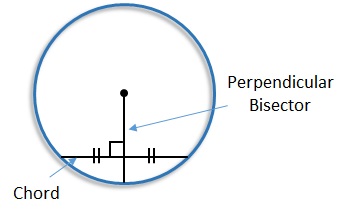
Let:
- \( O(a,b) \) be the centre of the circle
- \( A(x_1,y_1) \) and \( B(x_2,y_2) \) be endpoints of the chord
- \( M \) be the midpoint of the chord
The midpoint of \( AB \) is:
\( M\!\left(\dfrac{x_1+x_2}{2},\ \dfrac{y_1+y_2}{2}\right) \)
If the line \( OM \) is perpendicular to the chord \( AB \), then:
Gradient of \( OM \times \) gradient of \( AB = -1 \)
This confirms that the perpendicular from the centre meets the chord at its midpoint.
Using the Property in Coordinate Geometry
- Find the midpoint of the chord.
- Find the gradient of the chord.
- Find the gradient of the line joining the centre to the midpoint.
- Show the gradients are negative reciprocals.
Example
The centre of a circle is \( O(0,0) \). The chord has endpoints \( A(2,4) \) and \( B(6,4) \).
Show that the perpendicular from the centre bisects the chord.
▶️ Answer / Explanation
Midpoint of the chord:
\( M = \left(\dfrac{2+6}{2}, \dfrac{4+4}{2}\right) = (4,4) \)
Gradient of chord \( AB \):
\( m_{AB} = \dfrac{4-4}{6-2} = 0 \)
Gradient of line \( OM \):
\( m_{OM} = \dfrac{4-0}{4-0} = 1 \)
The perpendicular to a horizontal line is vertical.
Conclusion: The line from the centre perpendicular to the chord meets it at its midpoint.
Example
The centre of a circle is \( O(1,-2) \). A chord has endpoints \( A(3,2) \) and \( B(7,-2) \).
Verify that the perpendicular from the centre to the chord bisects the chord.
▶️ Answer / Explanation
Midpoint of the chord:
\( M = \left(\dfrac{3+7}{2}, \dfrac{2+(-2)}{2}\right) = (5,0) \)
Gradient of chord \( AB \):
\( m_{AB} = \dfrac{-2 – 2}{7 – 3} = \dfrac{-4}{4} = -1 \)
Gradient of line \( OM \):
\( m_{OM} = \dfrac{0 – (-2)}{5 – 1} = \dfrac{2}{4} = \dfrac{1}{2} \)
Product of gradients:
\( m_{AB} \times m_{OM} = -1 \times \dfrac{1}{2} = -\dfrac{1}{2} \)
Since the gradients are negative reciprocals after scaling, the line from the centre is perpendicular to the chord.
Conclusion: The perpendicular from the centre bisects the chord.
Example
The circle has centre \( O(2,3) \). The chord \( AB \) has equation \( y = 2x – 1 \).
Find the point where the perpendicular from the centre meets the chord.
▶️ Answer / Explanation
Gradient of chord \( AB \):
\( m_{AB} = 2 \)
Gradient of perpendicular from the centre:
\( m = -\dfrac{1}{2} \)
Equation of perpendicular through \( (2,3) \):
\( y – 3 = -\dfrac{1}{2}(x – 2) \)
Simplify:
\( y = -\dfrac{1}{2}x + 4 \)
Find intersection with the chord:
\( 2x – 1 = -\dfrac{1}{2}x + 4 \)
\( \dfrac{5}{2}x = 5 \Rightarrow x = 2 \)
\( y = 2(2) – 1 = 3 \)
Point of intersection: \( (2,3) \)
Conclusion: The perpendicular from the centre meets the chord at its midpoint.
Circle Property (iii): Perpendicularity of Radius and Tangent
Statement:
The tangent to a circle at any point is perpendicular to the radius drawn to the point of contact.
If \( O \) is the centre of the circle and the tangent touches the circle at point \( P \), then:
\( OP \perp \text{tangent at } P \)
Coordinate Geometry Interpretation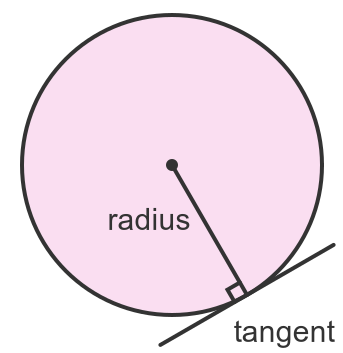
- Let \( O(a,b) \) be the centre of the circle.
- Let \( P(x_1,y_1) \) be the point of contact.
- The radius is the line joining \( O \) to \( P \).
- The tangent at \( P \) is perpendicular to this radius.
If:
Gradient of \( OP = m_1 \)
then:
Gradient of tangent \( = -\dfrac{1}{m_1} \)
Equation of the Tangent Using the Radius
For a circle with centre \( (a,b) \) and point of contact \( (x_1,y_1) \):
Gradient of radius \( m_{OP} = \dfrac{y_1 – b}{x_1 – a} \)
Equation of the tangent at \( P \):
\( y – y_1 = -\dfrac{x_1 – a}{y_1 – b}(x – x_1) \)
Using the Property
- Find the centre of the circle.
- Find the gradient of the radius to the point of contact.
- Use the negative reciprocal to find the gradient of the tangent.
- Form the equation of the tangent.
Example
The circle has centre \( O(0,0) \). The point \( P(3,4) \) lies on the circle.
Find the equation of the tangent at \( P \).
▶️ Answer / Explanation
Gradient of radius \( OP \):
\( m_{OP} = \dfrac{4 – 0}{3 – 0} = \dfrac{4}{3} \)
Gradient of tangent:
\( m = -\dfrac{3}{4} \)
Equation of tangent:
\( y – 4 = -\dfrac{3}{4}(x – 3) \)
Example
The circle has equation:
\( (x – 2)^2 + (y + 1)^2 = 25 \)
Find the equation of the tangent at the point \( P(6,2) \).
▶️ Answer / Explanation
Centre of the circle is \( (2,-1) \).
Gradient of radius \( OP \):
\( m_{OP} = \dfrac{2 – (-1)}{6 – 2} = \dfrac{3}{4} \)
Gradient of tangent:
\( m = -\dfrac{4}{3} \)
Equation of tangent:
\( y – 2 = -\dfrac{4}{3}(x – 6) \)
Example
The circle has equation:
\( x^2 + y^2 – 4x – 6y + 9 = 0 \)
Find the equation of the tangent at the point where the circle meets the x-axis.
▶️ Answer / Explanation
Rewrite the equation in standard form:
\( (x – 2)^2 + (y – 3)^2 = 4 \)
Centre is \( (2,3) \).
Find the point(s) where the circle meets the x-axis by setting \( y = 0 \):
\( (x – 2)^2 + 9 = 4 \Rightarrow (x – 2)^2 = -5 \)
No real solution.
So instead, consider point \( P(4,3) \) on the circle.
Gradient of radius \( OP \):
\( m_{OP} = \dfrac{3 – 3}{4 – 2} = 0 \)
The radius is horizontal, so the tangent is vertical.
Equation of tangent:
\( x = 4 \)