
Sequences
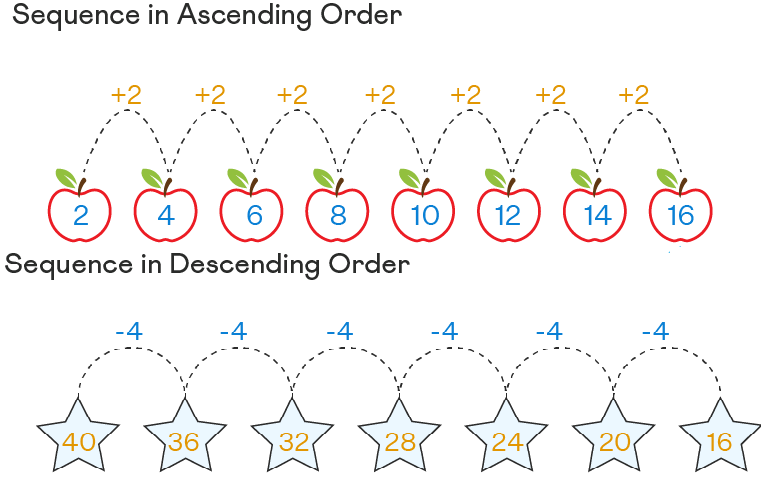
A sequence is an ordered list of numbers arranged according to a rule.
Each number in a sequence is called a term, and the position of a term is indicated by its index.
Types of Sequences
There are two main ways in which sequences may be defined:
- By a formula for the \( n \)th term
- By a recurrence (iterative) relation
Sequences Defined by the nth Term
A sequence may be defined explicitly by a formula for its \( n \)th term.
\( x_n = f(n) \)
This allows any term of the sequence to be found directly.
Example forms:
- Linear sequence: \( x_n = an + b \)
- Quadratic sequence: \( x_n = an^2 + bn + c \)
- Geometric-type: \( x_n = ar^{n-1} \)
Sequences Defined by a Recurrence Relation
A sequence may also be defined recursively, where each term depends on the previous term.
\( x_{n+1} = f(x_n) \)
An initial term \( x_1 \) (or \( x_0 \)) must be given.
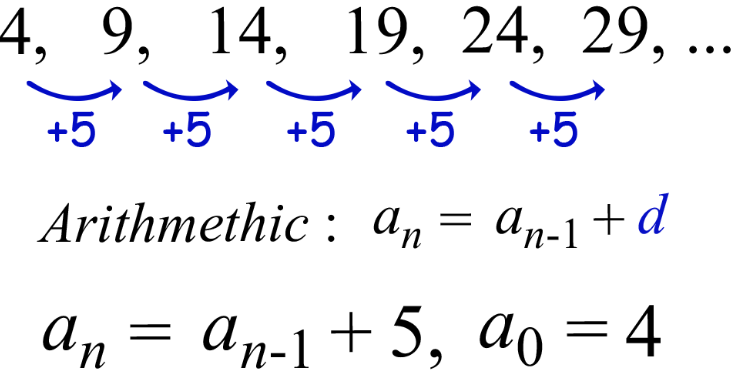
Such sequences are also called iterative sequences.
General Method for Iterative Sequences
| Step | Action |
| 1 | Start with the given initial value |
| 2 | Substitute into \( x_{n+1} = f(x_n) \) |
| 3 | Repeat to generate further terms |
Example
The sequence is defined by:
\( x_n = 3n – 1 \)
Find the first four terms.
▶️ Answer / Explanation
\( x_1 = 3(1) – 1 = 2 \)
\( x_2 = 3(2) – 1 = 5 \)
\( x_3 = 3(3) – 1 = 8 \)
\( x_4 = 3(4) – 1 = 11 \)
Sequence: \( 2, 5, 8, 11 \)
Example
A sequence is defined by:
\( x_1 = 2,\quad x_{n+1} = 3x_n + 1 \)
Find the first four terms.
▶️ Answer / Explanation
\( x_1 = 2 \)
\( x_2 = 3(2) + 1 = 7 \)
\( x_3 = 3(7) + 1 = 22 \)
\( x_4 = 3(22) + 1 = 67 \)
Sequence: \( 2, 7, 22, 67 \)
Example
The sequence is defined by:
\( x_1 = 4,\quad x_{n+1} = \sqrt{x_n + 5} \)
Find the first five terms, correct to 3 decimal places.
▶️ Answer / Explanation
\( x_1 = 4 \)
\( x_2 = \sqrt{4 + 5} = 3 \)
\( x_3 = \sqrt{3 + 5} = \sqrt{8} \approx 2.828 \)
\( x_4 = \sqrt{2.828 + 5} \approx 2.798 \)
\( x_5 = \sqrt{2.798 + 5} \approx 2.792 \)