
Arithmetic Sequences and Series
An arithmetic sequence is a sequence in which the difference between consecutive terms is constant.
This constant difference is called the common difference, denoted by \( d \).
Arithmetic Sequence
An arithmetic sequence has the form:
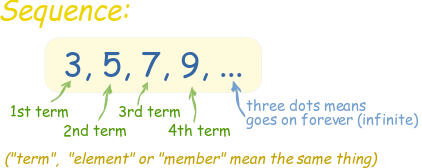
\( a,\ a+d,\ a+2d,\ a+3d,\ \ldots \)
where:
- \( a \) is the first term
- \( d \) is the common difference
Formula for the nth Term
The nth term of an arithmetic sequence is given by:
\( a_n = a + (n-1)d \)
This formula allows any term of the sequence to be found directly.
Arithmetic Series
An arithmetic series is the sum of the terms of an arithmetic sequence.
The sum of the first \( n \) terms is denoted by \( S_n \).
Sum of a Finite Arithmetic Series
The sum of the first \( n \) terms of an arithmetic sequence is given by:
\( S_n = \dfrac{n}{2}\,[2a + (n-1)d] \)
Alternatively, if the last term \( l \) is known:
\( S_n = \dfrac{n}{2}(a + l) \)
Proof of the Sum Formula
Consider the arithmetic series:
\( S_n = a + (a+d) + (a+2d) + \cdots + [a+(n-1)d] \)
Write the series in reverse order:
\( S_n = [a+(n-1)d] + [a+(n-2)d] + \cdots + a \)
Add the two expressions term by term:
\( 2S_n = n[2a + (n-1)d] \)
Divide both sides by 2:
\( S_n = \dfrac{n}{2}[2a + (n-1)d] \)
Hence proved.
Sum of the First n Natural Numbers
The sequence of natural numbers is:
\( 1,\ 2,\ 3,\ \ldots,\ n \)
This is an arithmetic sequence with:
- \( a = 1 \)
- \( d = 1 \)
Using the sum formula:
\( 1 + 2 + 3 + \cdots + n = \dfrac{n(n+1)}{2} \)
Sigma Notation \( \Sigma \)
Sigma notation is used to represent sums compactly.
The symbol \( \Sigma \) means “sum of”.
\( \sum_{k=1}^{n} a_k \)
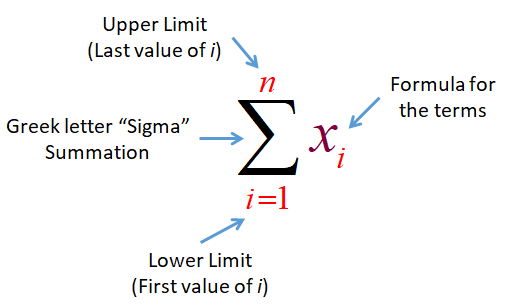
This means the sum of the terms \( a_1 + a_2 + \cdots + a_n \).
Examples:
- \( \sum_{k=1}^{n} k = 1 + 2 + \cdots + n \)
- \( \sum_{k=1}^{n} (2k+1) \) represents the sum of odd numbers
Example
Find the 15th term of the arithmetic sequence:
\( 3,\ 7,\ 11,\ \ldots \)
▶️ Answer / Explanation
\( a = 3,\ d = 4 \)
\( a_{15} = 3 + (15-1)4 \)
\( = 3 + 56 = 59 \)
Answer: 59
Example
Find the sum of the first 20 terms of the arithmetic sequence:
\( 5 + 9 + 13 + \cdots \)
▶️ Answer / Explanation
\( a = 5,\ d = 4,\ n = 20 \)
\( S_{20} = \dfrac{20}{2}[2(5) + 19(4)] \)
\( = 10(10 + 76) = 10 \times 86 = 860 \)
Answer: 860
Example
Evaluate:
\( \displaystyle \sum_{k=1}^{50} (2k – 1) \)
▶️ Answer / Explanation
This represents the first 50 odd numbers.
Sum of first \( n \) odd numbers:
\( = n^2 \)
\( = 50^2 = 2500 \)
Answer: 2500