
Increasing, Decreasing, and Periodic Sequences
Sequences can be classified according to how their terms change as the index \( n \) increases.
The three important types are increasing, decreasing, and periodic sequences.
Increasing Sequences
A sequence \( \{x_n\} \) is said to be increasing if each term is greater than the previous term.
\( x_{n+1} > x_n \quad \text{for all } n \)
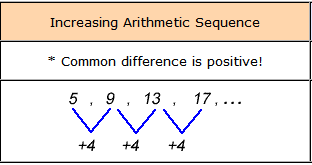
If the inequality is strict, the sequence is called strictly increasing.
Examples of increasing sequences:
- \( x_n = 2n + 1 \)
- \( x_n = n^2 \)
Decreasing Sequences
A sequence \( \{x_n\} \) is said to be decreasing if each term is less than the previous term.
\( x_{n+1} < x_n \quad \text{for all } n \)
If the inequality is strict, the sequence is called strictly decreasing.

Examples of decreasing sequences:
- \( x_n = \dfrac{1}{n} \)
- \( x_n = 10 – n \)
Periodic Sequences
A sequence \( \{x_n\} \) is said to be periodic if it repeats its values after a fixed number of terms.
\( x_{n+p} = x_n \quad \text{for all } n \)
The smallest positive integer \( p \) is called the period.

Examples of periodic sequences:
- \( x_n = (-1)^n \), period 2
- \( x_n = \sin(n\pi) \), period 2
Sequences Defined by a Recurrence Relation
For a sequence defined by:
\( x_{n+1} = f(x_n) \)
the behaviour (increasing, decreasing, or periodic) depends on:
- The function \( f(x) \)
- The initial value \( x_1 \)
Example
Determine whether the sequence
\( x_n = 5n – 2 \)
is increasing or decreasing.
▶️ Answer / Explanation
Find the difference:
\( x_{n+1} – x_n = [5(n+1)-2] – (5n – 2) = 5 \)
Since the difference is positive, the sequence is increasing.
Conclusion: Increasing sequence.
Example
The sequence is defined by:
\( x_1 = 10,\quad x_{n+1} = \dfrac{x_n}{2} \)
State whether the sequence is increasing or decreasing.
▶️ Answer / Explanation
Calculate first few terms:
\( 10,\ 5,\ 2.5,\ 1.25,\ \ldots \)
Each term is smaller than the previous one.
Conclusion: Decreasing sequence.
Example
The sequence is defined by:
\( x_1 = 1,\quad x_{n+1} = 2 – x_n \)
Find the first six terms and identify the type of sequence.
▶️ Answer / Explanation
\( x_1 = 1 \)
\( x_2 = 2 – 1 = 1 \)
\( x_3 = 2 – 1 = 1 \)
\( x_4 = 2 – 1 = 1 \)
All terms are equal.
This is a constant sequence, which is also periodic with any period.