
Geometric Sequences and Series
A geometric sequence is a sequence in which each term is obtained by multiplying the previous term by a constant value.
This constant multiplier is called the common ratio, denoted by \( r \).
Geometric Sequence
A geometric sequence has the form:
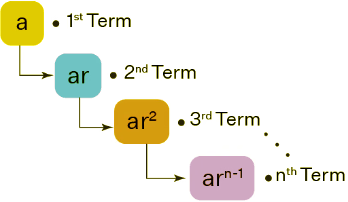
\( a,\ ar,\ ar^2,\ ar^3,\ \ldots \)
where:
- \( a \) is the first term
- \( r \) is the common ratio
Formula for the nth Term
The nth term of a geometric sequence is given by:
\( a_n = ar^{\,n-1} \)
This formula allows any term to be found directly.
Geometric Series
A geometric series is the sum of the terms of a geometric sequence.
The sum of the first \( n \) terms is denoted by \( S_n \).
Sum of a Finite Geometric Series
If \( r \ne 1 \), the sum of the first \( n \) terms is:
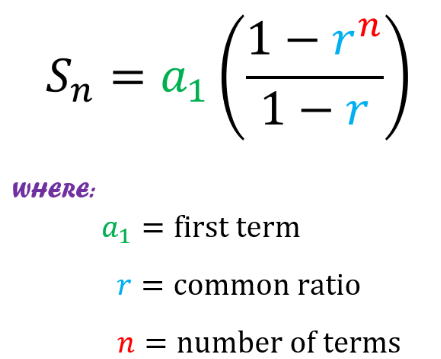
This formula is valid for any real value of \( r \), except \( r = 1 \).
Proof of the Finite Sum Formula
Let:
\( S_n = a + ar + ar^2 + \cdots + ar^{n-1} \)
Multiply both sides by \( r \):
\( rS_n = ar + ar^2 + \cdots + ar^n \)
Subtract:
\( S_n – rS_n = a – ar^n \)
Factorise:
\( S_n(1 – r) = a(1 – r^n) \)
Divide by \( (1 – r) \):
\( S_n = \dfrac{a(1 – r^n)}{1 – r} \)
Hence proved.
Sum to Infinity of a Geometric Series
If the common ratio satisfies:
\( |r| < 1 \)
then the geometric series is convergent.
As \( n \to \infty \), we have:
\( r^n \to 0 \)
The sum to infinity is written as \( S_\infty \) and is given by:
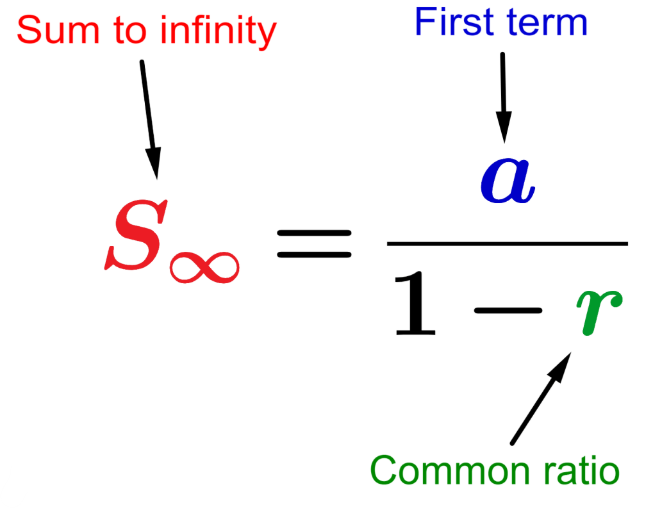
When Does the Sum to Infinity Exist?
- If \( |r| < 1 \): sum to infinity exists
- If \( |r| \ge 1 \): series diverges
Using Logarithms to Find \( n \)
When the sum \( S_n \) or a term is given and \( n \) is required, logarithms may be used.
From:
\( a_n = ar^{n-1} \)
take logarithms:
\( \log a_n = \log a + (n-1)\log r \)
This allows \( n \) to be found.
Example
Find the 8th term of the geometric sequence:
\( 3,\ 6,\ 12,\ \ldots \)
▶️ Answer / Explanation
\( a = 3,\ r = 2 \)
\( a_8 = 3 \times 2^7 = 3 \times 128 = 384 \)
Answer: 384
Example
Find the sum to infinity of the geometric series:
\( 5 + 2.5 + 1.25 + \cdots \)
▶️ Answer / Explanation
\( a = 5,\ r = \dfrac{1}{2} \)
Since \( |r| < 1 \), the sum to infinity exists.
\( S_\infty = \dfrac{5}{1 – \frac{1}{2}} = 10 \)
Answer: 10
Example
The sum of the first \( n \) terms of a geometric series is:
\( S_n = 62 \)
The first term is 2 and the common ratio is 3. Find the value of \( n \).
▶️ Answer / Explanation
Use the sum formula:
\( 62 = \dfrac{2(1 – 3^n)}{1 – 3} \)
\( 62 = \dfrac{2(1 – 3^n)}{-2} \)
\( 62 = 3^n – 1 \)
\( 3^n = 63 \)
Take logarithms:
\( n\log 3 = \log 63 \)
\( n = \dfrac{\log 63}{\log 3} \approx 3.76 \)
Answer: \( n \approx 3.76 \)