
Binomial Expansion of \( (a + bx)^n \)
The binomial theorem is used to expand expressions of the form:
\( (a + bx)^n \)
where \( n \) is a positive integer.
Binomial Coefficients
The coefficients in a binomial expansion are given by binomial coefficients.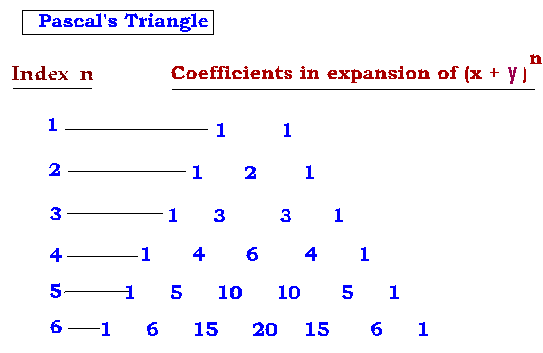
Factorial notation:
\( n! = n(n-1)(n-2)\cdots 2 \cdot 1 \)
with:
\( 0! = 1 \)
Binomial coefficient:
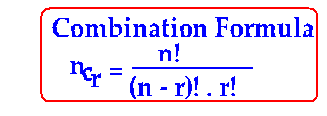
\( \binom{n}{r} = \dfrac{n!}{r!(n-r)!} \)
This may also be written as:
\( nCr \)
The Binomial Theorem
For a positive integer \( n \):
\( (a + bx)^n = \sum_{r=0}^{n} \binom{n}{r} a^{\,n-r}(bx)^r \)
This gives a total of \( n+1 \) terms.
General Term
The general term in the expansion of \( (a + bx)^n \) is:
\( T_{r+1} = \binom{n}{r} a^{\,n-r} (bx)^r \)
where \( r = 0,1,2,\ldots,n \).
Properties of the Expansion
- Powers of \( a \) decrease from \( n \) to 0.
- Powers of \( bx \) increase from 0 to \( n \).
- Coefficients are symmetric.
- The number of terms is \( n+1 \).
Example
Expand:
\( (2 + x)^3 \)
▶️ Answer / Explanation
Using the binomial theorem:
\( (2 + x)^3 = \binom{3}{0}2^3 + \binom{3}{1}2^2x + \binom{3}{2}2x^2 + \binom{3}{3}x^3 \)
\( = 8 + 12x + 6x^2 + x^3 \)
Answer: \( 8 + 12x + 6x^2 + x^3 \)
Example
Expand:
\( (1 – 3x)^4 \)
▶️ Answer / Explanation
\( (1 – 3x)^4 = \sum_{r=0}^{4} \binom{4}{r}(1)^{4-r}(-3x)^r \)
Terms:
\( = 1 – 12x + 54x^2 – 108x^3 + 81x^4 \)
Answer: \( 1 – 12x + 54x^2 – 108x^3 + 81x^4 \)
Example
Find the coefficient of \( x^3 \) in the expansion of:
\( (2 – x)^5 \)
▶️ Answer / Explanation
General term:
\( T_{r+1} = \binom{5}{r}2^{5-r}(-x)^r \)
For \( x^3 \), set \( r = 3 \).
Coefficient:
\( \binom{5}{3}2^2(-1)^3 = 10 \cdot 4 \cdot (-1) = -40 \)
Answer: Coefficient of \( x^3 \) is \( -40 \).