
Basic Trigonometric Identities
Trigonometric identities are equations involving trigonometric functions that are true for all values of \( \theta \) for which both sides are defined.
Two fundamental identities used extensively in algebraic manipulation and equation solving are:
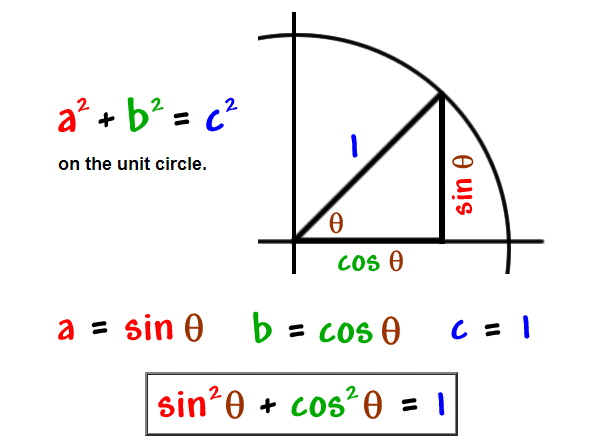
- \( \tan\theta = \dfrac{\sin\theta}{\cos\theta} \)
- \( \sin^2\theta + \cos^2\theta = 1 \)
Identity 1: Definition of Tangent
The tangent of an angle is defined as the ratio of sine to cosine:
\( \tan\theta = \dfrac{\sin\theta}{\cos\theta} \)
This identity is valid provided:
\( \cos\theta \ne 0 \)
Identity 2: Pythagorean Identity
The fundamental Pythagorean identity is:
\( \sin^2\theta + \cos^2\theta = 1 \)
This identity holds for all values of \( \theta \).
Rearranged Forms
| From | Derived Form |
| \( \sin^2\theta + \cos^2\theta = 1 \) | \( \sin^2\theta = 1 – \cos^2\theta \) |
| \( \sin^2\theta + \cos^2\theta = 1 \) | \( \cos^2\theta = 1 – \sin^2\theta \) |
Common Uses of These Identities
- Expressing all trigonometric functions in terms of sine or cosine
- Simplifying expressions
- Solving trigonometric equations
- Eliminating \( \tan\theta \) from equations
Example
Express \( \tan\theta \) in terms of \( \sin\theta \) and \( \cos\theta \).
▶️ Answer / Explanation
By definition:
\( \tan\theta = \dfrac{\sin\theta}{\cos\theta} \)
Example
Simplify:
\( \dfrac{\sin^2\theta}{1 – \cos^2\theta} \)
▶️ Answer / Explanation
Using the identity:
\( 1 – \cos^2\theta = \sin^2\theta \)
So the expression becomes:
\( \dfrac{\sin^2\theta}{\sin^2\theta} = 1 \)
Answer: 1
Example
Show that:
\( 1 + \tan^2\theta = \dfrac{1}{\cos^2\theta} \)
▶️ Answer / Explanation
Start with the left-hand side:
\( 1 + \tan^2\theta \)
Use \( \tan\theta = \dfrac{\sin\theta}{\cos\theta} \):
\( 1 + \dfrac{\sin^2\theta}{\cos^2\theta} \)
Write 1 as \( \dfrac{\cos^2\theta}{\cos^2\theta} \):
\( \dfrac{\cos^2\theta + \sin^2\theta}{\cos^2\theta} \)
Use \( \sin^2\theta + \cos^2\theta = 1 \):
\( \dfrac{1}{\cos^2\theta} \)
Hence proved.