
Applications of Differentiation: Maxima and Minima
Differentiation is used to find the maximum and minimum values of a function. These values occur at points where the graph changes direction.
Such points are called stationary points.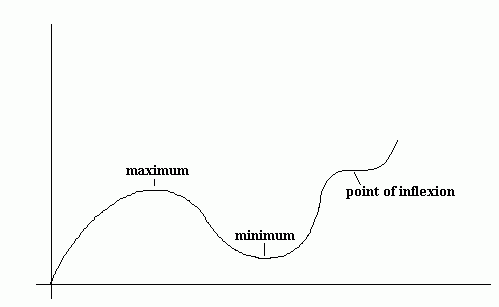
Stationary Points
A stationary point occurs where:
\( \dfrac{dy}{dx} = 0 \)
At a stationary point, the tangent to the curve is horizontal.
Types of Stationary Points
| Type | Description |
| Maximum | Function changes from increasing to decreasing |
| Minimum | Function changes from decreasing to increasing |
| Point of inflection | Gradient is zero but no maximum or minimum |
Second Derivative Test
To determine the nature of a stationary point, use the second derivative.
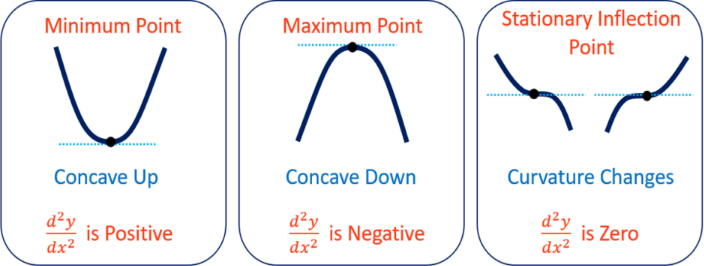
If:
- \( \dfrac{d^2y}{dx^2} > 0 \) → minimum point
- \( \dfrac{d^2y}{dx^2} < 0 \) → maximum point
- \( \dfrac{d^2y}{dx^2} = 0 \) → test is inconclusive
General Method
| Step | Action |
| 1 | Differentiate the function |
| 2 | Solve \( \dfrac{dy}{dx} = 0 \) |
| 3 | Find the second derivative |
| 4 | Classify the stationary point |
Example
Find the coordinates of the stationary point of:
\( y = x^2 – 4x + 1 \)
▶️ Answer / Explanation
Differentiate:
\( \dfrac{dy}{dx} = 2x – 4 \)
Set equal to zero:
\( 2x – 4 = 0 \Rightarrow x = 2 \)
Find the y-coordinate:
\( y = 2^2 – 4(2) + 1 = -3 \)
Stationary point is \( (2,-3) \).
Second derivative:
\( \dfrac{d^2y}{dx^2} = 2 > 0 \)
Minimum point.
Example
Find the maximum value of:
\( y = -x^2 + 6x – 1 \)
▶️ Answer / Explanation
Differentiate:
\( \dfrac{dy}{dx} = -2x + 6 \)
Set equal to zero:
\( -2x + 6 = 0 \Rightarrow x = 3 \)
Find the value of \( y \):
\( y = -(3)^2 + 6(3) – 1 = 8 \)
Second derivative:
\( \dfrac{d^2y}{dx^2} = -2 < 0 \)
Maximum value is 8.
Example
Find the maximum and minimum points of:
\( y = x^3 – 3x^2 + 2 \)
▶️ Answer / Explanation
Differentiate:
\( \dfrac{dy}{dx} = 3x^2 – 6x \)
Set equal to zero:
\( 3x(x – 2) = 0 \Rightarrow x = 0,\ 2 \)
Second derivative:
\( \dfrac{d^2y}{dx^2} = 6x – 6 \)
At \( x = 0 \):
\( \dfrac{d^2y}{dx^2} = -6 < 0 \Rightarrow \) maximum
At \( x = 2 \):
\( \dfrac{d^2y}{dx^2} = 6 > 0 \Rightarrow \) minimum
Coordinates:
\( y(0) = 2 \), so maximum at \( (0,2) \)
\( y(2) = -2 \), so minimum at \( (2,-2) \)
Applications of Differentiation: Increasing and Decreasing Functions
Differentiation can be used to determine where a function is increasing or decreasing over a given interval.
This is done by studying the sign of the first derivative.
Key Definitions
- A function is increasing where its gradient is positive.
- A function is decreasing where its gradient is negative.
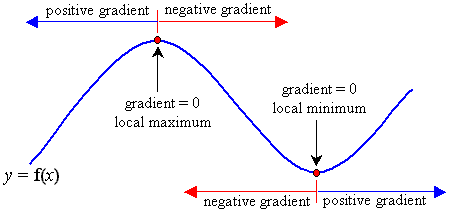
Mathematically:
If \( \dfrac{dy}{dx} > 0 \), the function is increasing.
If \( \dfrac{dy}{dx} < 0 \), the function is decreasing.
Using the First Derivative
Let \( y = f(x) \).
| Condition | Conclusion |
| \( f'(x) > 0 \) | Function is increasing |
| \( f'(x) < 0 \) | Function is decreasing |
| \( f'(x) = 0 \) | Stationary point |
General Method
| Step | Action |
| 1 | Differentiate the function |
| 2 | Solve \( \dfrac{dy}{dx} = 0 \) to find critical points |
| 3 | Test the sign of \( \dfrac{dy}{dx} \) in each interval |
| 4 | State intervals of increase and decrease |
Example
Determine where the function
\( y = x^2 – 4x + 1 \)
is increasing and decreasing.
▶️ Answer / Explanation
Differentiate:
\( \dfrac{dy}{dx} = 2x – 4 \)
Set equal to zero:
\( 2x – 4 = 0 \Rightarrow x = 2 \)
Test intervals:
- For \( x < 2 \), \( \dfrac{dy}{dx} < 0 \)
- For \( x > 2 \), \( \dfrac{dy}{dx} > 0 \)
Conclusion:
The function is decreasing for \( x < 2 \) and increasing for \( x > 2 \).
Example
Find the intervals where the function
\( y = x^3 – 3x^2 + 2 \)
is increasing and decreasing.
▶️ Answer / Explanation
Differentiate:
\( \dfrac{dy}{dx} = 3x^2 – 6x \)
\( = 3x(x – 2) \)
Critical points:
\( x = 0,\ 2 \)
Test intervals:
- \( x < 0 \): \( \dfrac{dy}{dx} > 0 \)
- \( 0 < x < 2 \): \( \dfrac{dy}{dx} < 0 \)
- \( x > 2 \): \( \dfrac{dy}{dx} > 0 \)
Conclusion:
Increasing for \( x < 0 \) and \( x > 2 \).
Decreasing for \( 0 < x < 2 \).
Example
Determine the intervals of increase and decrease for:
\( y = \dfrac{x}{x^2 + 1} \)
▶️ Answer / Explanation
Differentiate using the quotient rule:
\( \dfrac{dy}{dx} = \dfrac{(x^2 + 1) – 2x^2}{(x^2 + 1)^2} \)
\( = \dfrac{1 – x^2}{(x^2 + 1)^2} \)
Set numerator equal to zero:
\( 1 – x^2 = 0 \Rightarrow x = \pm 1 \)
Denominator is always positive.
Sign of \( \dfrac{dy}{dx} \):
- \( -1 < x < 1 \): \( \dfrac{dy}{dx} > 0 \)
- \( x < -1 \) or \( x > 1 \): \( \dfrac{dy}{dx} < 0 \)
Conclusion:
The function is increasing for \( -1 < x < 1 \).
The function is decreasing for \( x < -1 \) and \( x > 1 \).
Applications of Differentiation: Curve Sketching and Optimisation
Differentiation is used to analyse the shape of a curve and to solve maximum and minimum problems, including problems set in real-life contexts.
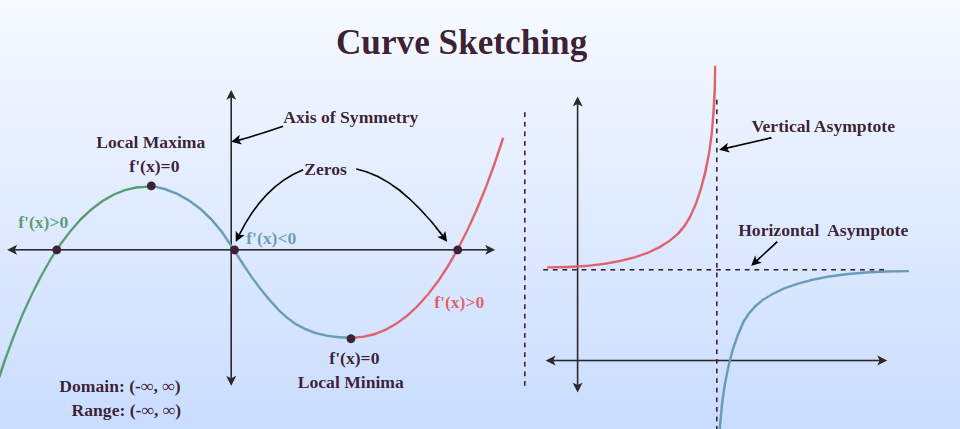
Using derivatives, we can determine:
- Where a curve is increasing or decreasing
- The location and nature of stationary points
- The overall shape of the graph
- Maximum or minimum values in practical situations
Curve Sketching Using Differentiation
When sketching a curve \( y = f(x) \), the following features are important:
| Feature | How to Find It |
| Intercepts | Solve \( f(x)=0 \) and find \( f(0) \) |
| Increasing / decreasing | Sign of \( \dfrac{dy}{dx} \) |
| Stationary points | Solve \( \dfrac{dy}{dx}=0 \) |
| Nature of stationary points | Second derivative test |
General Method for Curve Sketching
- Find intercepts.
- Differentiate to find stationary points.
- Use the second derivative to classify them.
- Determine increasing and decreasing intervals.
- Sketch the curve showing all key features.
Practical Maxima and Minima Problems
In practical problems, a quantity must be maximised or minimised, such as: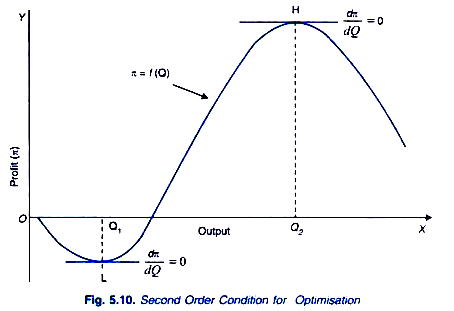
- Area or volume
- Cost or profit
- Distance or time
The steps are:
- Define a variable.
- Write the quantity to be optimised as a function.
- Differentiate and find stationary points.
- Identify the maximum or minimum value.
- Interpret the result in context.
Example
Sketch the curve:
\( y = x^2 – 4x + 3 \)
▶️ Answer / Explanation
Intercepts:
\( x^2 – 4x + 3 = 0 \Rightarrow (x-1)(x-3)=0 \)
\( x = 1,\ 3 \)
Differentiate:
\( \dfrac{dy}{dx} = 2x – 4 \)
Stationary point:
\( 2x – 4 = 0 \Rightarrow x = 2 \)
\( y = 2^2 – 8 + 3 = -1 \)
Second derivative:
\( \dfrac{d^2y}{dx^2} = 2 > 0 \)
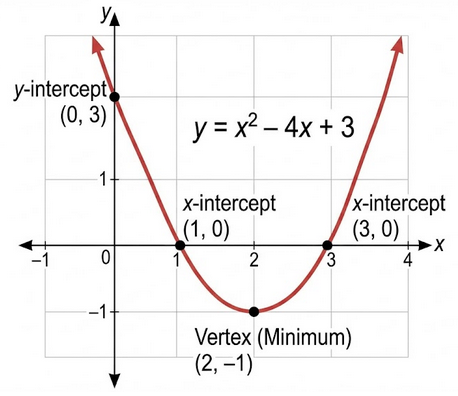
Minimum point at \( (2,-1) \).
Example
The cost \( C \) (in dollars) of producing \( x \) items is given by:
\( C = x^2 – 20x + 150 \)
Find the minimum cost.
▶️ Answer / Explanation
Differentiate:
\( \dfrac{dC}{dx} = 2x – 20 \)
Set equal to zero:
\( 2x – 20 = 0 \Rightarrow x = 10 \)
Second derivative:
\( \dfrac{d^2C}{dx^2} = 2 > 0 \)
Minimum cost:
\( C = 10^2 – 200 + 150 = 50 \)
Minimum cost is \$50 when 10 items are produced.
Example
A rectangle has perimeter 40 units. Find the maximum possible area.
▶️ Answer / Explanation
Let length be \( x \), width be \( y \).
Perimeter condition:
\( 2x + 2y = 40 \Rightarrow y = 20 – x \)
Area:
\( A = x(20 – x) = 20x – x^2 \)
Differentiate:
\( \dfrac{dA}{dx} = 20 – 2x \)
Set equal to zero:
\( 20 – 2x = 0 \Rightarrow x = 10 \)
Second derivative:
\( \dfrac{d^2A}{dx^2} = -2 < 0 \)
Maximum area:
\( A = 10 \times 10 = 100 \)
The rectangle is a square with maximum area 100 square units.