
Evaluation of Definite Integrals
A definite integral represents the signed area between the graph of a function and the x-axis over a given interval.
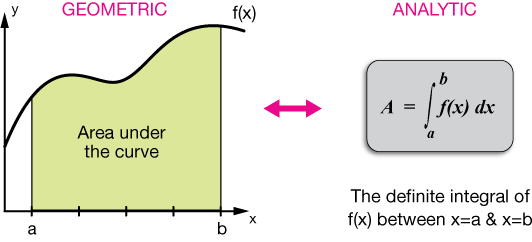
It is written in the form:
\( \displaystyle \int_a^b f(x)\,dx \)
where:
- \( a \) is the lower limit
- \( b \) is the upper limit
- \( f(x) \) is the integrand
Fundamental Theorem of Calculus
If \( F(x) \) is an antiderivative of \( f(x) \), then:
\( \displaystyle \int_a^b f(x)\,dx = F(b) – F(a) \)
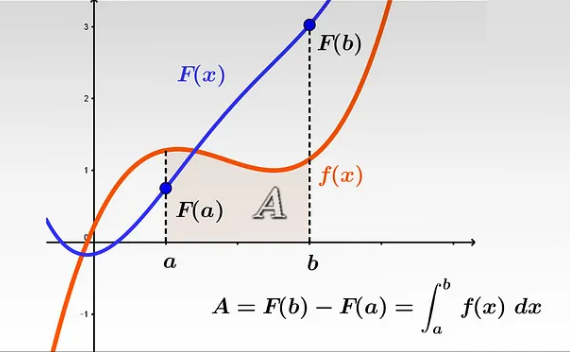
This theorem allows definite integrals to be evaluated using antiderivatives.
General Method
| Step | Action |
| 1 | Find the indefinite integral |
| 2 | Substitute the upper limit \( b \) |
| 3 | Substitute the lower limit \( a \) |
| 4 | Find \( F(b) – F(a) \) |
Geometrical Interpretation
- If \( f(x) \ge 0 \) on \( [a,b] \), the integral represents area above the x-axis.
- If \( f(x) \le 0 \), the integral gives a negative value.
- The definite integral gives signed area, not always total area.
Example
Evaluate:
\( \displaystyle \int_0^2 3x^2\,dx \)
▶️ Answer / Explanation
Integrate:
\( \displaystyle \int 3x^2\,dx = x^3 \)
Apply limits:
\( x^3 \Big|_0^2 = 2^3 – 0^3 = 8 \)
Answer: 8
Example
Evaluate:
\( \displaystyle \int_1^3 (2x – 1)\,dx \)
▶️ Answer / Explanation
Integrate:
\( \displaystyle \int (2x – 1)\,dx = x^2 – x \)
Apply limits:
\( (3^2 – 3) – (1^2 – 1) = (9 – 3) – (1 – 1) \)
\( = 6 \)
Answer: 6
Example
Evaluate:
\( \displaystyle \int_{-1}^2 (x^2 – 2x)\,dx \)
▶️ Answer / Explanation
Integrate:
\( \displaystyle \int (x^2 – 2x)\,dx = \dfrac{x^3}{3} – x^2 \)
Apply limits:
\( \left(\dfrac{2^3}{3} – 2^2\right) – \left(\dfrac{(-1)^3}{3} – (-1)^2\right) \)
\( = \left(\dfrac{8}{3} – 4\right) – \left(-\dfrac{1}{3} – 1\right) \)
\( = \dfrac{8}{3} – 4 + \dfrac{1}{3} + 1 \)
\( = -\dfrac{2}{3} \)
Answer: \( -\dfrac{2}{3} \)