
Interpretation of the Definite Integral as Area Under a Curve
The definite integral can be used to find the area of a region bounded by curves and straight lines.
If a curve is given by \( y = f(x) \) and lies above the x-axis on the interval \( [a,b] \), then the area under the curve is:
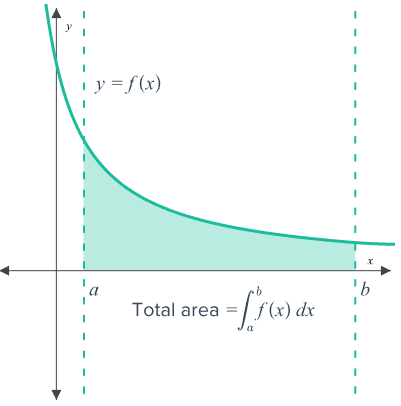
\( \displaystyle \int_a^b f(x)\,dx \)
This represents the area between the curve, the x-axis, and the vertical lines \( x = a \) and \( x = b \).
Important Notes on Area
- The definite integral gives signed area.
- Area below the x-axis gives a negative value.
- When finding area, the final answer must be positive.
- All area calculations are done with respect to \( x \).
Area Bounded by a Curve and Straight Lines
If a region is bounded by:
- a curve \( y = f(x) \)
- straight lines such as \( x = a \), \( x = b \), or another line \( y = g(x) \)
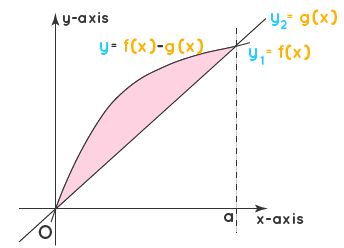
then the area is found by integrating the appropriate function between the points of intersection.
Area Between Two Curves
If two curves are given by:
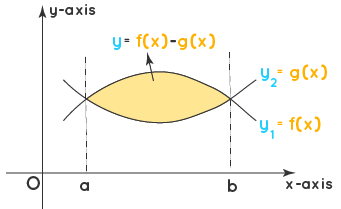
Upper curve: \( y = f(x) \)
Lower curve: \( y = g(x) \)
then the area between them from \( x = a \) to \( x = b \) is:
\( \displaystyle \int_a^b [f(x) – g(x)]\,dx \)
The upper curve must always be subtracted from the lower curve.
General Method for Area Problems
| Step | Action |
| 1 | Sketch the curves to identify the region |
| 2 | Find points of intersection |
| 3 | Identify upper and lower curves |
| 4 | Integrate the difference between the curves |
Example
Find the area under the curve:
\( y = 4x \) from \( x = 0 \) to \( x = 3 \).
▶️ Answer / Explanation
Area:
\( \displaystyle \int_0^3 4x\,dx \)
\( = 2x^2 \Big|_0^3 = 2(9) – 0 = 18 \)
Area = 18 square units.
Example
Find the finite area bounded by the curve
\( y = 6x – x^2 \)
and the line
\( y = 2x \).
▶️ Answer / Explanation
Find points of intersection:
\( 6x – x^2 = 2x \)
\( -x^2 + 4x = 0 \Rightarrow x(x – 4) = 0 \)
\( x = 0,\ 4 \)
Upper curve is \( y = 6x – x^2 \).
Lower curve is \( y = 2x \).
Area:
\( \displaystyle \int_0^4 [(6x – x^2) – 2x]\,dx \)
\( = \displaystyle \int_0^4 (4x – x^2)\,dx \)
\( = \left(2x^2 – \dfrac{x^3}{3}\right)\Big|_0^4 \)
\( = \left(32 – \dfrac{64}{3}\right) \)
\( = \dfrac{32}{3} \)
Area = \( \dfrac{32}{3} \) square units.
Example
Find the area of the region bounded by the curves:
\( y = x^2 \) and \( y = 2x \).
▶️ Answer / Explanation
Find points of intersection:
\( x^2 = 2x \Rightarrow x(x – 2) = 0 \)
\( x = 0,\ 2 \)
Upper curve: \( y = 2x \)
Lower curve: \( y = x^2 \)
Area:
\( \displaystyle \int_0^2 (2x – x^2)\,dx \)
\( = \left(x^2 – \dfrac{x^3}{3}\right)\Big|_0^2 \)
\( = 4 – \dfrac{8}{3} = \dfrac{4}{3} \)
Area = \( \dfrac{4}{3} \) square units.