
Simplification of Rational Expressions
A rational expression is an algebraic expression written as a fraction, where the numerator and denominator are polynomials.
The general form is: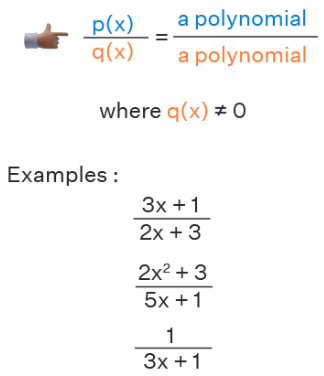
\( \dfrac{P(x)}{Q(x)} \)
where \( Q(x) \ne 0 \).
Key Skills Required
- Factorising polynomials
- Cancelling common factors
- Identifying restrictions on \( x \)
- Algebraic division where required
Important Rule
Only factors may be cancelled, not terms.
Always factorise fully before cancelling.
Restrictions on the Variable
The denominator of a rational expression must not be zero.
Values of \( x \) that make the denominator zero must be excluded.
Common Types of Denominators
| Denominator | Example |
| Linear | \( ax + b \) |
| Quadratic | \( px^2 + qx + r \) |
Algebraic Division of Rational Expressions
If the degree of the numerator is greater than or equal to the degree of the denominator, algebraic division may be required.
This rewrites the expression as:
\( \text{Quotient} + \dfrac{\text{Remainder}}{\text{Divisor}} \)
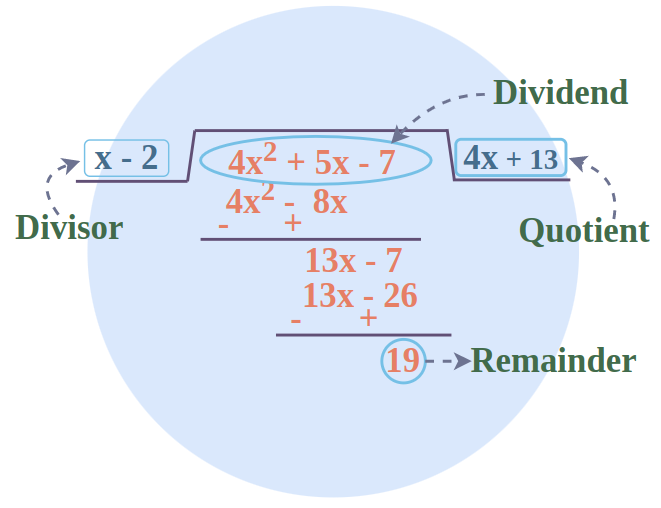
General Method
| Step | Action |
| 1 | Factorise numerator and denominator |
| 2 | Cancel common factors |
| 3 | State restrictions on \( x \) |
| 4 | Use algebraic division if required |
Example
Simplify:
\( \dfrac{6x^2}{3x} \)
▶️ Answer / Explanation
Cancel common factors:
\( \dfrac{6x^2}{3x} = \dfrac{6}{3} \cdot \dfrac{x^2}{x} \)
\( = 2x \)
Restriction: \( x \ne 0 \)
Answer: \( 2x \)
Example
Simplify:
\( \dfrac{ax + b}{px^2 + qx + r} \)
given that \( px^2 + qx + r = (ax + b)(mx + n) \).
▶️ Answer / Explanation
Factorise the denominator:
\( \dfrac{ax + b}{(ax + b)(mx + n)} \)
Cancel the common factor \( (ax + b) \):
\( \dfrac{1}{mx + n} \)
Restrictions:
\( ax + b \ne 0,\ mx + n \ne 0 \)
Answer: \( \dfrac{1}{mx + n} \)
Example
Simplify:
\( \dfrac{x^3 + 1}{x^2 – 1} \)
▶️ Answer / Explanation
Factorise numerator and denominator:
\( x^3 + 1 = (x + 1)(x^2 – x + 1) \)
\( x^2 – 1 = (x – 1)(x + 1) \)
Cancel common factor \( (x + 1) \):
\( \dfrac{x^2 – x + 1}{x – 1} \)
Restrictions:
\( x \ne \pm 1 \)
Answer: \( \dfrac{x^2 – x + 1}{x – 1} \)