
Definition of a Function
A function is a rule or relationship that assigns exactly one output to each input.
In other words:
Each value of the independent variable corresponds to one and only one value of the dependent variable.
Function Notation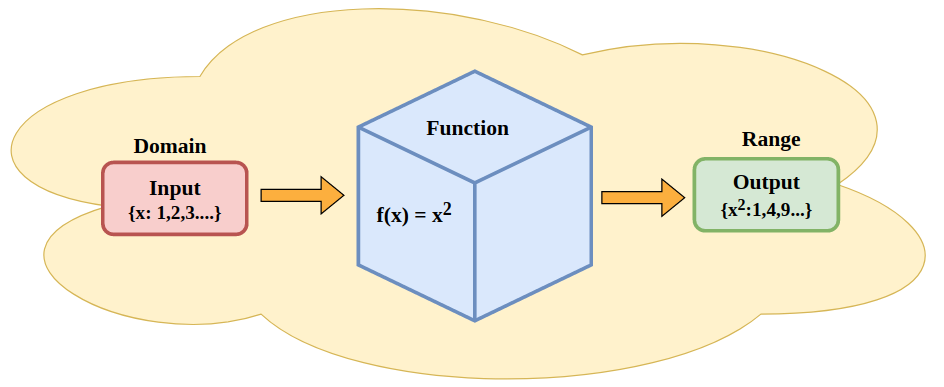
A function is commonly written as:
\( y = f(x) \)
Here:
- \( x \) is the independent variable
- \( y \) is the dependent variable
- \( f(x) \) means “the value of the function at \( x \)”
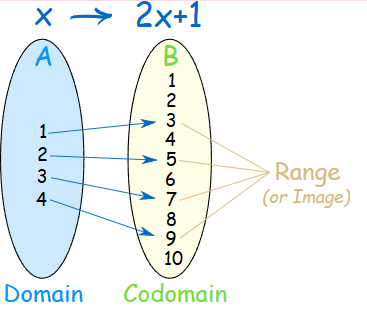
Domain, Codomain, and Range
| Term | Meaning |
| Domain | All possible input values of \( x \) |
| Codomain | Set into which outputs are defined |
| Range | Actual set of output values |
Key Property of a Function
A function must satisfy the condition:
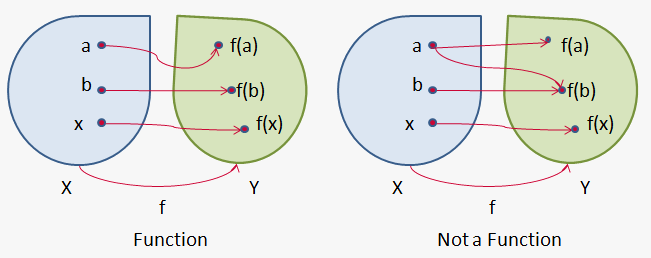
One input → one output
However:
- Different inputs may have the same output
- One input cannot have two different outputs
Functions and Graphs
A graph represents a function if it passes the vertical line test.
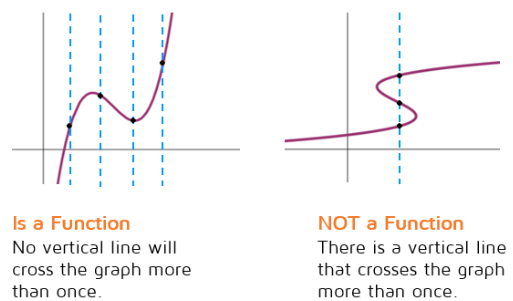
If any vertical line intersects the graph more than once, the relation is not a function.
Example
Determine whether the relation
\( y = 2x + 3 \)
is a function.
▶️ Answer / Explanation
Each value of \( x \) gives exactly one value of \( y \).
Conclusion: This relation is a function.
Example
The function is defined by:
\( f(x) = x^2 – 4 \)
Find:
(i) \( f(3) \)
(ii) \( f(-1) \)
▶️ Answer / Explanation
\( f(3) = 3^2 – 4 = 9 – 4 = 5 \)
\( f(-1) = (-1)^2 – 4 = 1 – 4 = -3 \)
Example
Explain why the relation
\( x = y^2 \)
is not a function of \( y \).
▶️ Answer / Explanation
For a given value of \( y \), there are two possible values of \( x \).
For example:
\( y = 2 \Rightarrow x = 4 \)
\( y = -2 \Rightarrow x = 4 \)
One output corresponds to more than one input.
Conclusion: This relation is not a function.
Domain and Range of Functions
For a function \( y = f(x) \), the domain and range describe the set of possible input and output values.
Domain of a Function
The domain of a function is the set of all values of \( x \) for which the function is defined.
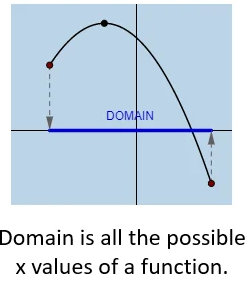
In algebraic functions, the domain is restricted when:
- There is division by zero
- There is a square root of a negative number
- There is a logarithm of a non-positive number
Common Domain Restrictions
| Function type | Restriction |
| Rational function | Denominator \( \ne 0 \) |
| Square root | Expression inside root \( \ge 0 \) |
| Logarithmic function | Argument \( > 0 \) |
Range of a Function
The range of a function is the set of all possible values of \( y \) produced by the function.
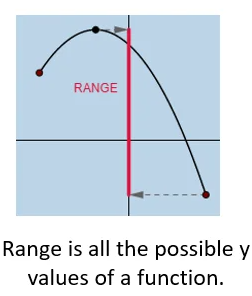
The range depends on:
- The type of function
- The domain
- The shape of the graph
Finding the Range
To find the range:
- Analyse the algebraic form of the function
- Use known properties (e.g. squares are non-negative)
- Consider maximum or minimum values
- Use the graph where appropriate
Domain and Range Using Graphs
- The domain is read from left to right (x-values)
- The range is read from bottom to top (y-values)
- Open circles indicate excluded values
- Closed circles indicate included values
Example
Find the domain of:
\( f(x) = \dfrac{1}{x – 3} \)
▶️ Answer / Explanation
The denominator must not be zero:
\( x – 3 \ne 0 \Rightarrow x \ne 3 \)
Domain: \( x \in \mathbb{R},\ x \ne 3 \)
Example
Find the domain and range of:
\( f(x) = \sqrt{2x – 1} \)
▶️ Answer / Explanation
Domain:
The expression under the square root must be non-negative:
\( 2x – 1 \ge 0 \Rightarrow x \ge \dfrac{1}{2} \)
Range:
The square root function produces non-negative values:
\( y \ge 0 \)
Answer:
Domain: \( x \ge \dfrac{1}{2} \)
Range: \( y \ge 0 \)
Example
Find the domain and range of:
\( f(x) = x^2 – 4x + 1 \)
▶️ Answer / Explanation
Domain:
This is a polynomial, so it is defined for all real values of \( x \).
Domain: \( x \in \mathbb{R} \)
Range:
Complete the square:
\( f(x) = (x – 2)^2 – 3 \)
Since \( (x – 2)^2 \ge 0 \), the minimum value is \( -3 \).
Range: \( y \ge -3 \)
Composition of Functions
The composition of functions involves combining two functions so that the output of one function becomes the input of another.
Definition
If two functions \( f \) and \( g \) are defined, then the composition of \( f \) with \( g \) is written as:
\( (f \circ g)(x) = f(g(x)) \)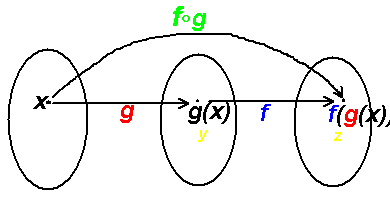
This means:
First apply \( g \), then apply \( f \).
Order of Composition
The order of composition is important.
In general:
\( f(g(x)) \ne g(f(x)) \)
So:
- \( f \circ g \) means apply \( g \) first
- \( g \circ f \) means apply \( f \) first
Domain of a Composite Function
The domain of \( (f \circ g)(x) \) consists of all values of \( x \) such that:
- \( x \) is in the domain of \( g \)
- \( g(x) \) is in the domain of \( f \)
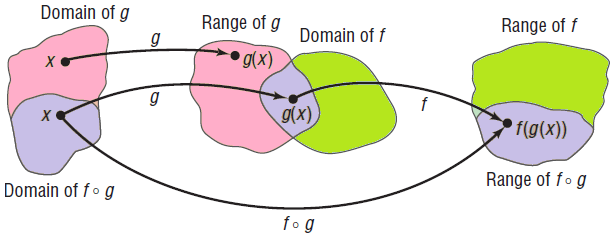
Both conditions must be satisfied.
General Method
| Step | Action |
| 1 | Write down \( g(x) \) |
| 2 | Substitute into \( f(x) \) |
| 3 | Simplify the expression |
| 4 | State the domain if required |
Example
Let:
\( f(x) = 2x + 1,\quad g(x) = x^2 \)
Find \( (f \circ g)(x) \).
▶️ Answer / Explanation
\( (f \circ g)(x) = f(g(x)) \)
\( = f(x^2) \)
\( = 2x^2 + 1 \)
Answer: \( (f \circ g)(x) = 2x^2 + 1 \)
Example
Let:
\( f(x) = \sqrt{x},\quad g(x) = 3x – 1 \)
Find:
(i) \( (f \circ g)(x) \)
(ii) the domain of \( f \circ g \)
▶️ Answer / Explanation
(i)
\( (f \circ g)(x) = f(3x – 1) = \sqrt{3x – 1} \)
(ii) Domain:
The expression inside the square root must be non-negative:
\( 3x – 1 \ge 0 \Rightarrow x \ge \dfrac{1}{3} \)
Domain: \( x \ge \dfrac{1}{3} \)
Example
Let:
\( f(x) = \dfrac{1}{x},\quad g(x) = x – 2 \)
Find:
(i) \( (f \circ g)(x) \)
(ii) \( (g \circ f)(x) \)
(iii) the domain of each composite function
▶️ Answer / Explanation
(i)
\( (f \circ g)(x) = f(x – 2) = \dfrac{1}{x – 2} \)
Domain: \( x \ne 2 \)
(ii)
\( (g \circ f)(x) = g\!\left(\dfrac{1}{x}\right) = \dfrac{1}{x} – 2 \)
Domain: \( x \ne 0 \)
(iii)
The domains are different, showing that composition is not commutative.
Inverse Functions and Their Graphs
An inverse function reverses the effect of a given function.
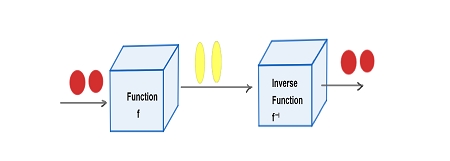
If a function maps:
\( x \longrightarrow f(x) \)
then its inverse maps:
\( f(x) \longrightarrow x \)
Definition of an Inverse Function
If \( f \) is a function and has an inverse, then the inverse function is denoted by:
\( f^{-1}(x) \)
and satisfies:
\( f(f^{-1}(x)) = x \quad \text{and} \quad f^{-1}(f(x)) = x \)
for all values of \( x \) in the appropriate domains.
Condition for an Inverse to Exist
A function has an inverse if and only if it is one-to-one.
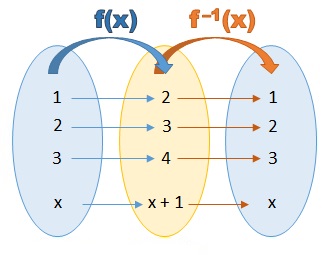
This means:
Different inputs give different outputs.
Graphically, this is tested using the horizontal line test.
Finding the Inverse of a Function
To find the inverse of \( f(x) \):
| Step | Action |
| 1 | Write \( y = f(x) \) |
| 2 | Interchange \( x \) and \( y \) |
| 3 | Solve for \( y \) |
| 4 | Write \( y = f^{-1}(x) \) |
Domain and Range of Inverse Functions
The domain and range are swapped between a function and its inverse:
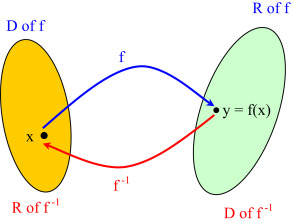
- Domain of \( f \) = Range of \( f^{-1} \)
- Range of \( f \) = Domain of \( f^{-1} \)
Graphs of Inverse Functions
The graph of \( y = f^{-1}(x) \) is the reflection of the graph of \( y = f(x) \) in the line:
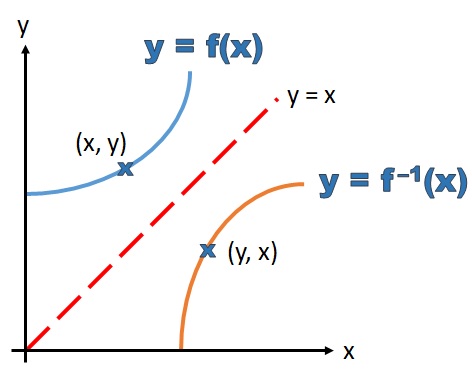
\( y = x \)
Key graphical properties:
- Points \( (a,b) \) on \( y=f(x) \) become \( (b,a) \) on \( y=f^{-1}(x) \)
- Intercepts are swapped
- Both graphs are symmetric about \( y = x \)
Example
Find the inverse of:
\( f(x) = 3x + 2 \)
▶️ Answer / Explanation
Let \( y = 3x + 2 \).
Interchange \( x \) and \( y \):
\( x = 3y + 2 \)
Solve for \( y \):
\( y = \dfrac{x – 2}{3} \)
Answer:
\( f^{-1}(x) = \dfrac{x – 2}{3} \)
Example
The function is defined by:
\( f(x) = x^2 + 1,\ x \ge 0 \)
Find \( f^{-1}(x) \).
▶️ Answer / Explanation
The restriction \( x \ge 0 \) makes the function one-to-one.
Let \( y = x^2 + 1 \).
Interchange \( x \) and \( y \):
\( x = y^2 + 1 \)
Solve for \( y \):
\( y^2 = x – 1 \Rightarrow y = \sqrt{x – 1} \)
Answer:
\( f^{-1}(x) = \sqrt{x – 1} \)
Example
Sketch the graphs of:
\( y = \ln x \) and its inverse.
▶️ Answer / Explanation
The inverse of \( y = \ln x \) is:
\( y = e^x \)
The two graphs are reflections of each other in the line \( y = x \).
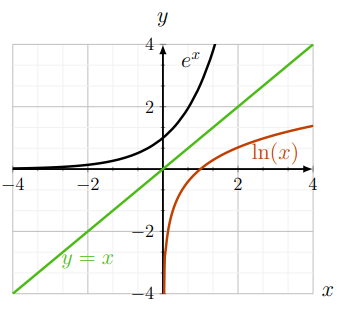
Key points:
- \( (1,0) \leftrightarrow (0,1) \)
- Domain and range are swapped