
Pythagorean Trigonometric Identities
The following identities are extensions of the fundamental trigonometric identity:
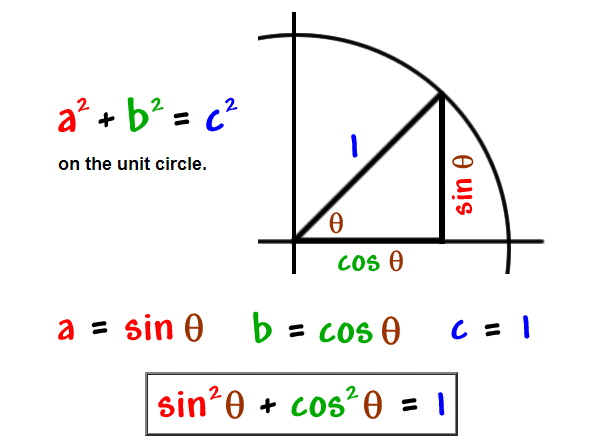
\( \sin^2\theta + \cos^2\theta = 1 \)
They involve the functions tangent, cotangent, secant and cosecant.
Key Identities
\( \sec^2\theta = 1 + \tan^2\theta \)
\( \ cosec^2\theta = 1 + \cot^2\theta \)
These identities are valid for all values of \( \theta \) for which the expressions are defined.
Derivation of the Identities
Derivation of \( \sec^2\theta = 1 + \tan^2\theta \)
Start from:
\( \sin^2\theta + \cos^2\theta = 1 \)
Divide throughout by \( \cos^2\theta \):
\( \dfrac{\sin^2\theta}{\cos^2\theta} + 1 = \dfrac{1}{\cos^2\theta} \)
Using definitions:
\( \tan^2\theta + 1 = \sec^2\theta \)
Derivation of \( \ cosec^2\theta = 1 + \cot^2\theta \)
Start again from:
\( \sin^2\theta + \cos^2\theta = 1 \)
Divide throughout by \( \sin^2\theta \):
\( 1 + \dfrac{\cos^2\theta}{\sin^2\theta} = \dfrac{1}{\sin^2\theta} \)
Using definitions:
\( 1 + \cot^2\theta = \ cosec^2\theta \)
When to Use These Identities
- Simplifying trigonometric expressions
- Proving trigonometric identities
- Solving trigonometric equations
- Replacing \( \sec \) or \( \ cosec \) with \( \tan \) or \( \cot \)
Common Equivalent Forms
- \( \sec^2\theta – \tan^2\theta = 1 \)
- \( \ cosec^2\theta – \cot^2\theta = 1 \)
Example
Find the value of \( \sec^2\theta \) given that \( \tan\theta = 3 \).
▶️ Answer / Explanation
Use the identity:
\( \sec^2\theta = 1 + \tan^2\theta \)
\( = 1 + 3^2 = 10 \)
Answer: \( \sec^2\theta = 10 \)
Example
Simplify:
\( \sec^2\theta – \tan^2\theta \)
▶️ Answer / Explanation
Using the identity:
\( \sec^2\theta = 1 + \tan^2\theta \)
\( \sec^2\theta – \tan^2\theta = 1 \)
Answer: 1
Example
Prove that:
\( \dfrac{\sec^2\theta – 1}{\tan^2\theta} = 1 \)
▶️ Answer / Explanation
Start with the numerator:
\( \sec^2\theta – 1 \)
Using the identity:
\( \sec^2\theta – 1 = \tan^2\theta \)
So the expression becomes:
\( \dfrac{\tan^2\theta}{\tan^2\theta} = 1 \)
Hence proved.