
The Exponential Function \( e^x \)
The function \( y = e^x \) is called the natural exponential function.
It is defined for all real values of \( x \) and models continuous growth and decay.
Key Properties of \( y = e^x \)
| Property | Description |
| Domain | \( x \in \mathbb{R} \) |
| Range | \( y > 0 \) |
| Intercept | \( (0,1) \) |
| Asymptote | \( y = 0 \) |
| Monotonicity | Strictly increasing |
Graph of \( y = e^x \)
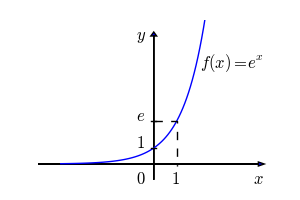
- Passes through \( (0,1) \)
- Approaches the x-axis as \( x \to -\infty \)
- Increases rapidly as \( x \to \infty \)
- Never crosses the x-axis
The Function \( y = e^{ax+b} + c \)
This is a transformed exponential function.
Each constant affects the graph in a specific way.
Effect of Parameters
| Parameter | Effect on Graph |
| \( a \) | Controls growth or decay and horizontal scaling If \( a>0 \): increasing If \( a<0 \): decreasing |
| \( b \) | Horizontal translation Left if \( b>0 \), right if \( b<0 \) |
| \( c \) | Vertical translation Up if \( c>0 \), down if \( c<0 \) |
Asymptote of \( y = e^{ax+b} + c \)
The horizontal asymptote is:
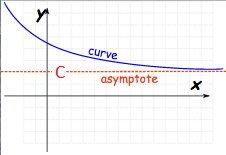
\( y = c \)
The graph never crosses this line.
Sketching Strategy
- Start from the basic graph of \( y = e^x \)
- Apply horizontal transformations (\( ax+b \))
- Apply vertical translation (\( +c \))
- Draw the horizontal asymptote first
- Plot one or two key points
Example
State the domain, range and asymptote of:
\( y = e^x \)
▶️ Answer / Explanation
Domain: \( x \in \mathbb{R} \)
Range: \( y > 0 \)
Asymptote: \( y = 0 \)
Example
Describe the transformations from \( y = e^x \) to:
\( y = e^{2x-1} + 3 \)
▶️ Answer / Explanation
- Horizontal compression by factor 2
- Translation right by \( \dfrac{1}{2} \)
- Translation up by 3 units
Horizontal asymptote becomes \( y = 3 \).
Example
Sketch the graph of:
\( y = e^{-x} – 2 \)
▶️ Answer / Explanation
- Reflection of \( y = e^x \) in the y-axis
- Translation down by 2 units
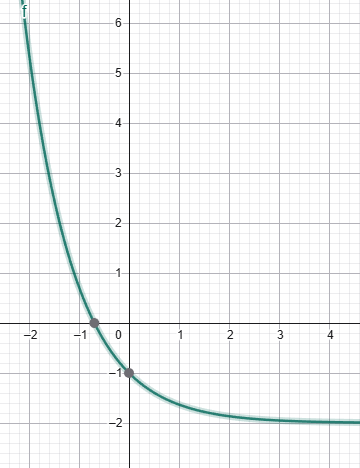
Horizontal asymptote is \( y = -2 \).
The graph is decreasing and never crosses the asymptote.