
The Natural Logarithmic Function \( \ln x \)
The function \( y = \ln x \) is called the natural logarithmic function.
It is defined as the inverse function of the exponential function \( y = e^x \).
\( \ln x \) as the Inverse of \( e^x \)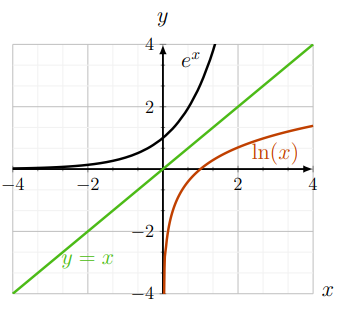
If:
\( y = e^x \)
then its inverse is:
\( y = \ln x \)
This means:
\( \ln(e^x) = x \quad \text{and} \quad e^{\ln x} = x \)
The graphs of \( y = e^x \) and \( y = \ln x \) are reflections of each other in the line:
\( y = x \)
Key Properties of \( y = \ln x \)
| Property | Description |
| Domain | \( x > 0 \) |
| Range | \( y \in \mathbb{R} \) |
| Intercept | \( (1,0) \) |
| Asymptote | \( x = 0 \) |
| Monotonicity | Strictly increasing |
Graph of \( y = \ln x \)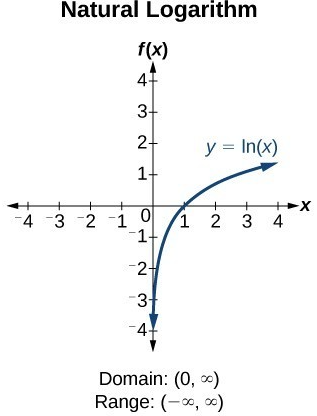
- Passes through \( (1,0) \)
- Approaches the y-axis as \( x \to 0^+ \)
- Increases slowly for large \( x \)
- Defined only for positive \( x \)
Solving Exponential Equations
Equations of the form \( e^{ax+b} = p \)
Method:
- Take natural logarithms on both sides
- Use \( \ln(e^k) = k \)
- Solve for \( x \)
\( e^{ax+b} = p \Rightarrow ax + b = \ln p \)
Solving Logarithmic Equations
Equations of the form \( \ln(ax+b) = q \)
Method:
- Rewrite using the exponential form
- Solve for \( x \)
- Check the domain \( ax+b>0 \)
\( \ln(ax+b) = q \Rightarrow ax+b = e^q \)
Example
Solve:
\( e^{2x} = 5 \)
▶️ Answer / Explanation
Take natural logarithms:
\( 2x = \ln 5 \)
\( x = \dfrac{1}{2}\ln 5 \)
Example
Solve:
\( e^{3x-1} = 7 \)
▶️ Answer / Explanation
Take natural logarithms:
\( 3x – 1 = \ln 7 \)
\( 3x = \ln 7 + 1 \)
\( x = \dfrac{\ln 7 + 1}{3} \)
Example
Solve:
\( \ln(2x – 3) = 1 \)
▶️ Answer / Explanation
Rewrite in exponential form:
\( 2x – 3 = e^1 = e \)
\( 2x = e + 3 \)
\( x = \dfrac{e + 3}{2} \)
Check domain:
\( 2x – 3 > 0 \Rightarrow x > \dfrac{3}{2} \)
The solution satisfies the domain.