Home / Edexcel A Level / Study notes

Edexcel IAL - Pure Maths 3- 4.2 Differentiation using the product rule, quotient rule and chain rule- Study notes  - New syllabus

Edexcel IAL – Pure Maths 3- 4.2 Differentiation using the product rule, quotient rule and chain rule -Study notes- New syllabus

Edexcel IAL – Pure Maths 3- 4.2 Differentiation using the product rule, quotient rule and chain rule -Study notes -Edexcel A level Physics – per latest Syllabus.

Key Concepts:

  • 4.2 Differentiation using the product rule, quotient rule and chain rule

Edexcel IAL Maths-Study Notes- All Topics

The Product Rule (Differentiation)

The product rule is used when a function is written as the product of two functions of \( x \).

Statement of the Product Rule

If:

\( y = u(x)\,v(x) \)

then:

\( \dfrac{dy}{dx} = u\dfrac{dv}{dx} + v\dfrac{du}{dx} \)

This means:

Differentiate one function at a time, keeping the other unchanged.

When to Use the Product Rule

  • When functions are multiplied together
  • When expanding first would be complicated
  • Common with polynomial × trig or exponential functions

Method

  • Identify \( u \) and \( v \)
  • Differentiate \( u \) and \( v \)
  • Substitute into the product rule formula
  • Simplify the final expression

Example 

Differentiate:

\( y = x\sin x \)

▶️ Answer / Explanation

Let:

\( u = x,\quad v = \sin x \)

\( \dfrac{du}{dx} = 1,\quad \dfrac{dv}{dx} = \cos x \)

Apply the product rule:

\( \dfrac{dy}{dx} = x\cos x + \sin x \)

Example

Differentiate:

\( y = 2x^4 \sin x \)

▶️ Answer / Explanation

Let:

\( u = 2x^4,\quad v = \sin x \)

\( \dfrac{du}{dx} = 8x^3,\quad \dfrac{dv}{dx} = \cos x \)

Apply the product rule:

\( \dfrac{dy}{dx} = 2x^4\cos x + 8x^3\sin x \)

Example

Differentiate:

\( y = x^2 e^x \)

▶️ Answer / Explanation

Let:

\( u = x^2,\quad v = e^x \)

\( \dfrac{du}{dx} = 2x,\quad \dfrac{dv}{dx} = e^x \)

Apply the product rule:

\( \dfrac{dy}{dx} = x^2 e^x + 2x e^x \)

Factorise:

\( \dfrac{dy}{dx} = e^x(x^2 + 2x) \)

The Quotient Rule (Differentiation)

The quotient rule is used when a function is written as one function divided by another.

Statement of the Quotient Rule

If:

\( y = \dfrac{u(x)}{v(x)} \)

then:

\( \dfrac{dy}{dx} = \dfrac{v\dfrac{du}{dx} – u\dfrac{dv}{dx}}{v^2} \)

This can be remembered as:

Bottom × derivative of top − Top × derivative of bottom, all over bottom squared.

When to Use the Quotient Rule

  • When one function is divided by another
  • When simplifying first is not convenient
  • Common with exponential or trigonometric numerators

Method

  • Identify the numerator \( u \)
  • Identify the denominator \( v \)
  • Differentiate \( u \) and \( v \)
  • Substitute carefully into the quotient rule formula
  • Simplify the final expression

Example

Differentiate:

\( y = \dfrac{x^2}{x+1} \)

▶️ Answer / Explanation

Let:

\( u = x^2,\quad v = x+1 \)

\( \dfrac{du}{dx} = 2x,\quad \dfrac{dv}{dx} = 1 \)

Apply the quotient rule:

\( \dfrac{dy}{dx} = \dfrac{(x+1)(2x) – x^2(1)}{(x+1)^2} \)

\( = \dfrac{x^2 + 2x}{(x+1)^2} \)

Example 

Differentiate:

\( y = \dfrac{e^x}{x} \)

▶️ Answer / Explanation

Let:

\( u = e^x,\quad v = x \)

\( \dfrac{du}{dx} = e^x,\quad \dfrac{dv}{dx} = 1 \)

Apply the quotient rule:

\( \dfrac{dy}{dx} = \dfrac{x e^x – e^x}{x^2} \)

Factorise:

\( \dfrac{dy}{dx} = \dfrac{e^x(x – 1)}{x^2} \)

Example 

Differentiate:

\( y = \dfrac{\sin x}{x^2} \)

▶️ Answer / Explanation

Let:

\( u = \sin x,\quad v = x^2 \)

\( \dfrac{du}{dx} = \cos x,\quad \dfrac{dv}{dx} = 2x \)

Apply the quotient rule:

\( \dfrac{dy}{dx} = \dfrac{x^2\cos x – \sin x(2x)}{x^4} \)

\( = \dfrac{x\cos x – 2\sin x}{x^3} \)

The Chain Rule (Differentiation)

The chain rule is used when a function is composed of another function, that is, when one function is inside another.

Statement of the Chain Rule

If:

\( y = f(g(x)) \)

then:

\( \dfrac{dy}{dx} = \dfrac{dy}{dg} \cdot \dfrac{dg}{dx} \)

This means:
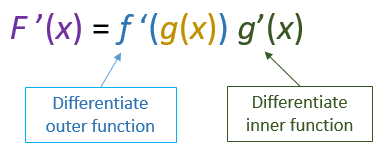
Differentiate the outer function first, then multiply by the derivative of the inner function.

When to Use the Chain Rule

  • When the argument is not just \( x \)
  • Functions involving powers, trigonometric or exponential functions of another expression
  • Expressions such as \( \cos x^2 \), \( e^{3x} \), \( \tan(2x) \)

Method

  • Identify the inner function
  • Differentiate the outer function
  • Multiply by the derivative of the inner function
  • Write the final answer clearly

Example 

Differentiate:

\( y = \cos(2x) \)

▶️ Answer / Explanation

Let:

\( u = 2x \)

\( y = \cos u \)

\( \dfrac{dy}{du} = -\sin u,\quad \dfrac{du}{dx} = 2 \)

\( \dfrac{dy}{dx} = -2\sin(2x) \)

Example 

Differentiate:

\( y = e^{3x} \)

▶️ Answer / Explanation

Let:

\( u = 3x \)

\( y = e^u \)

\( \dfrac{dy}{du} = e^u,\quad \dfrac{du}{dx} = 3 \)

\( \dfrac{dy}{dx} = 3e^{3x} \)

Example 

Differentiate:

\( y = \tan^2(2x) \)

▶️ Answer / Explanation

Rewrite:

\( y = (\tan(2x))^2 \)

Let:

\( u = \tan(2x) \)

\( \dfrac{dy}{du} = 2u \)

Now differentiate \( u \):

\( \dfrac{du}{dx} = 2\sec^2(2x) \)

Apply the chain rule:

\( \dfrac{dy}{dx} = 4\tan(2x)\sec^2(2x) \)

Scroll to Top