
Location of Roots Using Change of Sign
The roots of an equation \( f(x) = 0 \) can be located by examining the sign of \( f(x) \) over an interval.
This method does not find the exact root, but identifies an interval in which a root lies.
Key Principle
If:
- \( f(x) \) is continuous on an interval \([a,b]\)
- \( f(a) \) and \( f(b) \) have opposite signs
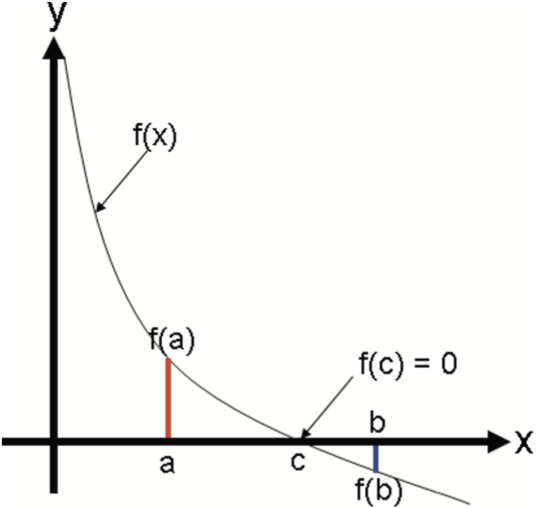
then there exists at least one root of \( f(x)=0 \) in the interval \((a,b)\).
That is: \( f(a)f(b) < 0 \)
Why Continuity Is Important
If a function is continuous, its graph can be drawn without lifting the pen.
A change of sign means the graph must cross the x-axis, so a root must exist.
Method
- Choose an interval \([a,b]\)
- Evaluate \( f(a) \) and \( f(b) \)
- Check the signs of \( f(a) \) and \( f(b) \)
- If the signs differ, state that a root lies in \((a,b)\)
Interpreting Results
- Opposite signs ⟶ at least one root
- Same signs ⟶ no conclusion can be drawn
- The method does not tell how many roots exist
Example
Show that the equation
\( f(x) = x^2 – 3 \)
has a root between \( x = 1 \) and \( x = 2 \).
▶️ Answer / Explanation
\( f(1) = 1 – 3 = -2 \)
\( f(2) = 4 – 3 = 1 \)
Since \( f(1) < 0 \) and \( f(2) > 0 \), there is a change of sign.
Conclusion: A root lies in the interval \( (1,2) \).
Example
Find an interval of length 1 in which a root of
\( f(x) = x^3 – 4x – 1 \)
lies.
▶️ Answer / Explanation
\( f(1) = 1 – 4 – 1 = -4 \)
\( f(2) = 8 – 8 – 1 = -1 \)
No change of sign between 1 and 2.
\( f(3) = 27 – 12 – 1 = 14 \)
Since \( f(2) < 0 \) and \( f(3) > 0 \), a change of sign occurs.
Conclusion: A root lies in \( (2,3) \).
Example
The function \( f \) is defined by:
\( f(x) = e^x – 3x \)
Show that \( f(x) = 0 \) has a root in the interval \( (0,1) \).
▶️ Answer / Explanation
\( f(0) = 1 – 0 = 1 \)
\( f(1) = e – 3 \approx -0.28 \)
Since the function changes sign and is continuous, a root exists.
Conclusion: A root lies in \( (0,1) \).