
Approximate Solutions Using Iterative Methods
Some equations cannot be solved exactly using algebra.
In such cases, iterative methods are used to obtain approximate solutions.
Fixed-Point Iteration
An equation of the form: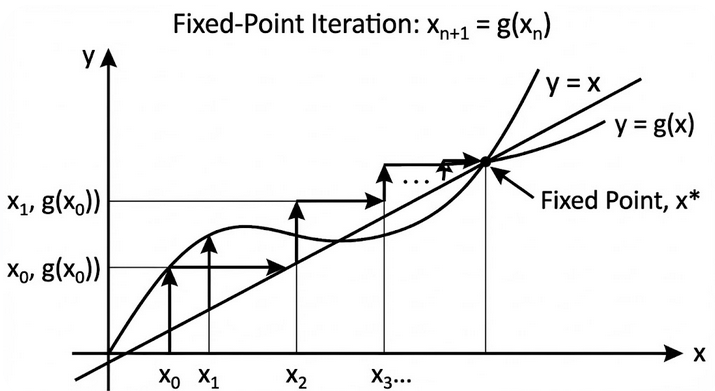
\( f(x) = 0 \)
is rearranged into the form:
\( x = g(x) \)
This leads to the recurrence relation:
\( x_{n+1} = g(x_n) \)
Starting from an initial value \( x_0 \), repeated substitution gives a sequence that may converge to a solution.
Meaning of “Leads Will Be Given”
In examination questions, the required rearrangement:
\( x = g(x) \)
or the recurrence relation:
\( x_{n+1} = g(x_n) \)
will usually be provided.
Students are expected to apply the iteration correctly, not to find the rearrangement themselves.
Iterative Algorithm
- Choose an initial approximation \( x_0 \)
- Use the recurrence relation to find \( x_1 \)
- Repeat to obtain \( x_2, x_3, \dots \)
- Stop when values agree to the required accuracy
Convergence (Basic Understanding)
- If successive values get closer, the method converges
- If values move away or oscillate, it diverges
- Different rearrangements may give different behaviour
Stopping Criterion
The iteration is usually stopped when:
Two successive values of \( x_n \) are the same to a given number of decimal places.
Example
The equation \( x = \cos x \) is solved using the iteration:
\( x_{n+1} = \cos x_n \)
Given \( x_0 = 0.5 \), find \( x_1 \) and \( x_2 \).
▶️ Answer / Explanation
\( x_1 = \cos(0.5) \approx 0.8776 \)
\( x_2 = \cos(0.8776) \approx 0.6390 \)
Example
The equation \( x^3 + x – 1 = 0 \) is rearranged as:
\( x_{n+1} = 1 – x_n^3 \)
Given \( x_0 = 0.6 \), perform three iterations.
▶️ Answer / Explanation
\( x_1 = 1 – (0.6)^3 = 0.784 \)
\( x_2 = 1 – (0.784)^3 \approx 0.518 \)
\( x_3 = 1 – (0.518)^3 \approx 0.861 \)
The values do not settle, suggesting poor convergence.
Example
The equation \( e^x = 3x \) is solved using the iteration:
\( x_{n+1} = \ln(3x_n) \)
Given \( x_0 = 1 \), find the solution correct to 3 decimal places.
▶️ Answer / Explanation
\( x_1 = \ln(3) \approx 1.099 \)
\( x_2 = \ln(3.297) \approx 1.193 \)
\( x_3 = \ln(3.579) \approx 1.275 \)
\( x_4 = \ln(3.825) \approx 1.342 \)
\( x_5 = \ln(4.026) \approx 1.392 \)
\( x_6 = \ln(4.176) \approx 1.430 \)
The values are converging.
Approximate solution:
\( x \approx 1.430 \)