
Proof by Contradiction
Proof by contradiction is a method in which a statement is proved true by assuming that it is false and then showing that this leads to an impossibility.
If assuming the opposite of a statement leads to a contradiction, then the original statement must be true.
Logical Structure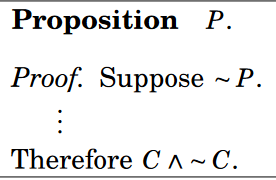
To prove a statement \( P \):
- Assume \( P \) is false
- Use logical steps to derive a contradiction
- Conclude that the assumption is impossible
- Therefore, \( P \) must be true
Proof that \( \sqrt{2} \) is Irrational
We prove that \( \sqrt{2} \) cannot be written as a fraction of two integers.
Assume that \( \sqrt{2} \) is rational.
Then:
\( \sqrt{2} = \dfrac{p}{q} \)
where \( p \) and \( q \) are integers with no common factors and \( q \ne 0 \).
Squaring both sides:
\( 2 = \dfrac{p^2}{q^2} \Rightarrow p^2 = 2q^2 \)
This shows that \( p^2 \) is even, so \( p \) is even.
Let \( p = 2k \) for some integer \( k \).
Then:
\( p^2 = 4k^2 = 2q^2 \Rightarrow q^2 = 2k^2 \)
This shows that \( q \) is also even.
So both \( p \) and \( q \) are even, which contradicts the assumption that they have no common factor.
Therefore, \( \sqrt{2} \) is irrational.
Proof that There Are Infinitely Many Prime Numbers
We prove this using contradiction.
Assume that there are only finitely many primes.
Let them be:
\( p_1, p_2, p_3, \dots, p_n \)
Consider the number:
\( N = p_1p_2p_3\cdots p_n + 1 \)
When \( N \) is divided by any prime \( p_i \), it leaves remainder 1.
So \( N \) is not divisible by any of the listed primes.
This means \( N \) is either prime itself or has a prime factor not in the list.
This contradicts the assumption that all primes were listed.
Therefore, there are infinitely many primes.
Application to an Unfamiliar Result
Statement: The number \( 3 + \sqrt{5} \) is irrational.
Assume that \( 3 + \sqrt{5} \) is rational.
Then:
\( 3 + \sqrt{5} = r \)
for some rational number \( r \).
So:
\( \sqrt{5} = r – 3 \)
The right-hand side is rational, since rational numbers are closed under subtraction.
This implies that \( \sqrt{5} \) is rational, which is false.
This is a contradiction.
Therefore, \( 3 + \sqrt{5} \) is irrational.
Common Mistakes to Avoid
- Forgetting to state the initial assumption clearly
- Not identifying the contradiction
- Using circular reasoning
- Stopping before concluding the result
Example
Prove that \( \sqrt{3} \) is irrational.
▶️ Answer / Explanation
Assume that \( \sqrt{3} \) is rational.
Then:
\( \sqrt{3} = \dfrac{p}{q} \)
where \( p \) and \( q \) are integers with no common factor and \( q \ne 0 \).
Squaring:
\( 3 = \dfrac{p^2}{q^2} \Rightarrow p^2 = 3q^2 \)
This shows that \( p^2 \) is divisible by 3, so \( p \) is divisible by 3.
Let \( p = 3k \).
Then:
\( 9k^2 = 3q^2 \Rightarrow q^2 = 3k^2 \)
So \( q \) is also divisible by 3.
This contradicts the assumption that \( p \) and \( q \) have no common factor.
Therefore, \( \sqrt{3} \) is irrational.
Example
Prove that there are infinitely many prime numbers.
▶️ Answer / Explanation
Assume that there are only finitely many primes:
\( p_1, p_2, p_3, \dots, p_n \)
Form the number:
\( N = p_1p_2p_3 \cdots p_n + 1 \)
When \( N \) is divided by any \( p_i \), the remainder is 1.
So none of the listed primes divides \( N \).
Therefore, \( N \) is either prime or has a prime factor not in the list.
This contradicts the assumption that all primes were listed.
Hence, there are infinitely many primes.
Example
Prove that the equation \( x^2 = 2 \) has no rational solution.
▶️Answer / Explanation
Assume that there exists a rational solution to \( x^2 = 2 \).
Then:
\( x = \dfrac{p}{q} \)
where \( p \) and \( q \) are integers with no common factor.
Substitute into the equation:
\( \dfrac{p^2}{q^2} = 2 \Rightarrow p^2 = 2q^2 \)
This shows \( p \) is even. Let \( p = 2k \).
Then:
\( 4k^2 = 2q^2 \Rightarrow q^2 = 2k^2 \)
So \( q \) is also even.
This contradicts the assumption that \( p \) and \( q \) have no common factor.
Therefore, \( x^2 = 2 \) has no rational solution.