
Partial Fractions
Partial fractions are used to rewrite a rational function as a sum of simpler fractions.
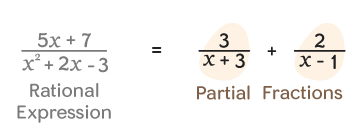
This allows integration, differentiation and series expansion to be carried out more easily.
Permitted Denominator Types
Only the following forms are required:
- \( (ax+b)(cx+d) \)
- \( (ax+b)(cx+d)(ex+f) \)
- \( (ax+b)(cx+d)^2 \)
Quadratic factors such as \( x^2+a \) are not required.
Proper and Improper Fractions
If:
degree of numerator \( < \) degree of denominator → Proper fraction
degree of numerator \( \ge \) degree of denominator → Improper fraction
Improper fractions must be divided first before using partial fractions.
Standard Decomposition Forms
| Denominator | Partial Fractions |
| \( (ax+b)(cx+d) \) | \( \dfrac{A}{ax+b} + \dfrac{B}{cx+d} \) |
| \( (ax+b)(cx+d)(ex+f) \) | \( \dfrac{A}{ax+b} + \dfrac{B}{cx+d} + \dfrac{C}{ex+f} \) |
| \( (ax+b)(cx+d)^2 \) | \( \dfrac{A}{ax+b} + \dfrac{B}{cx+d} + \dfrac{C}{(cx+d)^2} \) |
Applications
- Integration of rational functions
- Differentiation of rational functions
- Series expansions
Example
Decompose:
\( \dfrac{5x+1}{(x+1)(x+2)} \)
▶️ Answer / Explanation
Write:
\( \dfrac{5x+1}{(x+1)(x+2)} = \dfrac{A}{x+1} + \dfrac{B}{x+2} \)
\( 5x+1 = A(x+2) + B(x+1) \)
Let \( x=-1 \):
\( -4 = A \Rightarrow A=-4 \)
Let \( x=-2 \):
\( -9 = -B \Rightarrow B=9 \)
Answer:
\( \dfrac{-4}{x+1} + \dfrac{9}{x+2} \)
Example
Decompose:
\( \dfrac{3x+5}{(x+1)^2(x+2)} \)
▶️ Answer / Explanation
Write:
\( \dfrac{3x+5}{(x+1)^2(x+2)} = \dfrac{A}{x+2} + \dfrac{B}{x+1} + \dfrac{C}{(x+1)^2} \)
\( 3x+5 = A(x+1)^2 + B(x+1)(x+2) + C(x+2) \)
Let \( x=-2 \): \( -1=A \)
Let \( x=-1 \): \( 2=C \)
Substitute and solve gives \( B=4 \)
Answer:
\( \dfrac{-1}{x+2} + \dfrac{4}{x+1} + \dfrac{2}{(x+1)^2} \)
Example
Evaluate:
\( \displaystyle \int \dfrac{2x+1}{(x+1)(x+3)}\,dx \)
▶️ Answer / Explanation
First decompose:
\( \dfrac{2x+1}{(x+1)(x+3)} = \dfrac{A}{x+1} + \dfrac{B}{x+3} \)
\( 2x+1 = A(x+3) + B(x+1) \)
Let \( x=-1 \): \( -1=2A \Rightarrow A=-\dfrac12 \)
Let \( x=-3 \): \( -5=-2B \Rightarrow B=\dfrac52 \)
So:
\( \int \left( -\dfrac{1}{2(x+1)} + \dfrac{5}{2(x+3)} \right) dx \)
\( = -\dfrac12 \ln|x+1| + \dfrac52 \ln|x+3| + C \)