
Parametric Equations of Curves
A curve can be described by expressing both \( x \) and \( y \) in terms of a third variable, called a parameter.
This parameter is usually denoted by \( t \).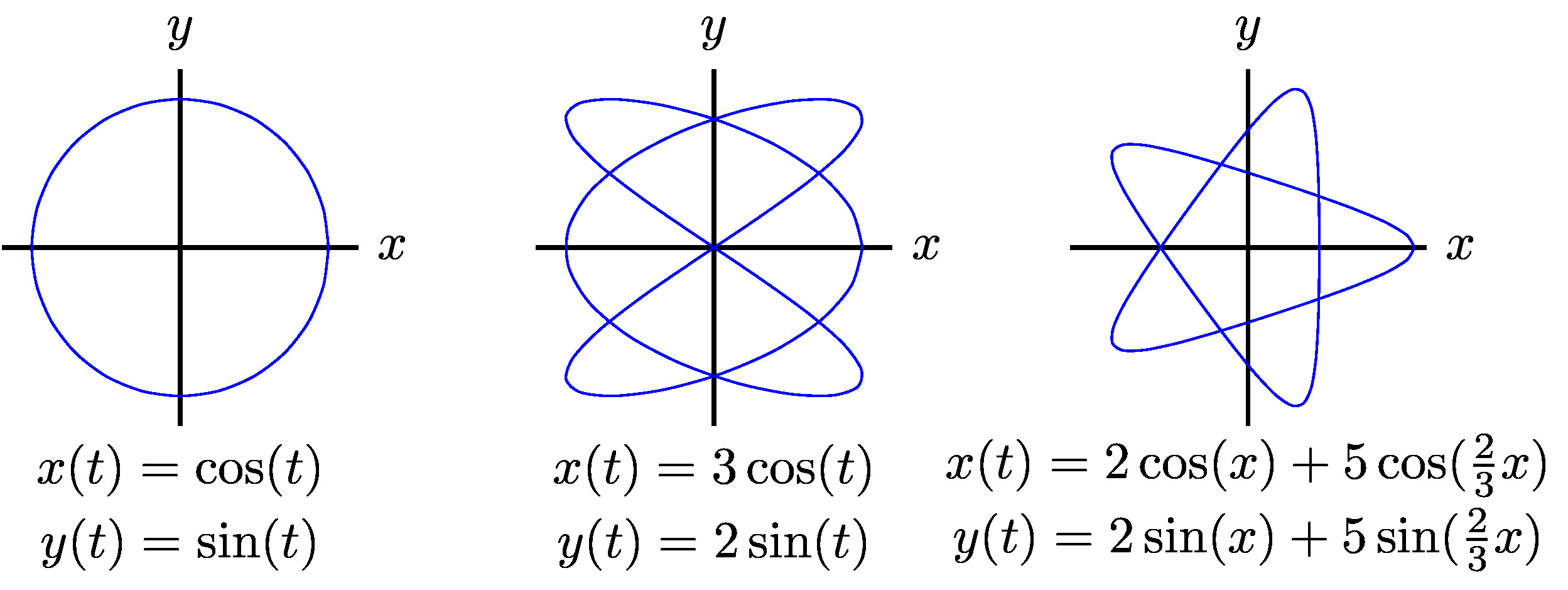
\( x = f(t), \quad y = g(t) \)
As \( t \) varies, the point \( (x,y) \) moves along the curve.
Why Use Parametric Equations
- To describe curves that cannot be written easily as \( y=f(x) \)
- To represent motion in mechanics
- To describe curves with direction
Conversion from Parametric to Cartesian
To convert to a Cartesian equation:
- Eliminate the parameter \( t \)
- Express \( y \) directly in terms of \( x \)
Conversion from Cartesian to Parametric
Choose a parameter and write:
\( x = f(t) \)
Then substitute into the equation for \( y \).
Example
The curve is defined by:
\( x = 2t,\ y = t^2 \)
Find the Cartesian equation.
▶️ Answer / Explanation
From \( x=2t \),
\( t = \dfrac{x}{2} \)
Substitute into \( y \):
\( y = \left(\dfrac{x}{2}\right)^2 = \dfrac{x^2}{4} \)
Example
The curve has Cartesian equation:
\( y = x^2 + 1 \)
Write it in parametric form.
▶️ Answer / Explanation
Let \( x = t \)
Then:
\( y = t^2 + 1 \)
So the parametric form is:
\( x = t,\ y = t^2 + 1 \)
Example
The curve is given by:
\( x = 1 + \cos t,\ y = 2 + \sin t \)
Find the Cartesian equation.
▶️ Answer / Explanation
From \( x = 1+\cos t \):
\( \cos t = x-1 \)
From \( y = 2+\sin t \):
\( \sin t = y-2 \)
Use identity:
\( \cos^2 t + \sin^2 t = 1 \)
So:
\( (x-1)^2 + (y-2)^2 = 1 \)