
Binomial Series for Any Rational \( n \)
For any rational number \( n \), the binomial expansion of \( (1+x)^n \) is an infinite series: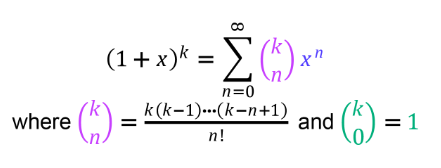
\( (1+x)^n = 1 + nx + \dfrac{n(n-1)}{2!}x^2 + \dfrac{n(n-1)(n-2)}{3!}x^3 + \cdots \)
This expansion is valid only when:
\( |x| < 1 \)
Expansion of \( (ax+b)^n \)
Rewrite:
\( (ax+b)^n = b^n \left(1 + \dfrac{a}{b}x\right)^n \)
Now apply the binomial series:
\( (ax+b)^n = b^n \left[ 1 + n\dfrac{a}{b}x + \dfrac{n(n-1)}{2}\left(\dfrac{a}{b}x\right)^2 + \cdots \right] \)
This expansion is valid when:
\( \left|\dfrac{a}{b}x\right| < 1 \Rightarrow |x| < \dfrac{b}{a} \)
Rational Functions and Partial Fractions
Rational functions are expanded into series by first using partial fractions.
Each part is then expanded using a binomial series.
Standard Form
\( \dfrac{1}{ax+b} = \dfrac{1}{b}\dfrac{1}{1+\dfrac{a}{b}x} \)
So:
\( \dfrac{1}{ax+b} = \dfrac{1}{b}\left(1 – \dfrac{a}{b}x + \left(\dfrac{a}{b}x\right)^2 – \cdots \right) \)
Example
Expand \( (1+2x)^{1/2} \) up to the term in \( x^2 \).
▶️ Answer / Explanation
Using:
\( (1+x)^{1/2} = 1 + \dfrac12 x – \dfrac18 x^2 + \cdots \)
Replace \( x \) by \( 2x \):
\( (1+2x)^{1/2} = 1 + x – \dfrac12 x^2 + \cdots \)
Example
Expand \( (3+2x)^{-1} \) in ascending powers of \( x \).
▶️ Answer / Explanation
\( (3+2x)^{-1} = \dfrac13 \left(1+\dfrac23 x\right)^{-1} \)
\( = \dfrac13 \left(1 – \dfrac23 x + \dfrac49 x^2 – \cdots \right) \)
\( = \dfrac13 – \dfrac29 x + \dfrac4{27}x^2 – \cdots \)
Example
Find the expansion of
\( \dfrac{1}{(1-x)(2+x)} \)
up to the term in \( x^2 \).
▶️ Answer / Explanation
Use partial fractions:
\( \dfrac{1}{(1-x)(2+x)} = \dfrac{A}{1-x} + \dfrac{B}{2+x} \)
Solving gives:
\( A=\dfrac13,\quad B=\dfrac13 \)
So:
\( \dfrac{1}{(1-x)(2+x)} = \dfrac13\left(\dfrac{1}{1-x} + \dfrac{1}{2+x}\right) \)
\( \dfrac{1}{1-x} = 1+x+x^2+\cdots \)
\( \dfrac{1}{2+x} = \dfrac12\left(1-\dfrac{x}{2}+\dfrac{x^2}{4}-\cdots\right) \)
So:
\( = \dfrac13\left(1+x+x^2 + \dfrac12 – \dfrac{x}{4} + \dfrac{x^2}{8}\right) \)
\( = \dfrac12 + \dfrac14 x + \dfrac{3}{8}x^2 + \cdots \)