
Implicit Differentiation
In implicit differentiation, \( x \) and \( y \) are related in one equation, but \( y \) is not written explicitly as a function of \( x \).
Example of an implicit relation:
\( x^2 + y^2 = 25 \)
Differentiate both sides with respect to \( x \), treating \( y \) as a function of \( x \).
\( \dfrac{d}{dx}(y^2) = 2y\dfrac{dy}{dx} \)
Finding \( \dfrac{dy}{dx} \) Implicitly
Differentiate every term with respect to \( x \).
Whenever \( y \) appears, multiply by \( \dfrac{dy}{dx} \).
Tangent and Normal to an Implicit Curve
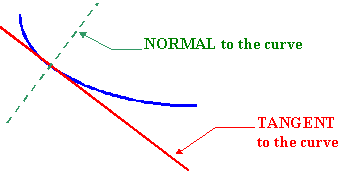
The gradient of the tangent is \( \dfrac{dy}{dx} \).
The gradient of the normal is:
\( -\dfrac{1}{\dfrac{dy}{dx}} \)
Parametric Differentiation
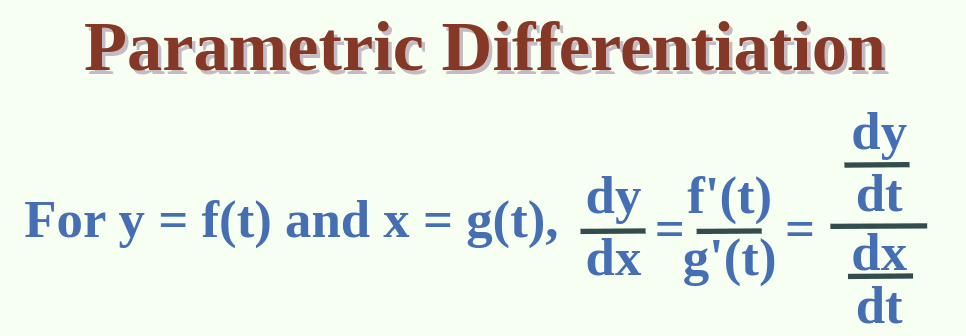
If:
\( x = f(t), \quad y = g(t) \)
then:
\( \dfrac{dy}{dx} = \dfrac{\dfrac{dy}{dt}}{\dfrac{dx}{dt}} \)
Tangent and Normal to a Parametric Curve
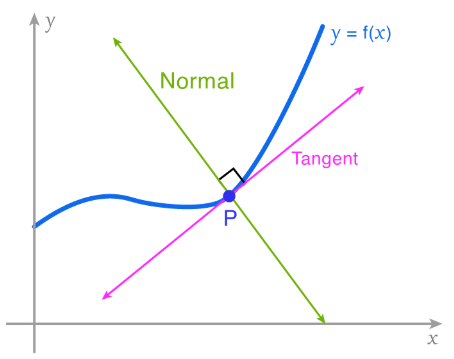
Find \( \dfrac{dy}{dx} \) using:
\( \dfrac{dy}{dx} = \dfrac{\dfrac{dy}{dt}}{\dfrac{dx}{dt}} \)
At the given value of \( t \), find the point and gradient.
The gradient of the normal is:
\( -\dfrac{1}{\dfrac{dy}{dx}} \) At the given value of \( t \).
Example
Find \( \dfrac{dy}{dx} \) if
\( x^2 + xy + y^2 = 7 \)
▶️ Answer / Explanation
Differentiate:
\( 2x + x\dfrac{dy}{dx} + y + 2y\dfrac{dy}{dx} = 0 \)
\( (x + 2y)\dfrac{dy}{dx} = -(2x + y) \)
\( \dfrac{dy}{dx} = -\dfrac{2x+y}{x+2y} \)
Example
The curve is given by:
\( x = t^2+1,\ y = t^3 \)
Find \( \dfrac{dy}{dx} \).
▶️ Answer / Explanation
\( \dfrac{dx}{dt} = 2t \)
\( \dfrac{dy}{dt} = 3t^2 \)
\( \dfrac{dy}{dx} = \dfrac{3t^2}{2t} = \dfrac{3t}{2} \)
Example
The curve is defined by:
\( x = \cos t,\ y = \sin t \)
Find the equations of the tangent and normal when \( t=\dfrac{\pi}{4} \).
▶️ Answer / Explanation
At \( t=\dfrac{\pi}{4} \):
\( x=\dfrac{\sqrt2}{2},\quad y=\dfrac{\sqrt2}{2} \)
\( \dfrac{dx}{dt}=-\sin t,\quad \dfrac{dy}{dt}=\cos t \)
\( \dfrac{dy}{dx}=\dfrac{\cos t}{-\sin t}=-\cot t \)
At \( t=\dfrac{\pi}{4} \), \( m=-1 \)
Tangent:
\( y-\dfrac{\sqrt2}{2}=-1\left(x-\dfrac{\sqrt2}{2}\right) \)
Normal:
\( y-\dfrac{\sqrt2}{2}=1\left(x-\dfrac{\sqrt2}{2}\right) \)