
Formation of Simple Differential Equations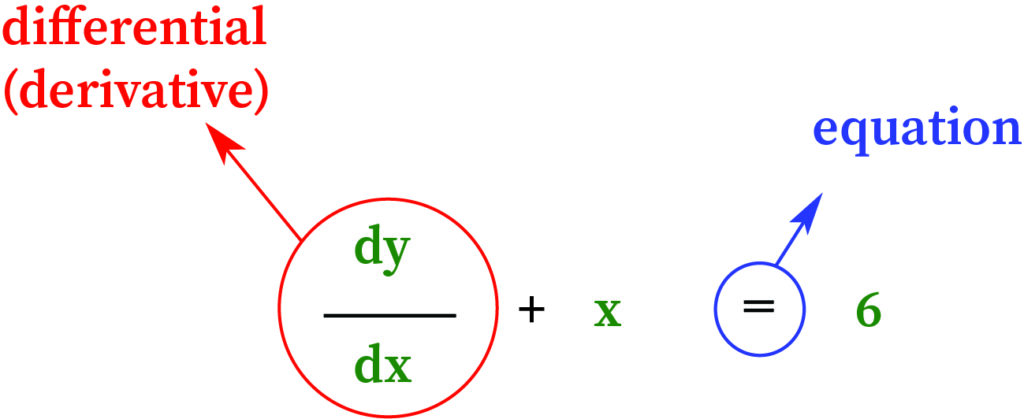
A differential equation is an equation involving a variable and its rate of change.
It is usually written using derivatives such as \( \dfrac{dy}{dx} \) or \( \dfrac{dV}{dt} \).
General Idea
When a quantity depends on another quantity, their rates of change are related.
This relationship is expressed using a differential equation.
Connected Rates of Change
If two or more quantities depend on a common variable such as time \( t \), then their rates are connected.
For example:
\( V = V(r) \), and \( r = r(t) \)
Then:
\( \dfrac{dV}{dt} = \dfrac{dV}{dr}\dfrac{dr}{dt} \)
Steps to Form a Differential Equation
- Define variables clearly
- Write the formula connecting them
- Differentiate with respect to time
- Substitute known rates
- Rearrange to form a differential equation
Example
The radius \( r \) of a circle increases at a constant rate. The area \( A \) is given by \( A=\pi r^2 \). Form a differential equation relating \( \dfrac{dA}{dt} \) and \( \dfrac{dr}{dt} \).
▶️ Answer / Explanation
\( A=\pi r^2 \)
Differentiate with respect to \( t \):
\( \dfrac{dA}{dt} = 2\pi r\dfrac{dr}{dt} \)
Example
The volume of a sphere is \( V=\dfrac{4}{3}\pi r^3 \). If the radius is increasing at \( 0.2 \) cm s\(^{-1}\), find a differential equation for \( \dfrac{dV}{dt} \) in terms of \( r \).
▶️ Answer / Explanation
\( \dfrac{dV}{dt}=\dfrac{d}{dt}\left(\dfrac{4}{3}\pi r^3\right) \)
\( =4\pi r^2\dfrac{dr}{dt} \)
Since \( \dfrac{dr}{dt}=0.2 \):
\( \dfrac{dV}{dt}=0.8\pi r^2 \)
Example
A ladder leans against a wall. The foot of the ladder moves away from the wall at \( 0.5 \) m s\(^{-1}\). The ladder is 10 m long. Form a differential equation connecting the rate at which the top slides down the wall to the motion of the foot.
▶️ Answer / Explanation
Let \( x \) be the distance from the wall and \( y \) the height of the top.
\( x^2+y^2=100 \)
Differentiate:
\( 2x\dfrac{dx}{dt}+2y\dfrac{dy}{dt}=0 \)
So:
\( \dfrac{dy}{dt}=-\dfrac{x}{y}\dfrac{dx}{dt} \)
Since \( \dfrac{dx}{dt}=0.5 \), the differential equation is:
\( \dfrac{dy}{dt}=-\dfrac{0.5x}{y} \)