
Integration by Substitution and Integration by Parts
These two techniques allow us to integrate functions that are not in basic standard form.
Integration by substitution is the reverse of the chain rule, and integration by parts is the reverse of the product rule.
Integration by Substitution
If an integral contains a function and its derivative, a substitution can simplify it.
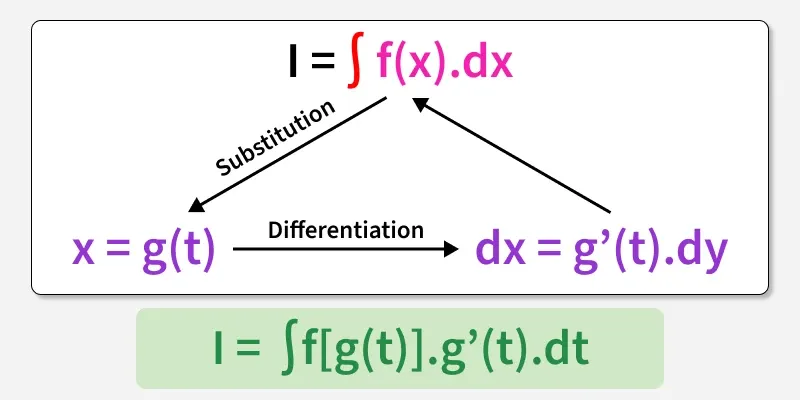
Method:
- Choose a substitution \( u = g(x) \).
- Differentiate to find \( \dfrac{du}{dx} \).
- Rewrite the integral in terms of \( u \).
- Integrate and substitute back.
This method is the reverse of the chain rule.
Example
Evaluate \( \displaystyle\int x\sqrt{x-2}\,dx \).
▶️ Answer / Explanation
Let \( u = x – 2 \), so \( du = dx \) and \( x = u + 2 \).
\( \displaystyle\int x\sqrt{x-2}\,dx = \int (u+2)\sqrt{u}\,du \)
\( = \int (u^{3/2} + 2u^{1/2})\,du \)
\( = \dfrac{2}{5}u^{5/2} + \dfrac{4}{3}u^{3/2} + C \)
Substitute back:
\( \dfrac{2}{5}(x-2)^{5/2} + \dfrac{4}{3}(x-2)^{3/2} + C \)
Integration by Parts
The product rule is:
\( \dfrac{d}{dx}(uv) = u\dfrac{dv}{dx} + v\dfrac{du}{dx} \)
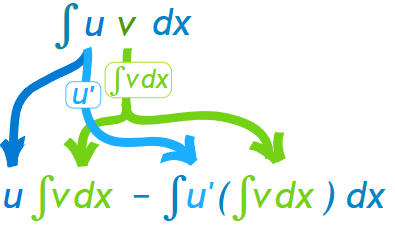
Rearranging gives the integration by parts formula:
\( \displaystyle\int u\,dv = uv – \int v\,du \)
Choosing \( u \) and \( dv \)
Use the LIATE rule:
- Logarithmic
- Inverse trig
- Algebraic
- Trigonometric
- Exponential
Choose \( u \) from the earliest type in this list.
The Integral of \( \ln x \)
\( \ln x \) is integrated using parts.
Let \( u = \ln x \), \( dv = dx \).
Then \( du = \dfrac{1}{x}dx \), \( v = x \).
\( \displaystyle\int \ln x \, dx = x\ln x – \int 1\,dx = x\ln x – x + C \)
Example
Evaluate \( \displaystyle\int x^2 e^x \, dx \).
▶️ Answer / Explanation
Let \( u = x^2 \), \( dv = e^x dx \).
Then \( du = 2x dx \), \( v = e^x \).
\( \int x^2 e^x dx = x^2 e^x – \int 2x e^x dx \)
Apply integration by parts again to \( \int 2x e^x dx \).
Let \( u = 2x \), \( dv = e^x dx \).
\( = x^2 e^x – (2x e^x – \int 2e^x dx) \)
\( = x^2 e^x – 2x e^x + 2e^x + C \)
\( = e^x(x^2 – 2x + 2) + C \)
Example
Evaluate \( \displaystyle\int e^x \sin x \, dx \).
▶️ Answer / Explanation
Let \( u = \sin x \), \( dv = e^x dx \).
\( du = \cos x dx \), \( v = e^x \).
\( I = e^x \sin x – \int e^x \cos x dx \)
Now integrate \( \int e^x \cos x dx \) using parts again.
Let \( u = \cos x \), \( dv = e^x dx \).
\( = e^x \sin x – (e^x \cos x – \int -e^x \sin x dx) \)
\( = e^x \sin x – e^x \cos x – I \)
So:
\( 2I = e^x(\sin x – \cos x) \)
\( I = \dfrac{1}{2} e^x(\sin x – \cos x) + C \)