
First Order Differential Equations with Separable Variables
A first order differential equation contains the first derivative \( \dfrac{dy}{dx} \) only. A differential equation is said to be separable if the variables \( x \) and \( y \) can be rearranged so that all terms involving \( y \) are on one side and all terms involving \( x \) are on the other.
These equations can be solved by separating the variables and integrating both sides.
General Form
A separable differential equation has the form: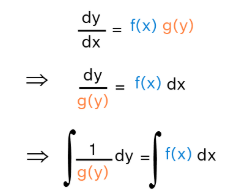
\( \dfrac{dy}{dx} = f(x)g(y) \)
It can be rearranged as:
\( \dfrac{1}{g(y)}\,dy = f(x)\,dx \)
Both sides are then integrated.
General Solution
After integrating both sides, the result contains an arbitrary constant \( C \). This is called the general solution.
\( \int \dfrac{1}{g(y)}\,dy = \int f(x)\,dx + C \)
Particular Solution
If a point \( (x_1, y_1) \) on the curve is given, it is used to find the constant \( C \). The resulting equation is called the particular solution.
Steps for Solving a Separable Differential Equation
| Step | What to Do |
| 1 | Rewrite the equation to separate \( x \) and \( y \). |
| 2 | Integrate both sides. |
| 3 | Add the constant of integration \( C \). |
| 4 | Use given conditions to find \( C \) if required. |
Example
Solve \( \dfrac{dy}{dx} = 3x y \).
▶️ Answer / Explanation
Separate the variables:
\( \dfrac{1}{y}\,dy = 3x\,dx \)
Integrate both sides:
\( \int \dfrac{1}{y}\,dy = \int 3x\,dx \)
\( \ln|y| = \dfrac{3x^2}{2} + C \)
So the general solution is:
\( y = Ae^{\frac{3x^2}{2}} \), where \( A = e^C \).
Example
Solve \( \dfrac{dy}{dx} = \dfrac{x}{y} \), given that \( y = 2 \) when \( x = 1 \).
▶️ Answer / Explanation
Separate the variables:
\( y\,dy = x\,dx \)
Integrate:
\( \int y\,dy = \int x\,dx \)
\( \dfrac{y^2}{2} = \dfrac{x^2}{2} + C \)
Multiply both sides by 2:
\( y^2 = x^2 + C \)
Use the condition \( y = 2 \) when \( x = 1 \):
\( 4 = 1 + C \Rightarrow C = 3 \)
Particular solution:
\( y^2 = x^2 + 3 \)
Example
Solve \( \dfrac{dy}{dx} = y(1 + x) \), given that \( y = 1 \) when \( x = 0 \).
▶️ Answer / Explanation
Separate the variables:
\( \dfrac{1}{y}\,dy = (1 + x)\,dx \)
Integrate:
\( \int \dfrac{1}{y}\,dy = \int (1 + x)\,dx \)
\( \ln|y| = x + \dfrac{x^2}{2} + C \)
So:
\( y = Ae^{x + \frac{x^2}{2}} \)
Use \( y = 1 \) when \( x = 0 \):
\( 1 = A \Rightarrow A = 1 \)
Particular solution:
\( y = e^{x + \frac{x^2}{2}} \)