
Algebraic Addition of Vectors
If:
\( \mathbf{a} = a_1\mathbf{i} + a_2\mathbf{j} \), \( \mathbf{b} = b_1\mathbf{i} + b_2\mathbf{j} \)
then:
\( \mathbf{a} + \mathbf{b} = (a_1+b_1)\mathbf{i} + (a_2+b_2)\mathbf{j} \)
Vector subtraction is:
\( \mathbf{a} – \mathbf{b} = (a_1-b_1)\mathbf{i} + (a_2-b_2)\mathbf{j} \)
Geometrical Interpretation
Triangle Law
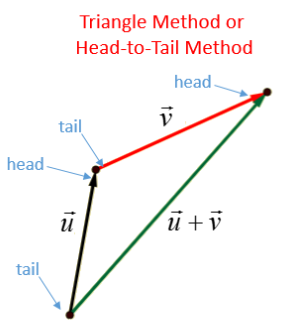
Place the tail of \( \mathbf{b} \) at the head of \( \mathbf{a} \). The vector from the tail of \( \mathbf{a} \) to the head of \( \mathbf{b} \) is \( \mathbf{a}+\mathbf{b} \).
Parallelogram Law
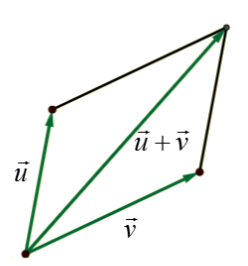
When \( \mathbf{a} \) and \( \mathbf{b} \) start at the same point, their sum is the diagonal of the parallelogram formed.
Scalar Multiplication

If \( k \) is a scalar:
\( k\mathbf{a} = ka_1\mathbf{i} + ka_2\mathbf{j} \)
If \( k>0 \), the direction is unchanged. If \( k<0 \), the direction is reversed.
Example
Given \( \mathbf{a} = 2\mathbf{i} + 3\mathbf{j} \) and \( \mathbf{b} = 4\mathbf{i} – \mathbf{j} \), find \( \mathbf{a}+\mathbf{b} \).
▶️ Answer / Explanation
\( \mathbf{a}+\mathbf{b} = (2+4)\mathbf{i} + (3-1)\mathbf{j} = 6\mathbf{i} + 2\mathbf{j} \)
Example
Find the vector \( \vec{AB} \) if \( A(1,2) \) and \( B(5,7) \).
▶️ Answer / Explanation
\( \vec{AB} = (5-1)\mathbf{i} + (7-2)\mathbf{j} = 4\mathbf{i} + 5\mathbf{j} \)
Example
Find \( 3\mathbf{a}-2\mathbf{b} \) if \( \mathbf{a}= \mathbf{i}+4\mathbf{j} \) and \( \mathbf{b}=2\mathbf{i}-\mathbf{j} \).
▶️ Answer / Explanation
\( 3\mathbf{a} = 3\mathbf{i}+12\mathbf{j} \)
\( 2\mathbf{b} = 4\mathbf{i}-2\mathbf{j} \)
\( 3\mathbf{a}-2\mathbf{b} = -\mathbf{i}+14\mathbf{j} \)
Multiplication of Vectors by Scalars and Their Geometrical Interpretation
Multiplying a vector by a scalar changes its length and possibly its direction.

Algebraic Definition
If:
\( \mathbf{a} = a_1\mathbf{i} + a_2\mathbf{j} \)
and \( k \) is a scalar, then:
\( k\mathbf{a} = ka_1\mathbf{i} + ka_2\mathbf{j} \)
Geometrical Interpretation
- If \( k>1 \), the vector becomes longer in the same direction.
- If \( 0<k<1 \), the vector becomes shorter in the same direction.
- If \( k<0 \), the vector reverses direction.
- If \( k=0 \), the vector becomes the zero vector.
Magnitude Under Scalar Multiplication
If \( \mathbf{a} \) is a vector and \( k \) a scalar:
\( |k\mathbf{a}| = |k|\,|\mathbf{a}| \)
Example
Find \( 3\mathbf{a} \) if \( \mathbf{a} = 2\mathbf{i} – 5\mathbf{j} \).
▶️ Answer / Explanation
\( 3\mathbf{a} = 3(2\mathbf{i}-5\mathbf{j}) = 6\mathbf{i}-15\mathbf{j} \)
Example
Find \( -2\mathbf{b} \) if \( \mathbf{b} = 4\mathbf{i} + \mathbf{j} \).
▶️ Answer / Explanation
\( -2\mathbf{b} = -8\mathbf{i}-2\mathbf{j} \)
The direction is reversed because the scalar is negative.
Example
A vector \( \mathbf{a} \) has magnitude 5. Find the magnitude of \( 0.4\mathbf{a} \).
▶️ Answer / Explanation
\( |0.4\mathbf{a}| = 0.4 \times 5 = 2 \)