
Vector Equations of Lines
A straight line in three dimensions can be written in vector form.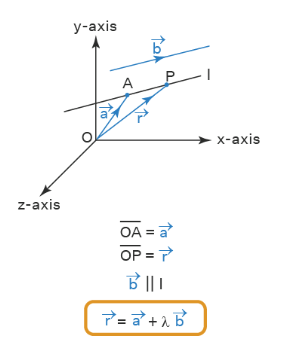
The general vector equation of a line is:
\( \mathbf{r} = \mathbf{a} + t\mathbf{b} \)
where:
- \( \mathbf{a} \) is the position vector of a point on the line
- \( \mathbf{b} \) is a direction vector of the line
- \( t \) is a scalar parameter
- \( \mathbf{r} \) is the position vector of any point on the line
Line Through Two Points
If a line passes through points with position vectors \( \mathbf{c} \) and \( \mathbf{d} \), then: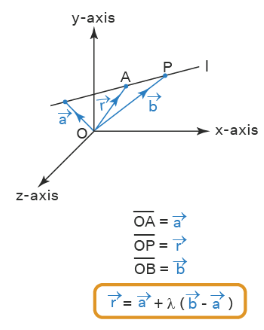
\( \mathbf{r} = \mathbf{c} + t(\mathbf{d} – \mathbf{c}) \)
Here, \( \mathbf{d} – \mathbf{c} \) is the direction vector.
Parallel Lines
Two lines are parallel if their direction vectors are scalar multiples of each other.
\( \mathbf{b}_1 = k\mathbf{b}_2 \)
Intersecting Lines
Two lines intersect if they have a common point.
This occurs when their vector equations give the same \( \mathbf{r} \) for some values of their parameters.
Skew Lines
Two lines are skew if they are not parallel and do not intersect.
Key Points
- Use \( \mathbf{r}=\mathbf{a}+t\mathbf{b} \) for a line.
- Use \( \mathbf{r}=\mathbf{c}+t(\mathbf{d}-\mathbf{c}) \) for two points.
- Parallel lines have proportional direction vectors.
- Intersecting lines share a common solution.
- Skew lines neither intersect nor are parallel.
Example
Find the vector equation of the line through the point \( (1,2,3) \) with direction vector \( 2\mathbf{i}-\mathbf{j}+3\mathbf{k} \).
▶️ Answer / Explanation
\( \mathbf{a} = \mathbf{i}+2\mathbf{j}+3\mathbf{k}, \quad \mathbf{b} = 2\mathbf{i}-\mathbf{j}+3\mathbf{k} \)
\( \mathbf{r} = (\mathbf{i}+2\mathbf{j}+3\mathbf{k}) + t(2\mathbf{i}-\mathbf{j}+3\mathbf{k}) \)
Example
Find the vector equation of the line through \( A(2,-1,1) \) and \( B(4,3,5) \).
▶️ Answer / Explanation
\( \mathbf{c} = 2\mathbf{i}-\mathbf{j}+\mathbf{k}, \quad \mathbf{d} = 4\mathbf{i}+3\mathbf{j}+5\mathbf{k} \)
\( \mathbf{d}-\mathbf{c} = 2\mathbf{i}+4\mathbf{j}+4\mathbf{k} \)
\( \mathbf{r} = (2\mathbf{i}-\mathbf{j}+\mathbf{k}) + t(2\mathbf{i}+4\mathbf{j}+4\mathbf{k}) \)
Example
The lines
\( \mathbf{r} = (1,2,0) + \lambda(2,1,1) \)
\( \mathbf{r} = (3,4,2) + \mu(4,2,2) \)
show that the lines are parallel or find whether they intersect.
▶️ Answer / Explanation
Direction vectors: \( (2,1,1) \) and \( (4,2,2) \)
Since \( (4,2,2)=2(2,1,1) \), the lines are parallel.
Substitute a point from one into the other to test intersection:
\( (3,4,2)-(1,2,0)=(2,2,2) \) is not a multiple of \( (2,1,1) \)
So the lines are parallel and distinct.