
Scalar (Dot) Product
If
\( \mathbf{a} = a_1\mathbf{i} + a_2\mathbf{j} + a_3\mathbf{k} \), \( \mathbf{b} = b_1\mathbf{i} + b_2\mathbf{j} + b_3\mathbf{k} \)
then

Perpendicular Vectors
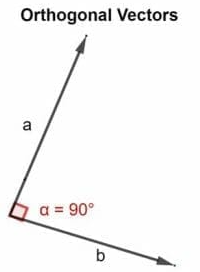
If
\( \mathbf{a}\cdot\mathbf{b} = 0 \)
and neither vector is zero, then the vectors are perpendicular.
Example
Find the dot product of \( \mathbf{a} = 3\mathbf{i} + 2\mathbf{j} \) and \( \mathbf{b} = 5\mathbf{i} – \mathbf{j} \).
▶️ Answer / Explanation
\( \mathbf{a}\cdot\mathbf{b} = 3\times5 + 2\times(-1) = 15 – 2 = 13 \)
Example
Find the value of \( k \) such that the vectors \( (k,2,1) \) and \( (3,-1,2) \) are perpendicular.
▶️ Answer / Explanation
\( (k,2,1)\cdot(3,-1,2)=3k-2+2=3k \)
Since the vectors are perpendicular, \( 3k=0 \Rightarrow k=0 \)
Angle Between Two Vectors
The angle between two vectors measures how they are oriented relative to each other. It is found using the scalar (dot) product.
Formula
If \( \mathbf{a} \) and \( \mathbf{b} \) are two non-zero vectors, and \( \theta \) is the angle between them, then

\( \cos \theta = \dfrac{\mathbf{a}\cdot\mathbf{b}}{|\mathbf{a}|\,|\mathbf{b}|} \)
This formula comes from the definition of the scalar product.
Important Cases
- If \( \mathbf{a}\cdot\mathbf{b} = 0 \), then \( \theta = 90^\circ \) and the vectors are perpendicular.
- If \( \mathbf{a}\cdot\mathbf{b} > 0 \), then \( \theta < 90^\circ \).
- If \( \mathbf{a}\cdot\mathbf{b} < 0 \), then \( \theta > 90^\circ \).
Procedure
- Find the dot product \( \mathbf{a}\cdot\mathbf{b} \).
- Find the magnitudes \( |\mathbf{a}| \) and \( |\mathbf{b}| \).
- Substitute into the cosine formula.
- Use \( \cos^{-1} \) to find \( \theta \).
Example
Find the angle between the vectors \( \mathbf{a} = \mathbf{i} \) and \( \mathbf{b} = \mathbf{j} \).
▶️ Answer / Explanation
\( \mathbf{a}\cdot\mathbf{b} = 0 \)
So \( \cos\theta = 0 \Rightarrow \theta = 90^\circ \)
Example
Find the angle between \( \mathbf{a}=2\mathbf{i}+3\mathbf{j} \) and \( \mathbf{b}=4\mathbf{i}-\mathbf{j} \).
▶️ Answer / Explanation
\( \mathbf{a}\cdot\mathbf{b}=2\times4+3\times(-1)=5 \)
\( |\mathbf{a}|=\sqrt{13},\ |\mathbf{b}|=\sqrt{17} \)
\( \cos\theta=\dfrac{5}{\sqrt{13}\sqrt{17}} \)
Example
Find the acute angle between \( \mathbf{a}=(1,2,2) \) and \( \mathbf{b}=(2,-1,2) \).
▶️ Answer / Explanation
\( \mathbf{a}\cdot\mathbf{b}=2-2+4=4 \)
\( |\mathbf{a}|=3,\ |\mathbf{b}|=3 \)
\( \cos\theta=\dfrac49 \Rightarrow \theta=\cos^{-1}\!\left(\dfrac49\right) \)