
Elementary Probability
Probability is a measure of how likely an event is to occur. It is used to quantify uncertainty and to model random situations in a wide range of contexts.
Basic Probability Concepts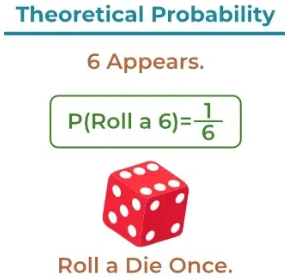
For an experiment with a finite number of equally likely outcomes, the probability of an event \( A \) is defined as
\( P(A) = \dfrac{\text{number of favourable outcomes}}{\text{total number of possible outcomes}} \)
The value of a probability always satisfies

\( 0 \leq P(A) \leq 1 \)
Sample Space and Events
The sample space is the set of all possible outcomes of a random experiment.

An event is any subset of the sample space.
- Certain event: probability 1
- Impossible event: probability 0
Complement of an Event
If \( A \) is an event, its complement, denoted \( A’ \), is the event that \( A \) does not occur.

\( P(A’) = 1 – P(A) \)
Mutually Exclusive Events
Two events are mutually exclusive if they cannot occur at the same time.
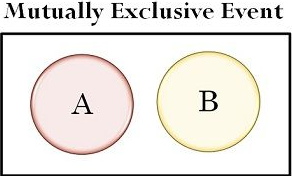
For mutually exclusive events \( A \) and \( B \),
\( P(A \cup B) = P(A) + P(B) \)
Simple Probability Laws
| Law | Statement |
|---|---|
| Total probability | Sum of probabilities of all outcomes is 1 |
| Complement rule | \( P(A’) = 1 – P(A) \) |
| Mutually exclusive rule | \( P(A \cup B) = P(A) + P(B) \) |
Example :
A fair six-sided die is rolled. Find the probability that the number obtained is greater than 4.
▶️ Answer/Explanation
Possible outcomes are \( \{1,2,3,4,5,6\} \).
Numbers greater than 4 are 5 and 6.
\( P = \dfrac{2}{6} = \dfrac{1}{3} \)
Conclusion: The probability is \( \dfrac{1}{3} \).
Example :
The probability that it rains on a given day is 0.35. Find the probability that it does not rain on that day.
▶️ Answer/Explanation
Let \( R \) be the event that it rains.
\( P(R’) = 1 – P(R) = 1 – 0.35 = 0.65 \)
Conclusion: The probability that it does not rain is 0.65.
Example :
In a class, the probability that a randomly chosen student studies Physics is 0.4 and the probability that a student studies Chemistry is 0.5. Given that no student studies both subjects, find the probability that a student studies either Physics or Chemistry.
▶️ Answer/Explanation
The events are mutually exclusive.
\( P(P \cup C) = P(P) + P(C) = 0.4 + 0.5 = 0.9 \)
Conclusion: The required probability is 0.9.