
Sample Space
The sample space is the set of all possible outcomes of a random experiment. It is usually denoted by \( S \). Every possible event is a subset of the sample space.
Listing a Sample Space
For experiments with a small number of outcomes, the sample space can be written by listing all outcomes explicitly.
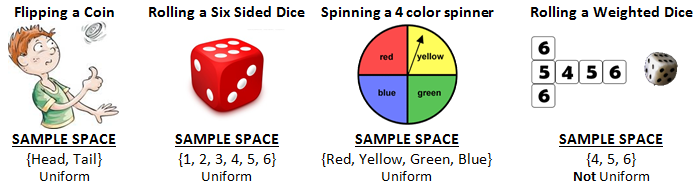
Example: Tossing a coin once
\( S = \{H, T\} \)
Example: Rolling a fair six-sided die
\( S = \{1,2,3,4,5,6\} \)
Sample Space Using Tables or Diagrams
When an experiment has two or more stages, the sample space can be represented using tables, tree diagrams, or systematic listings.
Example: Tossing two coins
\( S = \{HH, HT, TH, TT\} \)
Events
An event is any subset of the sample space.
Certain event: the whole sample space
Impossible event: the empty set
Probability Using the Sample Space
If all outcomes in the sample space are equally likely, the probability of an event \( A \) is
\( P(A) = \dfrac{\text{number of outcomes in } A}{\text{number of outcomes in } S} \)
Example :
A fair die is rolled once. Write down the sample space.
▶️ Answer/Explanation
\( S = \{1,2,3,4,5,6\} \)
Conclusion: The sample space contains six equally likely outcomes.
Example :
Two coins are tossed. List the sample space and find the probability of obtaining exactly one head.
▶️ Answer/Explanation
\( S = \{HH, HT, TH, TT\} \)
Exactly one head occurs in \( HT \) and \( TH \).
\( P = \dfrac{2}{4} = \dfrac{1}{2} \)
Conclusion: The probability is \( \dfrac{1}{2} \).
Example :
A card is drawn at random from a standard pack of 52 cards. State the sample space and explain why all outcomes are equally likely.
▶️ Answer/Explanation
The sample space consists of all 52 distinct cards.
Each card has an equal chance of being drawn.
Conclusion: The assumption of equally likely outcomes is valid.
Exclusive and Complementary Events
Events can be related to each other in different ways. Two important types of relationships between events are mutual exclusivity and complementarity. Understanding these ideas is essential for applying probability laws correctly.
Mutually Exclusive Events
Two events \( A \) and \( B \) are said to be mutually exclusive if they cannot occur at the same time.
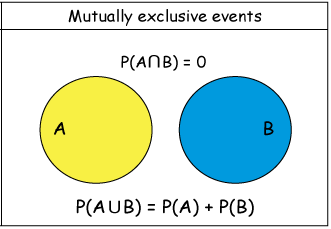
In this case, the intersection of the two events is empty:
\( A \cap B = \varnothing \)
For mutually exclusive events, the probability of \( A \) or \( B \) occurring is
\( P(A \cup B) = P(A) + P(B) \)
This formula applies only when the events are mutually exclusive.
Complementary Events
If \( A \) is an event, its complement, denoted \( A’ \), is the event that \( A \) does not occur.

The event \( A \) and its complement \( A’ \) are always mutually exclusive and together make up the entire sample space.
- \( A \cup A’ = S \)
- \( A \cap A’ = \varnothing \)
The probability of the complement of an event is given by
\( P(A’) = 1 – P(A) \)
Key Differences
| Feature | Mutually Exclusive Events | Complementary Events |
|---|---|---|
| Can occur together | No | No |
| Number of events involved | Two or more distinct events | Exactly two: \( A \) and \( A’ \) |
| Cover entire sample space | Not necessarily | Always |
Example :
A card is drawn at random from a standard pack of 52 cards. Let \( A \) be the event that the card is a heart and \( B \) the event that the card is a spade. State whether \( A \) and \( B \) are mutually exclusive.
▶️ Answer/Explanation
A card cannot be both a heart and a spade at the same time.
Conclusion: Events \( A \) and \( B \) are mutually exclusive.
Example :
The probability that a student passes an exam is 0.72. Find the probability that the student does not pass the exam.
▶️ Answer/Explanation
Let \( P \) be the event that the student passes.
\( P(P’) = 1 – 0.72 = 0.28 \)
Conclusion: The probability that the student does not pass is 0.28.
Example :
Events \( A \) and \( B \) are mutually exclusive with \( P(A) = 0.3 \) and \( P(B) = 0.45 \). Find \( P(A \cup B) \).
▶️ Answer/Explanation
Since the events are mutually exclusive,
\( P(A \cup B) = P(A) + P(B) \)
\( = 0.3 + 0.45 = 0.75 \)
Conclusion: The required probability is 0.75.
Conditional Probability
Conditional probability deals with situations where the probability of an event depends on the fact that another event has already occurred.
Definition of Conditional Probability
The conditional probability of an event \( B \), given that event \( A \) has occurred, is denoted by \( P(B \mid A) \) and is defined as
\( P(B \mid A) = \dfrac{P(A \cap B)}{P(A)} \), provided \( P(A) \neq 0 \)
This formula restricts the sample space to outcomes where \( A \) has occurred.
Intersection in Terms of Conditional Probability
Rearranging the definition gives an important result:
\( P(A \cap B) = P(A)\,P(B \mid A) \)
Similarly,
\( P(A \cap B) = P(B)\,P(A \mid B) \)
These results are central to solving conditional probability problems.
Independent Events
Two events \( A \) and \( B \) are independent if the occurrence of one does not affect the probability of the other.
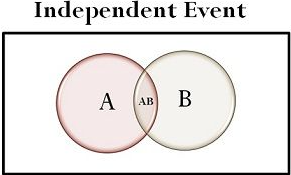
For independent events:
\( P(B \mid A) = P(B) \)
and hence
\( P(A \cap B) = P(A)P(B) \)
Common Mistakes
- Do not assume events are independent unless stated or clearly implied
- Always check which event has already occurred in conditional probabilities
Example :
A card is drawn at random from a standard pack of 52 cards. Find the probability that the card is a king, given that it is a face card.
▶️ Answer/Explanation
Let \( A \) be the event that the card is a king and \( B \) the event that the card is a face card.
There are 12 face cards and 4 kings.
\( P(A \mid B) = \dfrac{4}{12} = \dfrac{1}{3} \)
Conclusion: The probability is \( \dfrac{1}{3} \).
Example :
The probability that a student studies Mathematics is 0.6. The probability that a student studies Physics given that they study Mathematics is 0.5. Find the probability that a student studies both Mathematics and Physics.
▶️ Answer/Explanation
Using
\( P(A \cap B) = P(A)\,P(B \mid A) \)
\( P = 0.6 \times 0.5 = 0.3 \)
Conclusion: The probability is 0.3.
Example :
Two events \( A \) and \( B \) satisfy \( P(A) = 0.4 \), \( P(B) = 0.7 \), and \( P(B \mid A) = 0.5 \). Determine whether \( A \) and \( B \) are independent.
▶️ Answer/Explanation
If the events were independent, then
\( P(B \mid A) = P(B) = 0.7 \)
But given \( P(B \mid A) = 0.5 \).
Conclusion: The events are not independent.