
Sum and Product Laws of Probability
The sum law and product law are fundamental rules used to calculate probabilities involving more than one event. These laws are often applied using Venn diagrams and tree diagrams, especially in problems involving sampling.
Sum Law of Probability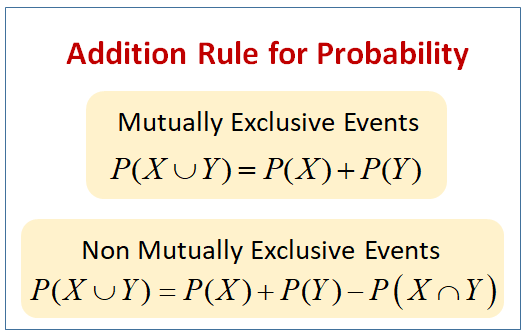
For any two events \( A \) and \( B \), the probability that at least one of them occurs is given by
\( P(A \cup B) = P(A) + P(B) – P(A \cap B) \)
If \( A \) and \( B \) are mutually exclusive, then \( P(A \cap B) = 0 \) and the formula simplifies to
\( P(A \cup B) = P(A) + P(B) \)
Product Law of Probability
The probability that both events \( A \) and \( B \) occur is given by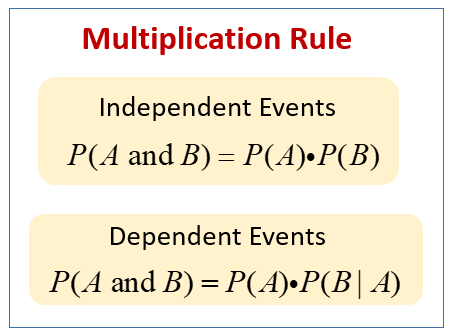
\( P(A \cap B) = P(A)\,P(B \mid A) \)
If \( A \) and \( B \) are independent, this becomes
\( P(A \cap B) = P(A)\,P(B) \)
Venn Diagrams
A Venn diagram is used to represent events and their relationships visually.
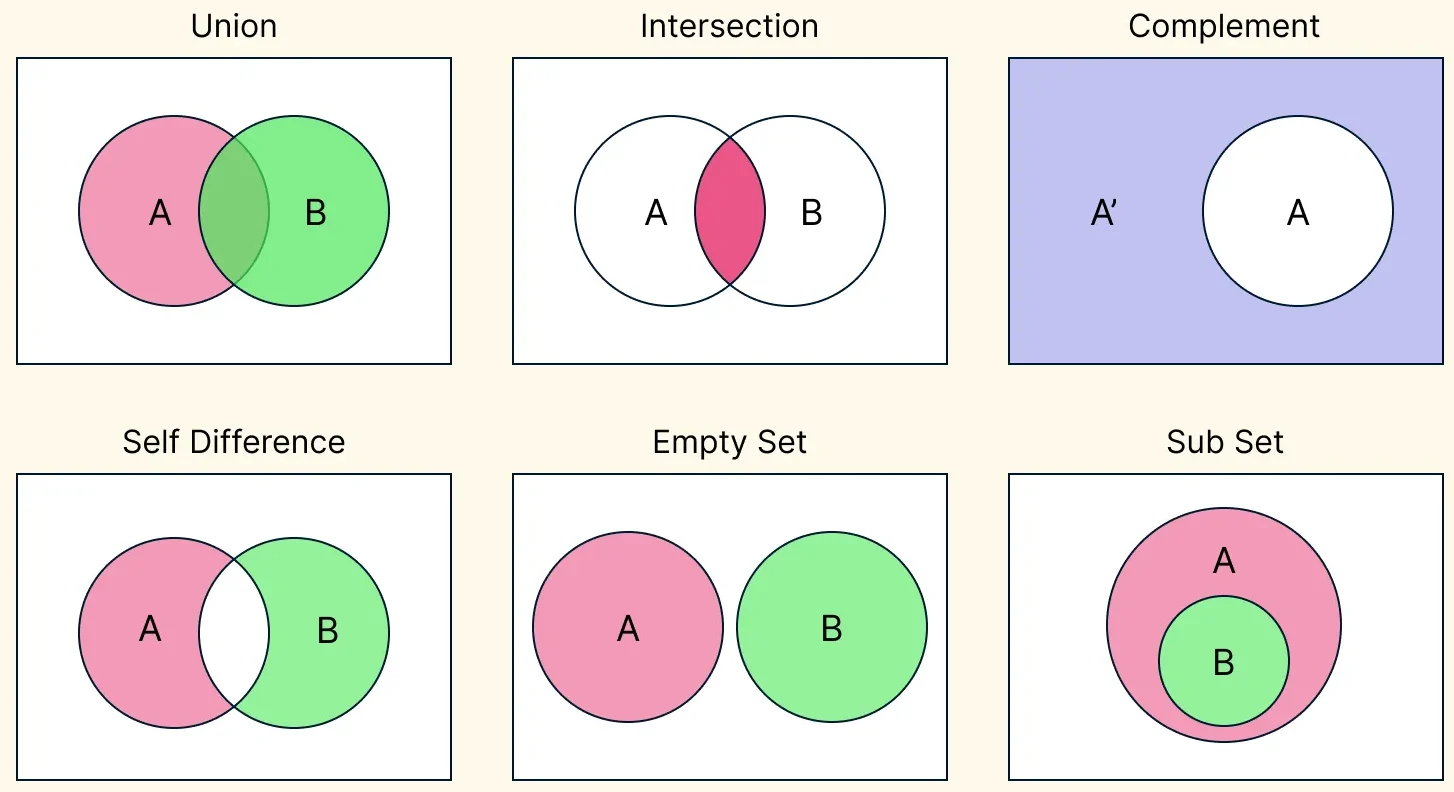
- P(A): Probability of event A occurring

- P(B): Probability of event B occurring
- P(A ∩ B): Probability of A and B both occurring (intersection)
- P(A ∪ B): Probability of A or B or both occurring (union)
- P(A’): Probability of A not occurring (complement)
- P(A’ ∩ B’) is neither A nor B so the outside
- P(A ∩ B’): is A and not B so all of A not containing B

They are particularly useful for:
- Applying the sum law
- Identifying intersections and complements
Tree Diagrams
A tree diagram is a graphical method used to represent a sequence of events and their associated probabilities. It is particularly useful for problems involving conditional probability and sampling with or without replacement.
Structure of a Tree Diagram
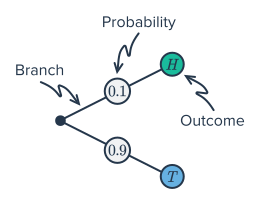
A tree diagram consists of:
- Branches representing possible outcomes at each stage
- Probabilities written on each branch
Each complete path through the diagram represents a sequence of outcomes.
Using a Tree Diagram
To use a tree diagram:
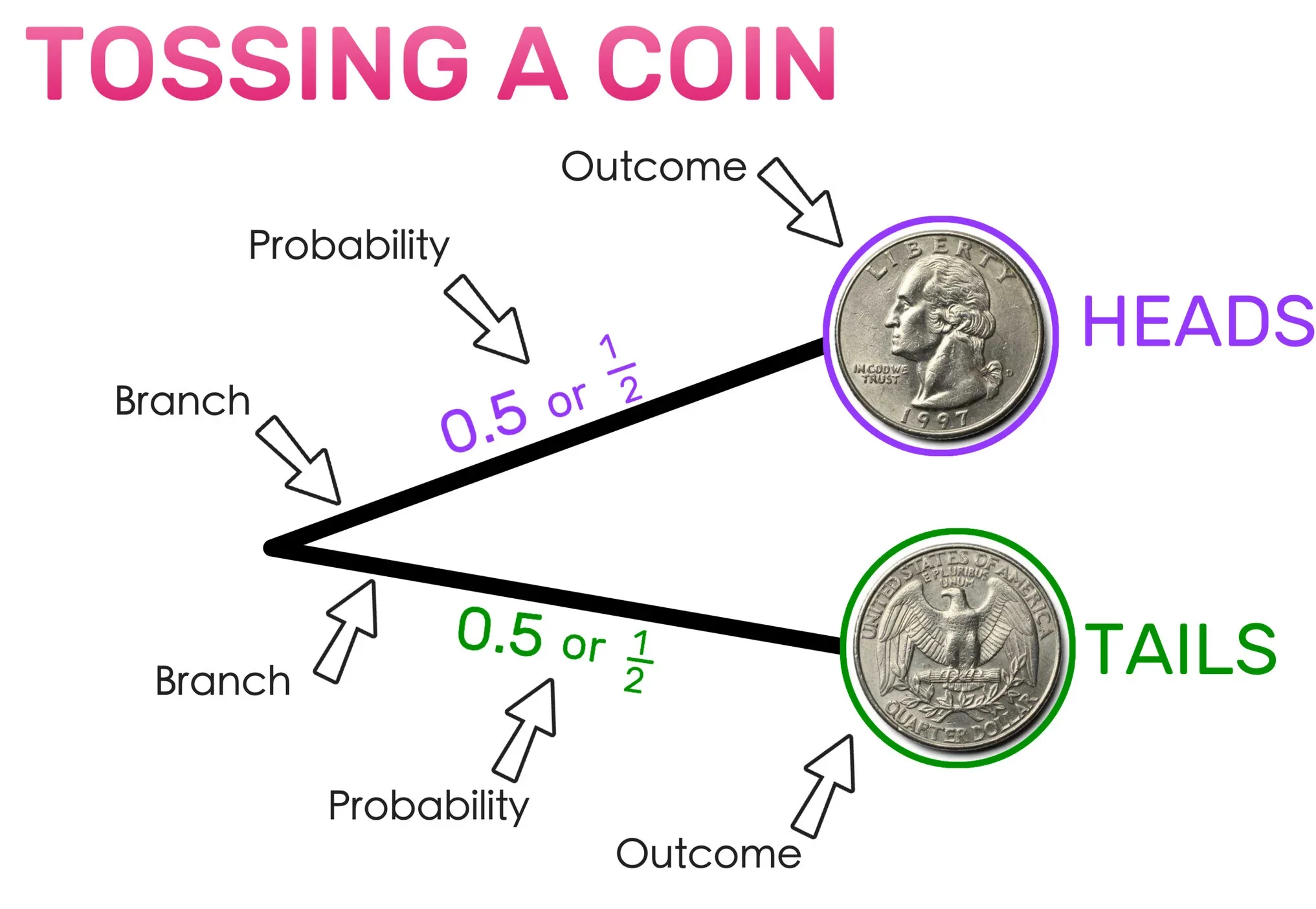
- Multiply probabilities along a single path to find the probability of that outcome
- Add probabilities of different paths to find the probability of an event involving several outcomes
Sampling With and Without Replacement
With replacement:
- The item is returned before the next selection
- Probabilities remain the same
- Events are independent
Without replacement:
- The item is not returned
- Probabilities change
- Events are dependent
Example :
Events \( A \) and \( B \) satisfy \( P(A) = 0.5 \), \( P(B) = 0.4 \), and \( P(A \cap B) = 0.2 \). Find \( P(A \cup B) \).
▶️ Answer/Explanation
\( P(A \cup B) = 0.5 + 0.4 – 0.2 = 0.7 \)
Conclusion: The probability is 0.7.
Example :
A bag contains 3 red and 2 blue balls. Two balls are drawn without replacement. Find the probability that both balls are red.
▶️ Answer/Explanation
Using a tree diagram or the product law:
\( P = \dfrac{3}{5} \times \dfrac{2}{4} = \dfrac{3}{10} \)
Conclusion: The probability is \( \dfrac{3}{10} \).
Example :
A fair coin is tossed twice. Find the probability of obtaining at least one head.
▶️ Answer/Explanation
Let \( H \) be the event of a head on a toss.
Use the complement:
\( P(\text{at least one head}) = 1 – P(\text{no heads}) \)
\( = 1 – \dfrac{1}{4} = \dfrac{3}{4} \)
Conclusion: The probability is \( \dfrac{3}{4} \).
Example :
A fair coin is tossed twice. Use a tree diagram to find the probability of obtaining exactly one head.
▶️ Answer/Explanation
Each toss has probability \( \dfrac{1}{2} \) of heads or tails.
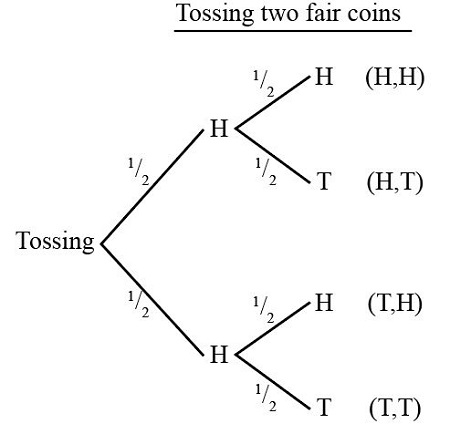
Possible paths with exactly one head are:
HT and TH
\( P(HT) = \dfrac{1}{2} \times \dfrac{1}{2} = \dfrac{1}{4} \)
\( P(TH) = \dfrac{1}{4} \)
Conclusion: \( P(\text{exactly one head}) = \dfrac{1}{4} + \dfrac{1}{4} = \dfrac{1}{2} \).
Example :
A bag contains 4 red balls and 1 blue ball. Two balls are drawn without replacement. Find the probability that both balls are red.
▶️ Answer/Explanation
First draw:
\( P(R) = \dfrac{4}{5} \)
Second draw, given a red has already been drawn:
\( P(R \mid R) = \dfrac{3}{4} \)
\( P(RR) = \dfrac{4}{5} \times \dfrac{3}{4} = \dfrac{3}{5} \)
Conclusion: The probability is \( \dfrac{3}{5} \).