
Discrete Random Variables
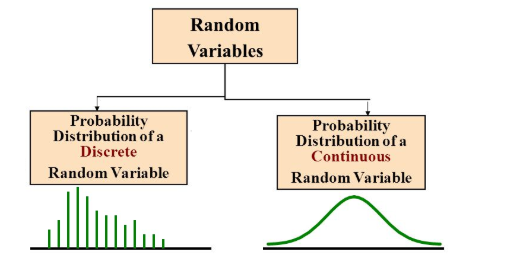
A random variable is a variable whose value depends on the outcome of a random experiment. A discrete random variable is one that can take only a finite or countably infinite set of distinct values.
Definition
A discrete random variable, usually denoted by \( X \), assigns a numerical value to each outcome in a sample space.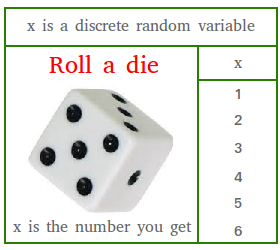
Typical examples include:
- The number of heads obtained when tossing coins
- The number shown on a rolled die
- The number of defective items in a batch
Probability Distribution
The probability distribution of a discrete random variable lists all possible values of the variable and their corresponding probabilities.
For a discrete random variable \( X \):
\( P(X = x) \geq 0 \) for all values of \( x \)
\( \sum P(X = x) = 1 \)
Probabilities may be given:
- In a table
- By a formula
Interpretation
When working with discrete random variables, students are expected to:
- Identify the random variable clearly
- State the possible values it can take
- Assign probabilities correctly
Example :
A fair six-sided die is rolled once. Define a suitable discrete random variable and state its possible values.
▶️ Answer/Explanation
Let \( X \) be the number shown on the die.
Possible values: \( 1, 2, 3, 4, 5, 6 \)
Conclusion: \( X \) is a discrete random variable with six possible values.
Example :
Two coins are tossed. Let \( X \) be the number of heads obtained. List the possible values of \( X \).
▶️ Answer/Explanation
Possible outcomes are \( HH, HT, TH, TT \).
Corresponding values of \( X \) are:
0, 1, 2
Conclusion: \( X \) takes the values 0, 1, and 2.
Example :
Explain why the time taken for a car to travel a fixed distance is not a discrete random variable.
▶️ Answer/Explanation
Time can take any value within an interval.
Conclusion: The variable is continuous, not discrete.