
Probability Function and Cumulative Distribution Function
For a discrete random variable \( X \), probabilities are described using a probability function and a cumulative distribution function. These functions allow probabilities of individual values and ranges of values to be calculated.
Probability Function
The probability function of a discrete random variable \( X \) is defined by
\( p(x) = P(X = x) \)
The probability function must satisfy:
\( p(x) \geq 0 \) for all possible values of \( x \)
\( \sum p(x) = 1 \)
Probabilities may be given in a table or by a formula.
Cumulative Distribution Function
The cumulative distribution function (cdf) of \( X \) is defined by
\( F(x_0) = P(X \leq x_0) = \sum_{x \leq x_0} p(x) \)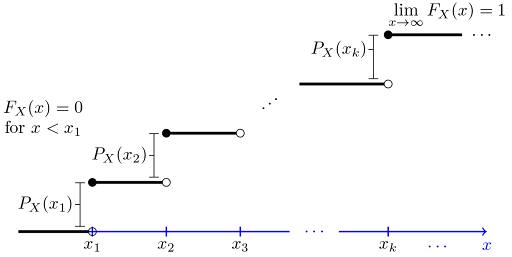
The cumulative distribution function:
- Is non-decreasing
- Satisfies \( 0 \leq F(x) \leq 1 \)
- Increases in steps for a discrete random variable
Using \( p(x) \) and \( F(x) \)
Once \( p(x) \) is known, probabilities such as
- \( P(X = a) \)
- \( P(X \leq b) \)
- \( P(a < X \leq b) \)
can be found using either the probability function or the cumulative distribution function.
Example :
A discrete random variable \( X \) has the probability function shown below:
\( p(x) = \dfrac{x}{10}, \quad x = 1, 2, 3, 4 \)
Find \( P(X = 3) \).
▶️ Answer/Explanation
\( P(X = 3) = p(3) = \dfrac{3}{10} \)
Conclusion: \( P(X = 3) = \dfrac{3}{10} \).
Example :
Using the probability function from Example 1, find \( P(X \leq 2) \).
▶️ Answer/Explanation
Using the cumulative distribution function:
\( F(2) = p(1) + p(2) = \dfrac{1}{10} + \dfrac{2}{10} = \dfrac{3}{10} \)
Conclusion: \( P(X \leq 2) = \dfrac{3}{10} \).
Example :
A discrete random variable \( X \) has cumulative distribution function
\( F(1) = 0.2,\; F(2) = 0.5,\; F(3) = 1 \)
Find \( P(X = 2) \).
▶️ Answer/Explanation
For a discrete random variable:
\( P(X = 2) = F(2) – F(1) \)
\( = 0.5 – 0.2 = 0.3 \)
Conclusion: \( P(X = 2) = 0.3 \).