
Mean (Expectation) of a Discrete Random Variable
The mean of a discrete random variable, also called the expected value, represents the long-term average value of the variable if the random experiment is repeated many times.
Definition of the Mean
If \( X \) is a discrete random variable with probability function \( p(x) = P(X = x) \), then the mean (or expectation) of \( X \) is defined as

The summation is taken over all possible values of \( x \).
Interpretation
The mean:
- Is not necessarily a value that the random variable can actually take
- Represents a weighted average of the possible values
- Depends on both the values of \( X \) and their probabilities
Key Property of Expectation
For constants \( a \) and \( b \),
\( E(aX + b) = aE(X) + b \)
This result can be used directly without proof.
Example :
A discrete random variable \( X \) has the probability distribution:
\( X : 0,\;1,\;2 \)
\( p(x) : 0.2,\;0.5,\;0.3 \)
Find \( E(X) \).
▶️ Answer/Explanation
\( E(X) = (0)(0.2) + (1)(0.5) + (2)(0.3) \)
\( = 0 + 0.5 + 0.6 = 1.1 \)
Conclusion: The mean of \( X \) is 1.1.
Example :
A fair six-sided die is rolled once. Let \( X \) be the number shown. Find \( E(X) \).
▶️ Answer/Explanation
Each outcome has probability \( \dfrac{1}{6} \).
\( E(X) = \dfrac{1}{6}(1 + 2 + 3 + 4 + 5 + 6) \)
\( = \dfrac{21}{6} = 3.5 \)
Conclusion: The expected value is 3.5.
Example :
A discrete random variable \( X \) has mean \( E(X) = 4 \). Find the mean of the random variable \( Y = 3X – 2 \).
▶️ Answer/Explanation
Using the property of expectation:
\( E(Y) = E(3X – 2) = 3E(X) – 2 \)
\( = 3(4) – 2 = 10 \)
Conclusion: The mean of \( Y \) is 10.
Variance of a Discrete Random Variable
The variance of a discrete random variable measures how spread out the values of the variable are about the mean. It gives an indication of the variability in the outcomes.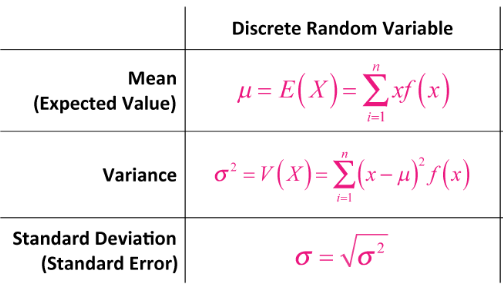
Definition of Variance
If \( X \) is a discrete random variable with mean \( E(X) \), then the variance of \( X \) is defined as
\( \mathrm{Var}(X) = E\!\left[(X – E(X))^2\right] \)
In practice, variance is usually calculated using the equivalent and more convenient formula
\( \mathrm{Var}(X) = E(X^2) – [E(X)]^2 \)
Calculating \( E(X^2) \)
For a discrete random variable with probability function \( p(x) \),
\( E(X^2) = \sum x^2 p(x) \)
This value is then substituted into the variance formula.
Properties of Variance
For constants \( a \) and \( b \),
\( \mathrm{Var}(aX + b) = a^2 \mathrm{Var}(X) \)
Adding or subtracting a constant does not change the variance, but multiplying by a constant changes the variance by the square of that constant.
Interpretation
- A larger variance indicates greater spread about the mean
- A variance of zero means the random variable always takes the same value
Example :
A discrete random variable \( X \) has the probability distribution:
\( X : 0,\;1,\;2 \)
\( p(x) : 0.2,\;0.5,\;0.3 \)
Find \( \mathrm{Var}(X) \).
▶️ Answer/Explanation
From earlier,
\( E(X) = 1.1 \)
Now calculate \( E(X^2) \):
\( E(X^2) = (0^2)(0.2) + (1^2)(0.5) + (2^2)(0.3) \)
\( = 0 + 0.5 + 1.2 = 1.7 \)
Hence
\( \mathrm{Var}(X) = 1.7 – (1.1)^2 = 0.49 \)
Conclusion: The variance of \( X \) is 0.49.
Example :
A fair six-sided die is rolled once. Let \( X \) be the number shown. Find \( \mathrm{Var}(X) \).
▶️ Answer/Explanation
From earlier,
\( E(X) = 3.5 \)
Calculate \( E(X^2) \):
\( E(X^2) = \dfrac{1}{6}(1^2 + 2^2 + 3^2 + 4^2 + 5^2 + 6^2) \)
\( = \dfrac{91}{6} \)
Hence
\( \mathrm{Var}(X) = \dfrac{91}{6} – (3.5)^2 = \dfrac{35}{12} \)
Conclusion: The variance is \( \dfrac{35}{12} \).
Example :
A discrete random variable \( X \) has variance \( \mathrm{Var}(X) = 5 \). Find the variance of the random variable \( Y = 4X – 3 \).
▶️ Answer/Explanation
Using the variance property:
\( \mathrm{Var}(Y) = \mathrm{Var}(4X – 3) = 4^2 \mathrm{Var}(X) \)
\( = 16 \times 5 = 80 \)
Conclusion: The variance of \( Y \) is 80.