
Poisson Approximation to the Binomial Distribution
In some situations, a binomial distribution can be approximated by a Poisson distribution. This approximation is useful when calculating binomial probabilities directly is difficult.
When the Approximation Is Appropriate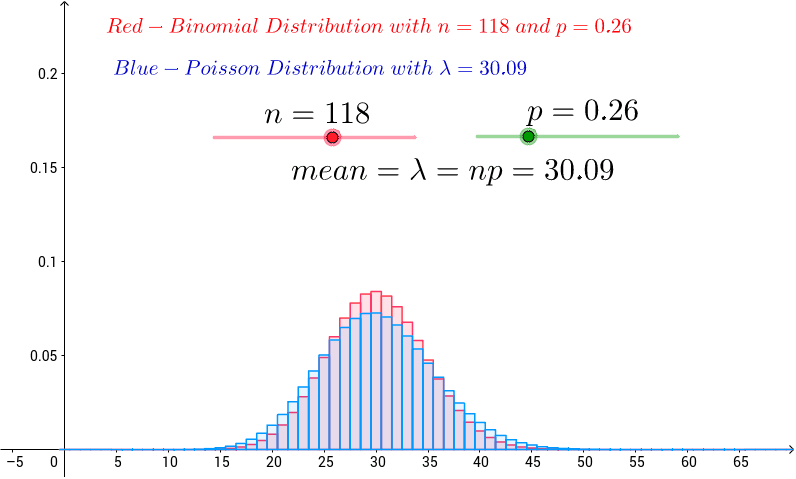
A binomial distribution \( X \sim \mathrm{Bin}(n,p) \) may be approximated by a Poisson distribution if:
- \( n \) is large
- \( p \) is small
- The product \( np \) is of moderate size
A commonly used guideline is:
\( n \geq 50 \) and \( p \leq 0.1 \)
These conditions are not strict rules, but they help decide whether the approximation is reasonable.
The Approximation
If
\( X \sim \mathrm{Bin}(n,p) \)
and the conditions above are satisfied, then \( X \) may be approximated by
\( X \approx \mathrm{Po}(\lambda) \quad \text{where } \lambda = np \)
The mean of both distributions is the same:
Mean \( = np \)
However, the variances differ slightly:
- Binomial variance: \( np(1-p) \)
- Poisson variance: \( np \)
When \( p \) is small, \( 1-p \approx 1 \), so the variances are close.
Using the Approximation in Practice
To use the Poisson approximation:
- Identify the binomial model and check suitability
- Calculate \( \lambda = np \)
- Replace the binomial distribution with \( \mathrm{Po}(np) \)
- Use Poisson probabilities or tables to calculate required values
Critical Commentary
When using this approximation, students should comment on:
- Whether \( n \) is sufficiently large
- Whether \( p \) is sufficiently small
- Why the Poisson model simplifies calculations
If these conditions are not met, the approximation may be inaccurate.
Example :
A machine produces components, each of which has a probability of 0.02 of being defective. A batch of 100 components is produced.
Find the probability that exactly 3 components are defective, using a Poisson approximation.
▶️ Answer/Explanation
Here \( n = 100 \) and \( p = 0.02 \).
\( np = 100 \times 0.02 = 2 \)
Since \( n \) is large and \( p \) is small, the Poisson approximation is appropriate.
Let \( X \sim \mathrm{Po}(2) \).
\( \mathrm{P}(X = 3) = \dfrac{e^{-2}2^3}{3!} = 0.1804 \)
Conclusion: The required probability is approximately 0.180.
Example :
A survey shows that 0.5% of emails received by a company are spam. On a particular day, 200 emails are received.
Find the probability that at most one spam email is received, using a suitable approximation.
▶️ Answer/Explanation
Here \( n = 200 \) and \( p = 0.005 \).
\( np = 200 \times 0.005 = 1 \)
The Poisson approximation is appropriate.
Let \( X \sim \mathrm{Po}(1) \).
\( \mathrm{P}(X \leq 1) = \mathrm{P}(X=0) + \mathrm{P}(X=1) \)
\( = e^{-1}(1 + 1) = 0.7358 \)
Conclusion: The probability is approximately 0.736.
Example :
A factory finds that 1% of light bulbs produced are faulty. A box contains 500 bulbs.
Estimate the probability that more than 5 bulbs in the box are faulty. Comment on the suitability of the approximation.
▶️ Answer/Explanation
Here \( n = 500 \) and \( p = 0.01 \).
\( np = 500 \times 0.01 = 5 \)
The Poisson approximation is appropriate since \( n \) is large and \( p \) is small.
Let \( X \sim \mathrm{Po}(5) \).
We require
\( \mathrm{P}(X > 5) = 1 – \mathrm{P}(X \leq 5) \)
\( \mathrm{P}(X \leq 5) = 0.6159 \) (from Poisson tables)
\( \mathrm{P}(X > 5) = 1 – 0.6159 = 0.3841 \)
Comment: The approximation is suitable because the number of trials is large and the probability of a fault is small.
Conclusion: The required probability is approximately 0.384.