
The Probability Density Function and the Cumulative Distribution Function
For a continuous random variable, probabilities are described using a probability density function (pdf) and a cumulative distribution function (cdf).
Probability Density Function (pdf)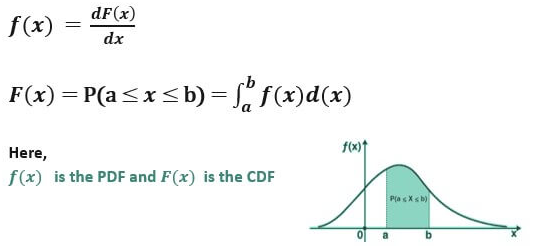
A probability density function, denoted by \( f(x) \), satisfies the following conditions:
\( f(x) \geq 0 \) for all \( x \)
The total area under the graph of \( f(x) \) is 1
\( \displaystyle \int_{-\infty}^{\infty} f(x)\,\mathrm{d}x = 1 \)
The function \( f(x) \) itself does not give probabilities. Probabilities are obtained by finding areas under the curve.
Using the Probability Density Function
For a continuous random variable \( X \) with pdf \( f(x) \), the probability that \( X \) lies in an interval is given by
\( \mathrm{P}(a < X \leq b) = \displaystyle \int_{a}^{b} f(x)\,\mathrm{d}x \)
Since \( \mathrm{P}(X=a)=0 \), the probabilities
- \( \mathrm{P}(a < X \leq b) \)
- \( \mathrm{P}(a \leq X < b) \)
- \( \mathrm{P}(a \leq X \leq b) \)
are all equal.
Cumulative Distribution Function (cdf) 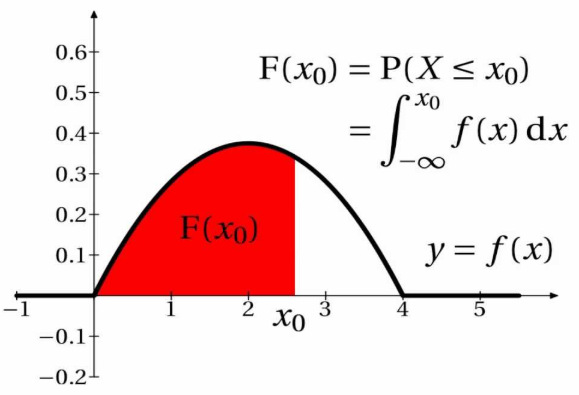
The cumulative distribution function of a continuous random variable \( X \) is defined by
\( \mathrm{F}(x_0) = \mathrm{P}(X \leq x_0) = \displaystyle \int_{-\infty}^{x_0} f(x)\,\mathrm{d}x \)
The cdf gives the probability that the random variable takes a value less than or equal to a given number.
Relationship Between pdf and cdf
For a continuous random variable:
- The cdf is obtained by integrating the pdf
- The pdf is the derivative of the cdf, where it exists
- \( \mathrm{f}(x) = \dfrac{\mathrm{d}}{\mathrm{d}x}\,\mathrm{F}(x) \)
Form of the Probability Density Function
In this syllabus, probability density functions will be restricted to:
- Simple polynomial functions
- Piecewise-defined functions
These forms allow probabilities and cumulative distribution functions to be found using straightforward integration.
Example :
A continuous random variable \( X \) has probability density function
\( f(x) = 3x^2,\; 0 \leq x \leq 1 \)
Find \( \mathrm{P}(0.2 < X \leq 0.5) \).
▶️ Answer/Explanation
\( \mathrm{P}(0.2 < X \leq 0.5) = \displaystyle \int_{0.2}^{0.5} 3x^2\,\mathrm{d}x \)
\( = \left[ x^3 \right]_{0.2}^{0.5} = 0.125 – 0.008 = 0.117 \)
Conclusion: The required probability is 0.117.
Example :
A continuous random variable \( X \) has probability density function
\( f(x) = kx,\; 0 \leq x \leq 2 \)
Find the value of \( k \) and hence determine the cumulative distribution function \( \mathrm{F}(x) \) for \( 0 \leq x \leq 2 \).
▶️ Answer/Explanation
Since the total area is 1:
\( \displaystyle \int_{0}^{2} kx\,\mathrm{d}x = 1 \)
\( k\left[\dfrac{x^2}{2}\right]_{0}^{2} = 1 \Rightarrow 2k = 1 \Rightarrow k = \dfrac{1}{2} \)
Now find the cdf:
\( \mathrm{F}(x) = \displaystyle \int_{0}^{x} \dfrac{1}{2}t\,\mathrm{d}t = \dfrac{x^2}{4},\; 0 \leq x \leq 2 \)
Conclusion: \( k = \dfrac{1}{2} \) and \( \mathrm{F}(x) = \dfrac{x^2}{4} \).
Example :
A continuous random variable \( X \) has cumulative distribution function
\( \mathrm{F}(x) = \begin{cases} 0, & x < 0 \\ x^2, & 0 \leq x \leq 1 \\ 1, & x > 1 \end{cases} \)
Find the probability density function \( f(x) \) and determine \( \mathrm{P}(X \leq 0.6) \).
▶️ Answer/Explanation
Differentiate the cdf:
\( f(x) = \dfrac{\mathrm{d}}{\mathrm{d}x}\mathrm{F}(x) = 2x,\; 0 \leq x \leq 1 \)
Now find the probability:
\( \mathrm{P}(X \leq 0.6) = \mathrm{F}(0.6) = (0.6)^2 = 0.36 \)
Conclusion: \( f(x) = 2x \) for \( 0 \leq x \leq 1 \) and the required probability is 0.36.