
Relationship Between the Probability Density Function and the Cumulative Distribution Function
For a continuous random variable, the probability density function (pdf) and the cumulative distribution function (cdf) are closely related.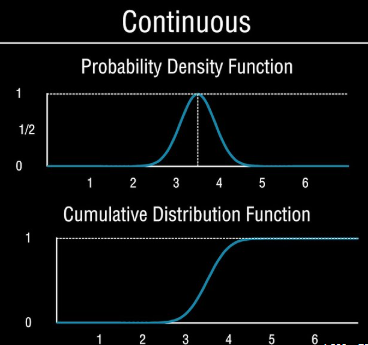
Cumulative Distribution Function
The cumulative distribution function of a continuous random variable \( X \) is defined as
\( \mathrm{F}(x) = \mathrm{P}(X \leq x) = \displaystyle \int_{-\infty}^{x} f(t)\,\mathrm{d}t \)
It gives the probability that the random variable takes a value less than or equal to \( x \).
Probability Density Function
The probability density function describes how probability is distributed over values of the random variable.
The pdf is obtained by differentiating the cdf, where the derivative exists:
\( \mathrm{f}(x) = \dfrac{\mathrm{d}}{\mathrm{d}x}\,\mathrm{F}(x) \)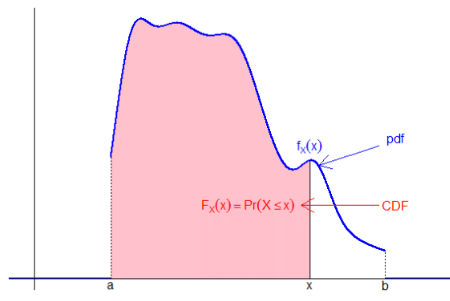
Key Relationship
Hence, for a continuous random variable:
- The cdf is the integral of the pdf
- The pdf is the derivative of the cdf
These two functions contain the same information about the distribution of the random variable.
Important Notes
The cdf is always non-decreasing
\( \mathrm{F}(x) \to 0 \) as \( x \to -\infty \)
\( \mathrm{F}(x) \to 1 \) as \( x \to \infty \)
Example:
A continuous random variable \( X \) has cumulative distribution function
\( \mathrm{F}(x) = x^3,\; 0 \leq x \leq 1 \)
Find the probability density function.
▶️ Answer/Explanation
Differentiate the cdf:
\( \mathrm{f}(x) = \dfrac{\mathrm{d}}{\mathrm{d}x}(x^3) = 3x^2,\; 0 \leq x \leq 1 \)
Conclusion: The pdf is \( \mathrm{f}(x) = 3x^2 \) for \( 0 \leq x \leq 1 \).
Example :
A continuous random variable \( X \) has cumulative distribution function
\( \mathrm{F}(x) = \begin{cases} 0, & x < 1 \\ \dfrac{x-1}{3}, & 1 \leq x \leq 4 \\ 1, & x > 4 \end{cases} \)
Find the probability density function and determine \( \mathrm{P}(2 \leq X \leq 3) \).
▶️ Answer/Explanation
Differentiate the cdf on the interval \( 1 \leq x \leq 4 \):
\( \mathrm{f}(x) = \dfrac{\mathrm{d}}{\mathrm{d}x}\left(\dfrac{x-1}{3}\right) = \dfrac{1}{3} \)
Hence,
\( \mathrm{f}(x) = \dfrac{1}{3} \) for \( 1 \leq x \leq 4 \)
\( \mathrm{f}(x) = 0 \) otherwise
Now find the probability:
\( \mathrm{P}(2 \leq X \leq 3) = \mathrm{F}(3) – \mathrm{F}(2) = \dfrac{2}{3} – \dfrac{1}{3} = \dfrac{1}{3} \)
Conclusion: The pdf is constant on \( [1,4] \) and the required probability is \( \dfrac{1}{3} \).
Example :
A continuous random variable \( X \) has probability density function
\( \mathrm{f}(x) = \begin{cases} 2(1-x), & 0 \leq x \leq 1 \\ 0, & \text{otherwise} \end{cases} \)
Find the cumulative distribution function \( \mathrm{F}(x) \).
▶️ Answer/Explanation
For \( x < 0 \):
\( \mathrm{F}(x) = 0 \)
For \( 0 \leq x \leq 1 \):
\( \mathrm{F}(x) = \displaystyle \int_{0}^{x} 2(1-t)\,\mathrm{d}t \)
\( = \left[ 2t – t^2 \right]_{0}^{x} = 2x – x^2 \)
For \( x > 1 \):
\( \mathrm{F}(x) = 1 \)
Conclusion:
\( \mathrm{F}(x) = \begin{cases} 0, & x < 0 \\ 2x – x^2, & 0 \leq x \leq 1 \\ 1, & x > 1 \end{cases} \)