
Mean and Variance of a Continuous Random Variable
For a continuous random variable, the mean and variance describe the location and spread of the distribution. These are calculated using the probability density function \( \mathrm{f}(x) \).
Mean (Expected Value)
If a continuous random variable \( X \) has pdf \( \mathrm{f}(x) \), then the mean (or expected value) of \( X \) is defined as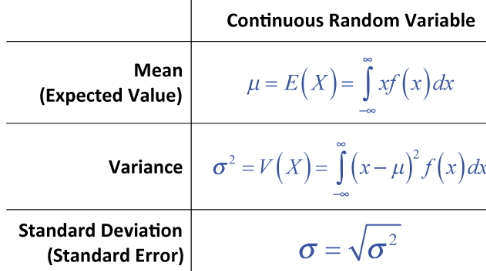
\( \mathrm{E}(X) = \displaystyle \int_{-\infty}^{\infty} x\,\mathrm{f}(x)\,\mathrm{d}x \)
The mean represents the balance point of the distribution.
Variance
The variance of a continuous random variable measures how spread out the values are about the mean.
Variance is defined by
\( \mathrm{Var}(X) = \mathrm{E}\!\left[(X-\mathrm{E}(X))^2\right] \)
In practice, the variance is usually calculated using the equivalent formula
\( \mathrm{Var}(X) = \mathrm{E}(X^2) – [\mathrm{E}(X)]^2 \)
Calculating \( \mathrm{E}(X^2) \)
The expected value of \( X^2 \) is given by
\( \mathrm{E}(X^2) = \displaystyle \int_{-\infty}^{\infty} x^2\,\mathrm{f}(x)\,\mathrm{d}x \)
Properties
For constants \( a \) and \( b \):
\( \mathrm{E}(aX+b) = a\,\mathrm{E}(X)+b \)
\( \mathrm{Var}(aX+b) = a^2\,\mathrm{Var}(X) \)
Adding a constant shifts the mean but does not change the variance.
Example :
A continuous random variable \( X \) has probability density function
\( \mathrm{f}(x) = 2x,\; 0 \leq x \leq 1 \)
Find the mean of \( X \).
▶️ Answer/Explanation
\( \mathrm{E}(X) = \displaystyle \int_{0}^{1} x(2x)\,\mathrm{d}x = \int_{0}^{1} 2x^2\,\mathrm{d}x \)
\( = \left[\dfrac{2x^3}{3}\right]_{0}^{1} = \dfrac{2}{3} \)
Conclusion: The mean is \( \dfrac{2}{3} \).
Example :
A continuous random variable \( X \) has pdf
\( \mathrm{f}(x) = 3x^2,\; 0 \leq x \leq 1 \)
Find the variance of \( X \).
▶️ Answer/Explanation
First find \( \mathrm{E}(X) \):
\( \mathrm{E}(X) = \displaystyle \int_{0}^{1} x(3x^2)\,\mathrm{d}x = \int_{0}^{1} 3x^3\,\mathrm{d}x = \dfrac{3}{4} \)
Now find \( \mathrm{E}(X^2) \):
\( \mathrm{E}(X^2) = \displaystyle \int_{0}^{1} x^2(3x^2)\,\mathrm{d}x = \int_{0}^{1} 3x^4\,\mathrm{d}x = \dfrac{3}{5} \)
Hence
\( \mathrm{Var}(X) = \dfrac{3}{5} – \left(\dfrac{3}{4}\right)^2 = \dfrac{3}{80} \)
Conclusion: The variance is \( \dfrac{3}{80} \).
Example :
A continuous random variable \( X \) has mean 4 and variance 9.
Find the mean and variance of the random variable \( Y = 2X – 1 \).
▶️ Answer/Explanation
Using properties:
\( \mathrm{E}(Y) = 2\,\mathrm{E}(X) – 1 = 2(4) – 1 = 7 \)
\( \mathrm{Var}(Y) = 2^2\,\mathrm{Var}(X) = 4 \times 9 = 36 \)
Conclusion: The mean of \( Y \) is 7 and the variance is 36.