
Mode, Median and Quartiles of Continuous Random Variables
For a continuous random variable, measures of location such as the mode, median, and quartiles are determined using the probability density function (pdf) and the cumulative distribution function (cdf).
Mode
The mode of a continuous random variable is the value of \( x \) at which the probability density function \( \mathrm{f}(x) \) is a maximum.
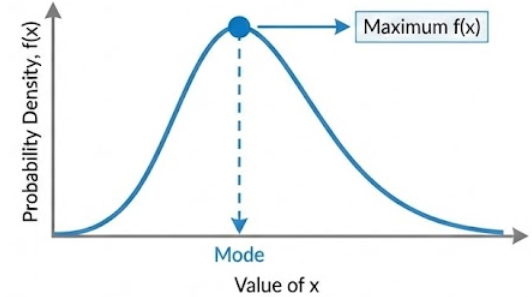
It represents the most likely value of the random variable
It is found by maximising \( \mathrm{f}(x) \)
Median
The median is the value \( m \) such that half of the probability lies below it:
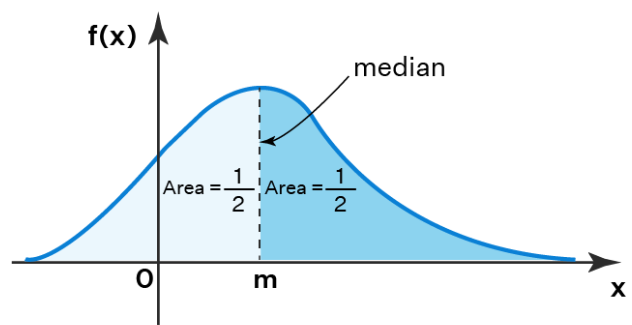
\( \mathrm{P}(X \leq m) = \dfrac{1}{2} \)
Equivalently, using the cumulative distribution function:
\( \mathrm{F}(m) = \dfrac{1}{2} \)
Quartiles
The quartiles divide the distribution into four equal probability parts:
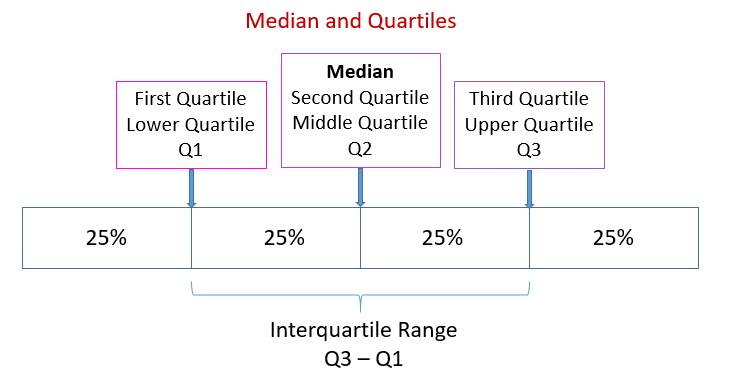
Lower quartile \( Q_1 \): \( \mathrm{F}(Q_1) = \dfrac{1}{4} \)
Upper quartile \( Q_3 \): \( \mathrm{F}(Q_3) = \dfrac{3}{4} \)
Quartiles are found by solving these equations using the cdf.
Summary
Mode: value that maximises \( \mathrm{f}(x) \)
Median: \( \mathrm{F}(x) = \dfrac{1}{2} \)
Quartiles: \( \mathrm{F}(x) = \dfrac{1}{4}, \dfrac{3}{4} \)
Example :
A continuous random variable \( X \) has probability density function
\( \mathrm{f}(x) = 6x(1-x),\; 0 \leq x \leq 1 \)
Find the mode of \( X \).
▶️ Answer/Explanation
To find the mode, maximise \( \mathrm{f}(x) \):
\( \mathrm{f}(x) = 6x – 6x^2 \)
\( \dfrac{\mathrm{d}}{\mathrm{d}x}\mathrm{f}(x) = 6 – 12x = 0 \Rightarrow x = \dfrac{1}{2} \)
Conclusion: The mode is \( \dfrac{1}{2} \).
Example:
A continuous random variable \( X \) has cumulative distribution function
\( \mathrm{F}(x) = x^2,\; 0 \leq x \leq 1 \)
Find the median of \( X \).
▶️ Answer/Explanation
The median \( m \) satisfies:
\( \mathrm{F}(m) = \dfrac{1}{2} \)
\( m^2 = \dfrac{1}{2} \Rightarrow m = \dfrac{1}{\sqrt{2}} \)
Conclusion: The median is \( \dfrac{1}{\sqrt{2}} \).
Example:
A continuous random variable \( X \) has cumulative distribution function
\( \mathrm{F}(x) = x^3,\; 0 \leq x \leq 1 \)
Find the lower and upper quartiles.
▶️ Answer/Explanation
Lower quartile \( Q_1 \):
\( x^3 = \dfrac{1}{4} \Rightarrow Q_1 = \sqrt[3]{\dfrac{1}{4}} \)
Upper quartile \( Q_3 \):
\( x^3 = \dfrac{3}{4} \Rightarrow Q_3 = \sqrt[3]{\dfrac{3}{4}} \)
Conclusion: \( Q_1 = \sqrt[3]{\dfrac{1}{4}} \), \( Q_3 = \sqrt[3]{\dfrac{3}{4}} \).