
The Continuous Uniform (Rectangular) Distribution
The continuous uniform distribution, also called the rectangular distribution, models a situation where a continuous random variable is equally likely to take any value within a fixed interval.
This distribution is commonly used when there is no reason to believe that any value in the interval is more likely than another.
Definition
Let \( X \) be a continuous random variable uniformly distributed on the interval \( [a,b] \), where \( a < b \).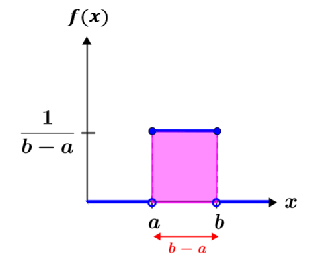
\( X \sim \mathrm{U}(a,b) \)
Probability Density Function
The probability density function of \( X \sim \mathrm{U}(a,b) \) is
\( \mathrm{f}(x) = \begin{cases} \dfrac{1}{b-a}, & a \leq x \leq b \\ 0, & \text{otherwise} \end{cases} \)
This constant height gives the distribution its rectangular shape.
Cumulative Distribution Function
The cumulative distribution function is found by integrating the pdf.
For \( x \in [a,b] \):
\( \mathrm{F}(x) = \displaystyle \int_{a}^{x} \dfrac{1}{b-a}\,\mathrm{d}t = \dfrac{x-a}{b-a} \)
Hence, the full cdf is
\( \mathrm{F}(x) = \begin{cases} 0, & x < a \\ \dfrac{x-a}{b-a}, & a \leq x \leq b \\ 1, & x > b \end{cases} \)
Derivation of the Mean
The mean of a continuous random variable is given by
\( \mathrm{E}(X) = \displaystyle \int_{a}^{b} x\,\mathrm{f}(x)\,\mathrm{d}x \)
For the uniform distribution:
\( \mathrm{E}(X) = \dfrac{1}{b-a} \displaystyle \int_{a}^{b} x\,\mathrm{d}x \)
\( = \dfrac{1}{b-a} \left[ \dfrac{x^2}{2} \right]_{a}^{b} = \dfrac{b^2 – a^2}{2(b-a)} \)
\( = \dfrac{a+b}{2} \)
Hence, the mean is the midpoint of the interval.
Derivation of the Variance
First find \( \mathrm{E}(X^2) \):
\( \mathrm{E}(X^2) = \dfrac{1}{b-a} \displaystyle \int_{a}^{b} x^2\,\mathrm{d}x \)
\( = \dfrac{1}{b-a} \left[ \dfrac{x^3}{3} \right]_{a}^{b} = \dfrac{b^3 – a^3}{3(b-a)} \)
The variance is
\( \mathrm{Var}(X) = \mathrm{E}(X^2) – [\mathrm{E}(X)]^2 \)
\( = \dfrac{b^3 – a^3}{3(b-a)} – \left(\dfrac{a+b}{2}\right)^2 \)
\( = \dfrac{(b-a)^2}{12} \)
Hence, the variance depends only on the width of the interval.
Summary of Results
Distribution: \( X \sim \mathrm{U}(a,b) \)
Mean: \( \dfrac{a+b}{2} \)
Variance: \( \dfrac{(b-a)^2}{12} \)
CDF: \( \mathrm{F}(x) = \dfrac{x-a}{b-a} \) for \( a \leq x \leq b \)
Example :
A random variable \( X \) is uniformly distributed on the interval \( [2,8] \).
Find the mean and variance of \( X \).
▶️ Answer/Explanation
Here \( X \sim \mathrm{U}(2,8) \).
Mean: \( \mathrm{E}(X) = \dfrac{2+8}{2} = 5 \)
Variance: \( \mathrm{Var}(X) = \dfrac{(8-2)^2}{12} = \dfrac{36}{12} = 3 \)
Conclusion: The mean is 5 and the variance is 3.
Example :
A random variable \( X \) has a continuous uniform distribution on \( [0,10] \).
Find the probability that \( X \) lies between 3 and 7.
▶️ Answer/Explanation
For \( X \sim \mathrm{U}(0,10) \), the pdf is
\( \mathrm{f}(x) = \dfrac{1}{10},\; 0 \leq x \leq 10 \)
The required probability is
\( \mathrm{P}(3 \leq X \leq 7) = \dfrac{7-3}{10} = \dfrac{4}{10} = 0.4 \)
Conclusion: The probability is 0.4.
Example :
The time, in minutes, that a customer waits to be served in a shop is uniformly distributed between 5 and 15.
Find the cumulative distribution function \( \mathrm{F}(x) \) and hence determine \( \mathrm{P}(X \leq 9) \).
▶️ Answer/Explanation
Here \( X \sim \mathrm{U}(5,15) \).
The cumulative distribution function is
\( \mathrm{F}(x) = \begin{cases} 0, & x < 5 \\ \dfrac{x-5}{10}, & 5 \leq x \leq 15 \\ 1, & x > 15 \end{cases} \)
Hence,
\( \mathrm{P}(X \leq 9) = \mathrm{F}(9) = \dfrac{9-5}{10} = 0.4 \)
Conclusion: The required probability is 0.4.