
Population, Census and Sample
In statistics, data are collected to make conclusions about a larger group. It is important to clearly distinguish between a population, a census, and a sample.
Population 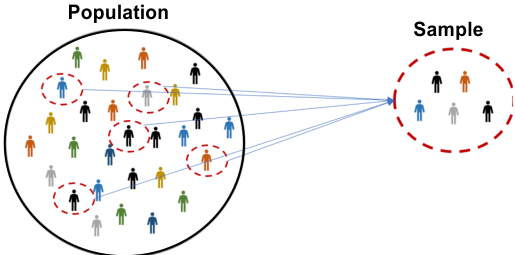
A population is the complete set of individuals, objects, or measurements that are of interest in a particular study.
- The population may be very large or even infinite
- Statistical investigations aim to draw conclusions about the population
Examples:
All students in a country
All light bulbs produced by a factory in a day
Census
A census is a method of data collection in which information is obtained from every member of the population.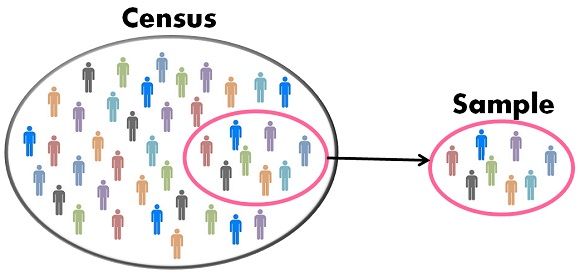
Advantages of a Census
- No sampling error, as the whole population is studied
- Provides complete and detailed information
Disadvantages of a Census
- Often expensive and time-consuming
- May be impractical for very large populations
- Not suitable when testing destroys the item (e.g. product testing)
Sample
A sample is a subset of the population selected for study.
Information from the sample is used to make inferences about the population.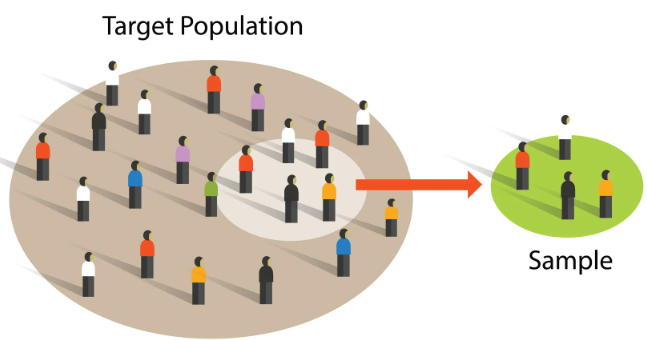
Advantages of a Sample Survey
- Cheaper and quicker than a census
- Practical for large populations
- Allows destructive testing
Disadvantages of a Sample Survey
- Results are subject to sampling error
- Poor sampling methods can lead to bias
- Less detailed than a census
Sampling Unit
A sampling unit is a single member of the population that can be selected for inclusion in the sample.
Examples:
- One person in a survey of voters
- One item produced in a factory
Sampling Frame
A sampling frame is a complete list of all the sampling units in the population from which a sample is selected.
The sampling frame should be:
- Accurate and up to date
- Free from omissions and duplications
A poor sampling frame can introduce bias even if the sampling method is random.
Examination Focus Point
- Correct use of statistical terminology
- Clear comparison of census and sample surveys
- Awareness of practical limitations and bias
Example :
A researcher wants to investigate the average height of students in a large university.
Identify:
(i) the population
(ii) a possible sampling unit
(iii) whether a census or a sample survey is more appropriate, giving a reason
▶️ Answer/Explanation
(i) Population: All students enrolled at the university
(ii) Sampling unit: One individual student
(iii) Sample survey: A census would be time-consuming and impractical due to the large population size
Conclusion: A sample survey is the most appropriate method.
Example :
A government conducts a national survey to record the age, gender, and employment status of every citizen.
State whether this is a census or a sample survey and give one advantage and one disadvantage of this method.
▶️ Answer/Explanation
Census: Information is collected from every member of the population.
Advantage: The data are complete and free from sampling error.
Disadvantage: The census is expensive and takes a long time to complete.
Conclusion: A census provides detailed information but has practical limitations.
Example :
A factory produces 10 000 light bulbs in one day. To check quality, 200 bulbs are randomly selected and tested.
Identify:
(i) the population
(ii) the sample
(iii) one advantage of using a sample instead of a census
▶️ Answer/Explanation
(i) Population: All 10 000 light bulbs produced that day
(ii) Sample: The 200 light bulbs selected for testing
(iii) Advantage: Testing is quicker and cheaper than checking every bulb, and allows destructive testing if required
Conclusion: A sample survey is more efficient while still providing useful information.