
Methods for Collecting Data
In statistics, data are collected in order to investigate questions, identify patterns, and make informed conclusions. The method used to collect data affects how reliable and unbiased the results are.
Types of Data Collection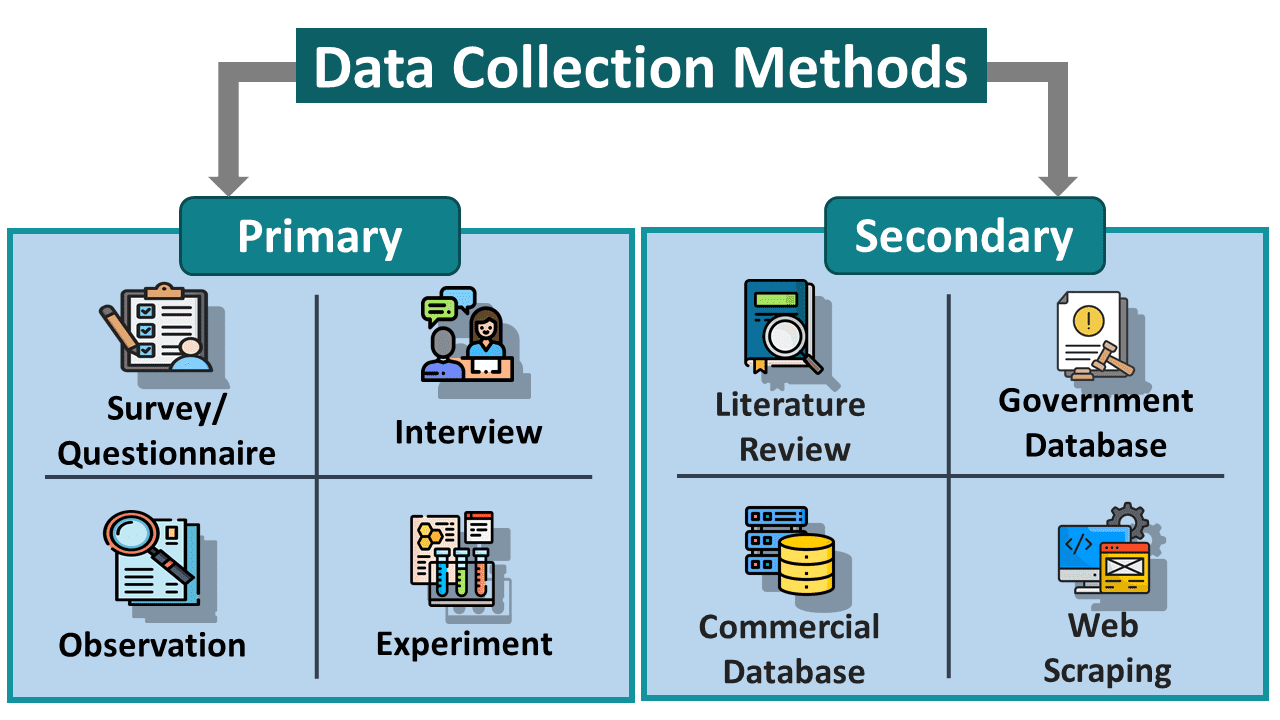
Common methods of collecting data include:
Surveys and questionnaires – asking individuals for information
Experiments – collecting data under controlled conditions
Observational studies – observing subjects without interference
To draw valid conclusions, the data collected should be based on a representative sample of the population.
Population and Sample
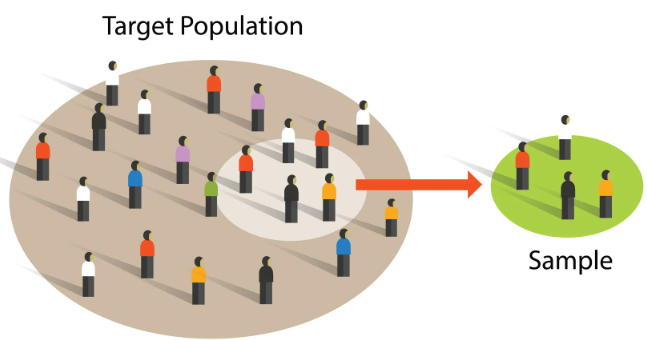
Population: the complete set of individuals or items of interest.
Sample: a subset of the population used to make inferences about the population.
A well-chosen sample should be unbiased and representative of the population.
Simple Random Sampling
A simple random sample is one in which every member of the population has an equal chance of being selected.
Key features of simple random sampling:
- Each individual has the same probability of selection
- Selections are made without bias
- Random numbers are commonly used
Use of Random Numbers for Sampling
To select a simple random sample using random numbers:
- Assign each member of the population a unique number
- Use a table of random numbers or a calculator to generate random digits
- Select individuals corresponding to those numbers
- Ignore numbers outside the required range or repeated selections
This method ensures fairness and reduces selection bias.
Example :
Explain what is meant by a simple random sample.
▶️ Answer/Explanation
In a simple random sample, every member of the population has an equal chance of being selected.
Conclusion: The selection is unbiased and based purely on chance.
Example :
A class has 30 students. Describe how a simple random sample of 5 students could be selected.
▶️ Answer/Explanation
Number the students from 01 to 30
Use random numbers to select five different numbers between 01 and 30
Choose the students corresponding to those numbers
Conclusion: This ensures each student has an equal chance of selection.
Example :
A population consists of 120 items. A table of random numbers produces the sequence 134, 087, 251, 019, 087.
State which items would be included in a simple random sample.
▶️ Answer/Explanation
Valid numbers must be between 001 and 120 and not repeated.
134 and 251 are rejected
087 is accepted once
019 is accepted
Conclusio