
Other Methods of Sampling
In addition to simple random sampling, other sampling methods are often used when practical constraints make random sampling difficult or when specific features of the population must be represented accurately.
The syllabus requires an understanding of:
- Stratified sampling
- Systematic sampling
- Quota sampling
including the circumstances in which they are used, together with their advantages and disadvantages.
Stratified Sampling
In stratified sampling, the population is divided into distinct subgroups called strata, based on a characteristic such as age, gender, or department.
A simple random sample is then taken from each stratum, usually in proportion to the size of the stratum.
When it is used
- When the population contains clearly defined subgroups
- When representation from each subgroup is important
Advantages
- Ensures all groups are represented
- Often more representative than a simple random sample
Disadvantages
- Requires detailed knowledge of the population
- More time-consuming to organise
Systematic Sampling
In systematic sampling, individuals are selected at regular intervals from an ordered list.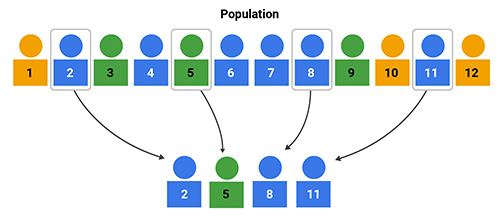
Typically:
- A random starting point is chosen
- Every \( k \)th individual is then selected
When it is used
- When a complete list of the population is available
- When a quick and simple method is required
Advantages
- Easy to carry out
- Ensures the sample is spread across the population
Disadvantages
- Can be biased if the list has a hidden pattern
- Not truly random after the first selection
Quota Sampling
In quota sampling, the population is divided into categories, and a fixed number (quota) of individuals is chosen from each category.
The individuals are selected by the researcher, not randomly.
When it is used
- When speed is important
- When random sampling is impractical
Advantages
- Quick and inexpensive
- Ensures key groups are included
Disadvantages
- Subject to researcher bias
- Not a random sample
Example :
A college has students in three year groups. A researcher wants to ensure each year group is represented fairly in a survey.
State the most suitable sampling method and explain why.
▶️ Answer/Explanation
Stratified sampling should be used.
Each year group forms a stratum, and random samples can be taken from each group in proportion to its size.
Conclusion: Stratified sampling ensures fair representation of all year groups.
Example :
A factory inspects every 20th item produced on a production line, starting from a randomly chosen item.
Name the sampling method used.
▶️ Answer/Explanation
This is systematic sampling.
Conclusion: Items are selected at regular intervals after a random start.
Example :
A market researcher interviews 40 adults, ensuring that 20 are male and 20 are female, chosen by convenience.
Identify the sampling method and state one disadvantage.
▶️ Answer/Explanation
This is quota sampling.
A disadvantage is that the selection is not random and may be biased.
Conclusion: Results may not be fully representative of the population.