
Estimators, Bias and Standard Error
When information about an entire population is not available, a sample is used to estimate population parameters such as the mean and variance. The values calculated from sample data are called estimators.
Estimator and Estimate
Estimator: a statistic (rule or formula) used to estimate an unknown population parameter. 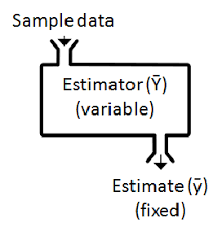
Estimate: the numerical value obtained from a particular sample using an estimator.
For example:
The sample mean \( \mathrm{\bar{x}} \) is an estimator of the population mean \( \mathrm{\mu} \)
The sample variance \( \mathrm{s^2} \) is an estimator of the population variance \( \mathrm{\sigma^2} \)
Bias
An estimator is said to be unbiased if its expected value is equal to the true value of the population parameter it estimates.
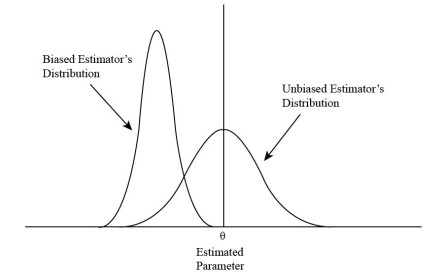
\( \mathrm{An\ estimator\ \hat{\theta}\ is\ unbiased\ if\ E(\hat{\theta}) = \theta} \)
If this condition is not satisfied, the estimator is said to be biased.
In this syllabus:
The sample mean \( \mathrm{\bar{x}} \) is an unbiased estimator of the population mean \( \mathrm{\mu} \)
The sample variance \( \mathrm{s^2} \) (with denominator \( \mathrm{n-1} \)) is an unbiased estimator of the population variance \( \mathrm{\sigma^2} \)
The Sample Mean
For a sample of size \( \mathrm{n} \) with observations \( \mathrm{x_1, x_2, \dots, x_n} \), the sample mean is defined as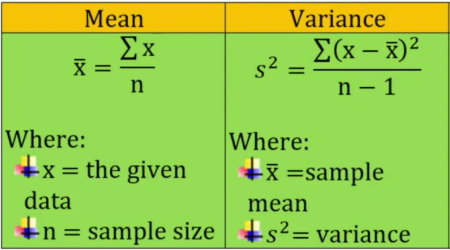
\( \mathrm{\bar{x} = \dfrac{1}{n}\sum_{i=1}^{n} x_i} \)
The sample mean provides an unbiased estimate of the population mean.
The Sample Variance
The sample variance is defined as
\( \mathrm{s^2 = \dfrac{1}{n-1}\sum_{i=1}^{n}(x_i – \bar{x})^2} \)
The use of \( \mathrm{n-1} \) instead of \( \mathrm{n} \) corrects for bias and ensures that \( \mathrm{s^2} \) is an unbiased estimator of the population variance.
Standard Error
The standard error measures the variability of an estimator from sample to sample.
For the sample mean, the standard error is
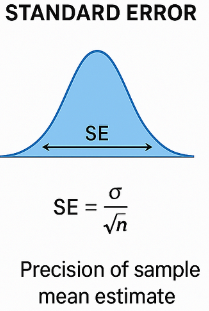
\( \mathrm{SE(\bar{x}) = \dfrac{\sigma}{\sqrt{n}}} \)
When the population standard deviation \( \mathrm{\sigma} \) is unknown, it is commonly approximated using the sample standard deviation \( \mathrm{s} \).
As the sample size increases, the standard error decreases, meaning the estimate becomes more precise.
Key Points to Remember
- An estimator is a formula; an estimate is its numerical value
- Unbiased estimators have expected value equal to the population parameter
- \( \mathrm{\bar{x}} \) estimates \( \mathrm{\mu} \), and \( \mathrm{s^2} \) estimates \( \mathrm{\sigma^2} \)
- Standard error measures the precision of an estimator
Example :
A random sample of size \( \mathrm{n = 25} \) is taken from a population with mean \( \mathrm{\mu = 50} \) and standard deviation \( \mathrm{\sigma = 10} \).
Find the standard error of the sample mean.
▶️ Answer/Explanation
The standard error of the sample mean is
\( \mathrm{SE(\bar{x}) = \dfrac{\sigma}{\sqrt{n}}} \)
\( \mathrm{SE(\bar{x}) = \dfrac{10}{\sqrt{25}} = 2} \)
Conclusion: The standard error of the sample mean is 2.
Example :
A sample of five observations is
\( \mathrm{4,\;6,\;8,\;10,\;12} \)
Find the sample mean and the unbiased estimate of the population variance.
▶️ Answer/Explanation
Sample mean:
\( \mathrm{\bar{x} = \dfrac{4+6+8+10+12}{5} = 8} \)
Now calculate the sample variance:
\( \mathrm{s^2 = \dfrac{1}{5-1}\left[(4-8)^2+(6-8)^2+(8-8)^2+(10-8)^2+(12-8)^2\right]} \)
\( \mathrm{s^2 = \dfrac{1}{4}(16+4+0+4+16) = 10} \)
Conclusion: The sample mean is 8 and the unbiased estimate of variance is 10.
Example :
Explain why the statistic
\( \mathrm{\dfrac{1}{n}\sum_{i=1}^{n}(x_i – \bar{x})^2} \)
is a biased estimator of the population variance, but
\( \mathrm{s^2 = \dfrac{1}{n-1}\sum_{i=1}^{n}(x_i – \bar{x})^2} \)
is unbiased.
▶️ Answer/Explanation
Using \( \mathrm{n} \) in the denominator underestimates the true population variance on average.
Replacing \( \mathrm{n} \) with \( \mathrm{n-1} \) corrects this bias.
Conclusion: The statistic \( \mathrm{s^2} \) is an unbiased estimator of the population variance.