
Use of the Central Limit Theorem for Inference
In practice, population distributions are often not normal and the population variance may be unknown. The Central Limit Theorem (CLT) allows hypothesis tests and confidence intervals for the mean to be extended to these situations when the sample size is sufficiently large.
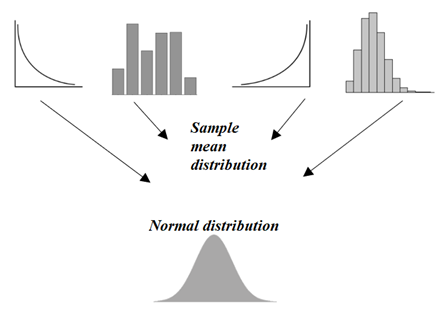
The Central Limit Theorem
The Central Limit Theorem states that, for a random sample of size \( \mathrm{n} \) from any population with mean \( \mathrm{\mu} \) and finite variance \( \mathrm{\sigma^2} \), the distribution of the sample mean approaches a normal distribution as \( \mathrm{n} \) becomes large.
\( \mathrm{\bar{X} \approx N\!\left(\mu,\;\dfrac{\sigma^2}{n}\right)\ \text{for large } n} \)
In this syllabus, a sample size of about \( \mathrm{n \geq 30} \) is typically regarded as large.
Extension to Non-Normal Populations
Even if the population distribution is not normal:
The sample mean \( \mathrm{\bar{X}} \) is approximately normally distributed for large \( \mathrm{n} \)
Normal-based confidence intervals and hypothesis tests for the mean may be used
This allows inference for a wide range of real-world data.
Unknown Variance and Large Samples
When the population variance \( \mathrm{\sigma^2} \) is unknown, it is replaced by the sample variance \( \mathrm{S^2} \).
For large samples, the statistic
\( \mathrm{Z = \dfrac{\bar{X} – \mu}{S/\sqrt{n}}} \)
can be treated as having the standard normal distribution:
\( \mathrm{Z \sim N(0,1)} \)
A knowledge of the \( \mathrm{t} \)-distribution is not required for this syllabus.
Confidence Intervals Using CLT
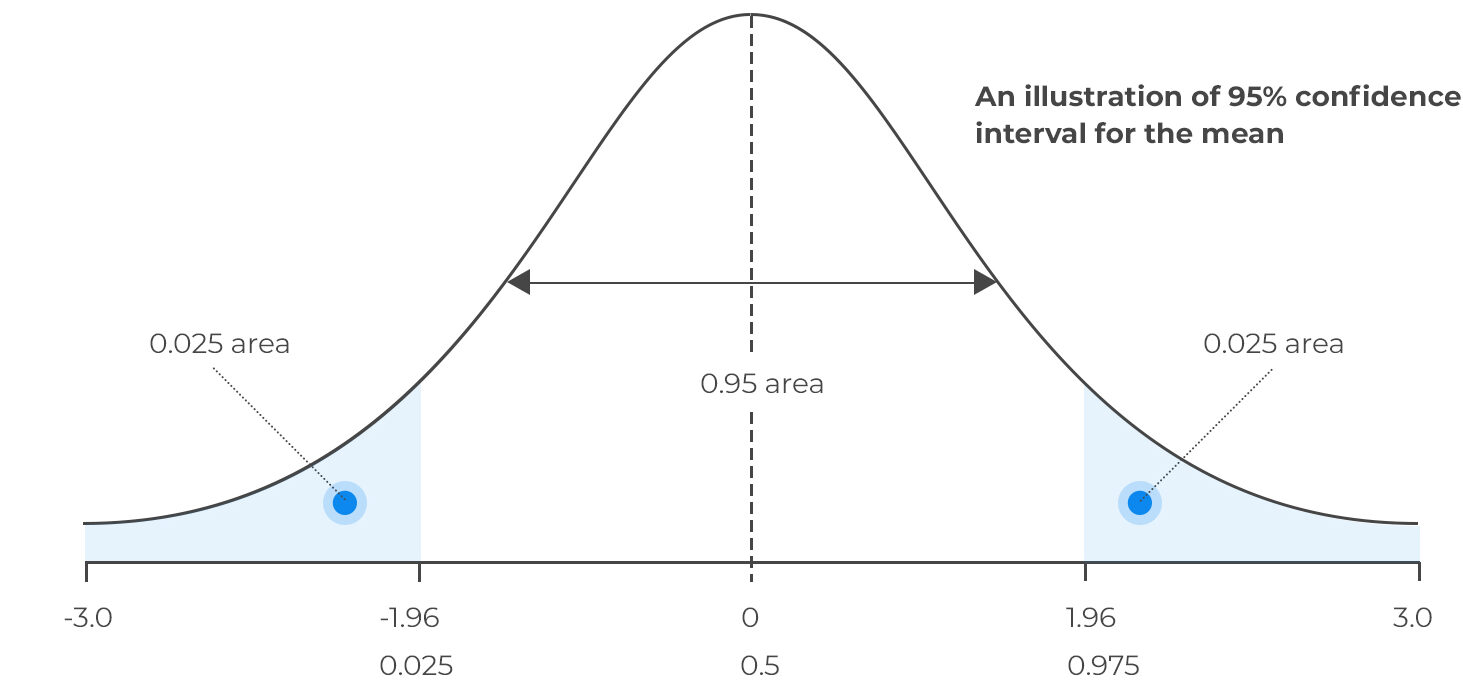
For large samples, an approximate \( \mathrm{(1-\alpha)\times100\%} \) confidence interval for the population mean is
\( \mathrm{\bar{X} \pm z_{\alpha/2}\dfrac{S}{\sqrt{n}}} \)
This interval is valid even when the population is not normal, provided the sample size is sufficiently large.
Hypothesis Tests Using CLT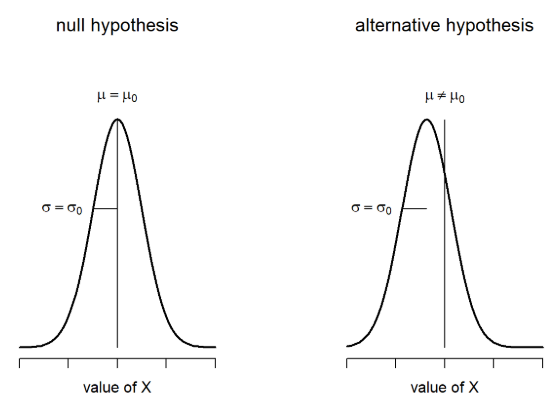
For testing
\( \mathrm{H_0:\mu = \mu_0} \)
the test statistic used is
\( \mathrm{Z = \dfrac{\bar{X} – \mu_0}{S/\sqrt{n}}} \)
Critical values and p-values are obtained from the standard normal distribution.
Conditions for Valid Use
- The sample is random and observations are independent
- The sample size is sufficiently large
- The population variance is finite
Points to Remember
- CLT allows inference for non-normal populations
- Large samples justify use of the normal distribution
- Unknown variance can be replaced by \( \mathrm{S^2} \) for large \( \mathrm{n} \)
- No knowledge of the \( \mathrm{t} \)-distribution is required
Example :
The lifetimes of components have a non-Normal distribution with mean \( \mathrm{\mu} \) and finite variance.
A random sample of size \( \mathrm{n = 64} \) has sample mean \( \mathrm{\bar{x} = 520} \) hours and sample standard deviation \( \mathrm{S = 40} \) hours.
Construct a 95% confidence interval for \( \mathrm{\mu} \).
▶️ Answer/Explanation
Since \( \mathrm{n} \) is large, use the CLT with
\( \mathrm{SE = \dfrac{S}{\sqrt{n}} = \dfrac{40}{\sqrt{64}} = 5} \)
For 95% confidence, \( \mathrm{z_{0.025} = 1.96} \).
\( \mathrm{520 \pm 1.96(5)} = \mathrm{520 \pm 9.8} \)
Conclusion: The 95% confidence interval is \( \mathrm{(510.2,\;529.8)} \) hours.
Example :
A factory claims that the mean mass of a product is \( \mathrm{1000\;g} \).
The mass distribution is not normal. A random sample of size \( \mathrm{n = 49} \) has mean \( \mathrm{\bar{x} = 995\;g} \) and standard deviation \( \mathrm{S = 21\;g} \).
Test the claim at the 5% significance level.
▶️ Answer/Explanation
Hypotheses
\( \mathrm{H_0:\mu = 1000} \)
\( \mathrm{H_1:\mu \neq 1000} \)
Test statistic (CLT, large \( \mathrm{n} \))
\( \mathrm{Z = \dfrac{995 – 1000}{21/\sqrt{49}} = \dfrac{-5}{3} = -1.67} \)
Critical region
Two-tailed 5% test: reject if \( \mathrm{|Z| > 1.96} \)
Decision: \( \mathrm{|−1.67| < 1.96} \), so do not reject \( \mathrm{H_0} \).
Conclusion: There is insufficient evidence at the 5% level to reject the claim.
Example :
The waiting times at a service desk have a skewed distribution.
A random sample of size \( \mathrm{n = 100} \) has mean waiting time \( \mathrm{\bar{x} = 12.4} \) minutes and standard deviation \( \mathrm{S = 5} \) minutes.
Find a 90% confidence interval for the population mean waiting time.
▶️ Answer/Explanation
Using the CLT, the standard error is
\( \mathrm{SE = \dfrac{5}{\sqrt{100}} = 0.5} \)
For 90% confidence, \( \mathrm{z_{0.05} = 1.645} \).
\( \mathrm{12.4 \pm 1.645(0.5)} = \mathrm{12.4 \pm 0.8225} \)
Conclusion: The 90% confidence interval is \( \mathrm{(11.58,\;13.22)} \) minutes.