
Testing the Hypothesis that a Correlation is Zero
In correlation analysis, a hypothesis test may be carried out to determine whether there is sufficient evidence of an association between two variables in the population.
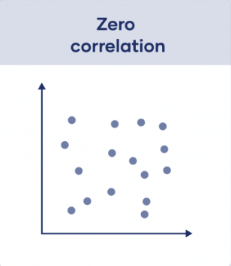
This applies to both:
- Spearman’s rank correlation coefficient
- Product moment correlation coefficient (PMCC)
In this syllabus, tests are carried out using critical values from tables. No derivations are required.
Hypotheses
The hypotheses for testing correlation are:
Null hypothesis: \( \mathrm{H_0:\rho = 0} \)
Alternative hypothesis: \( \mathrm{H_1:\rho \neq 0} \)
Here, \( \mathrm{\rho} \) denotes the population correlation coefficient.
One-tailed alternatives may also be used:
\( \mathrm{H_1:\rho > 0} \) (positive correlation)
\( \mathrm{H_1:\rho < 0} \) (negative correlation)
Test Statistic
The test statistic is the sample correlation coefficient:
Spearman’s rank correlation coefficient \( \mathrm{r_s} \)
Product moment correlation coefficient \( \mathrm{r} \)
Its value is compared with a critical value from the appropriate correlation table.
Use of Tables
Correlation tables give critical values based on:
- Sample size \( \mathrm{n} \)
- Chosen significance level (e.g. 5%, 1%)
- One-tailed or two-tailed test
The decision rule is:
Reject \( \mathrm{H_0} \) if \( \mathrm{|r|} \) or \( \mathrm{|r_s|} \) exceeds the tabulated critical value
Otherwise, do not reject \( \mathrm{H_0} \)
Interpretation
Rejecting \( \mathrm{H_0} \): there is evidence of a statistically significant correlation
Not rejecting \( \mathrm{H_0} \): insufficient evidence of correlation
A significant result indicates association, not causation.
Example
For a sample of size \( \mathrm{n = 10} \), Spearman’s rank correlation coefficient is calculated as \( \mathrm{r_s = 0.67} \).
Test at the 5% significance level whether there is evidence of correlation.
▶️ Answer/Explanation
Hypotheses:
\( \mathrm{H_0:\rho = 0} \)
\( \mathrm{H_1:\rho \neq 0} \)
From Spearman’s rank tables for \( \mathrm{n = 10} \) at 5% (two-tailed), the critical value is approximately 0.648.
Since \( \mathrm{0.67 > 0.648} \), reject \( \mathrm{H_0} \).
Conclusion: There is sufficient evidence of a correlation.
Example
For a data set of size \( \mathrm{n = 12} \), the product moment correlation coefficient is \( \mathrm{r = -0.48} \).
Test at the 5% level whether there is evidence of a linear correlation.
▶️ Answer/Explanation
Hypotheses:
\( \mathrm{H_0:\rho = 0} \)
\( \mathrm{H_1:\rho \neq 0} \)
From PMCC tables for \( \mathrm{n = 12} \) at 5% (two-tailed), the critical value is approximately 0.576.
Since \( \mathrm{|−0.48| < 0.576} \), do not reject \( \mathrm{H_0} \).
Conclusion: There is insufficient evidence of a linear correlation.
Example
For a sample of size \( \mathrm{n = 15} \), the product moment correlation coefficient is \( \mathrm{r = 0.52} \).
Test at the 1% significance level whether there is evidence of a positive correlation.
▶️ Answer/Explanation
Hypotheses:
\( \mathrm{H_0:\rho = 0} \)
\( \mathrm{H_1:\rho > 0} \)
From PMCC tables for \( \mathrm{n = 15} \) at 1% (one-tailed), the critical value is approximately 0.606.
Since \( \mathrm{0.52 < 0.606} \), do not reject \( \mathrm{H_0} \).
Conclusion: There is insufficient evidence at the 1% level of a positive correlation.