Home / IB DP Biology- D1.1 DNA replication – IB Style Questions For SL Paper 1A

IB DP Biology- D1.1 DNA replication - IB Style Questions For SL Paper 1A -New Syllabus

Question

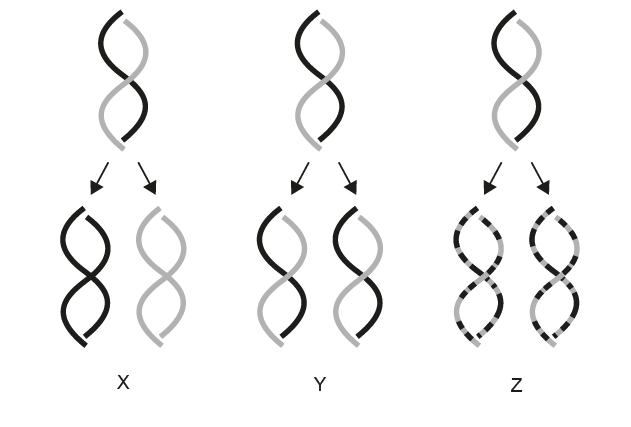
Which diagram(s) below best represent the process of semi-conservative DNA replication?

A. X only
B. Y only
C. Z only
D. X and Y only
▶️ Answer/Explanation

In semi-conservative replication, each new DNA molecule contains one original strand and one newly synthesized strand.

Only diagram Y shows this pattern correctly.

Correct Answer: B

Question

Which stage of DNA profiling involves the polymerase chain reaction (PCR)?

A. During extraction of the DNA sample
B. During replication of the DNA that has been cut with restriction enzymes
C. During electrophoresis to separate the DNA fragments on a gel
D. During incubation with labelled probes

▶️ Answer/Explanation

Answer: B. During replication of the DNA that has been cut with restriction enzymes

Explanation:

DNA profiling is a laboratory technique used to identify individuals by analyzing specific regions of their DNA.

The polymerase chain reaction (PCR) is a method that creates millions of copies of a targeted DNA segment. In DNA profiling, PCR is used after restriction enzymes have cut the DNA to amplify these fragments, making them easier to detect and analyze during subsequent steps like gel electrophoresis.

Answer Evaluation:

A. Incorrect – Extraction is the process of isolating DNA from cells. PCR is not used during extraction.

B. Correct – PCR amplifies (copies) the DNA fragments after they have been cut with restriction enzymes, allowing further analysis.

C. Incorrect – Electrophoresis is a separation technique based on fragment size; it does not involve replication or amplification.

D. Incorrect – Incubation with labelled probes is used for detecting specific DNA sequences, not for replication.

Question

What bonds do the enzymes DNA polymerase and helicase form or break during DNA replication?

OptionDNA polymeraseHelicase
AForms sugar–phosphate bondsBreaks hydrogen bonds
BForms hydrogen bondsBreaks sugar–phosphate bonds
CForms hydrogen bondsForms sugar–phosphate bonds
DForms sugar–phosphate bondsForms hydrogen bonds
▶️ Answer/Explanation

Correct Answer: \( \boxed{\mathbf{A}} \)

During DNA replication, helicase unwinds the DNA double helix by breaking the hydrogen bonds between complementary base pairs. DNA polymerase then synthesizes the new DNA strand by forming sugar–phosphate (phosphodiester) bonds between adjacent nucleotides in the growing strand.

Scroll to Top