IB DP Biology- D4.2 Stability and change - IB Style Questions For SL Paper 1A -New Syllabus
Question
Increased leaching of nitrogen fertilizers disrupts the stability of aquatic ecosystems such as lakes. What change is expected if nitrogen leaches into a lake over time?
(B) Increased biochemical oxygen demand (BOD)
(C) Weakened mollusc shells
(D) Bioaccumulation of pollutants at higher trophic levels
▶️ Answer/Explanation
Correct Answer: \( \boxed{\mathbf{B}} \)
Nitrogen runoff causes eutrophication, leading to rapid algal growth. When algae die, decomposers break them down, consuming large amounts of dissolved oxygen. This increases the biochemical oxygen demand (BOD) and can result in oxygen depletion, harming aquatic organisms.
Question
(B) Removal of apex predators
(C) Reintroduction of keystone species
(D) Restricting size for easier management
▶️ Answer/Explanation
Rewilding focuses on restoring natural processes and reintroducing key species that have been lost from ecosystems. The reintroduction of keystone species is a central strategy in rewilding projects to restore ecological balance.
✅ Answer: (C)
Question
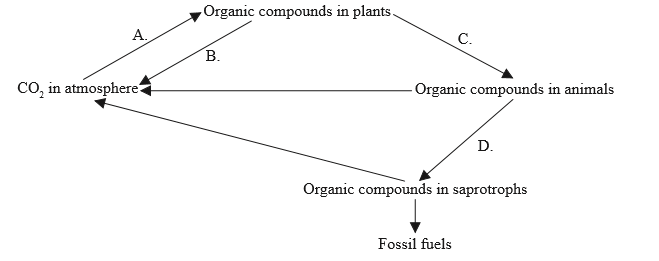
The diagram shows the carbon cycle. Which letter indicates respiration?

▶️ Answer/Explanation
Answer: B
Explanation:
- In the carbon cycle, respiration is the process in which organisms break down organic compounds (such as glucose) and release carbon dioxide (CO₂) into the atmosphere. This occurs in plants, animals, and decomposers.
- In the diagram, Arrow B shows carbon moving from organic compounds in plants to CO₂ in the atmosphere, which directly represents plant respiration.
- Other organisms also respire, but B is the clearest and most direct example shown.
Answer Evaluation:
A. Incorrect – Represents photosynthesis, where plants absorb CO₂.
B. Correct – Represents respiration, releasing CO₂ into the atmosphere.
C. Incorrect – Represents feeding (carbon transfer from plants to animals).
D. Incorrect – Represents decomposition, not respiration, though microbes respire during decay.
